Build a graph sketch from algebraic evidence
By UK A Level Mathematics · independent study · myAudience
Original myAudience generated mathematics illustration; not a documentary photograph. Diagram geometry is schematic, not a calibrated measurement. · Original generated project artwork; no source textbook or exam-board figures reused.
Build a graph sketch from algebraic evidence
A graph is a set of input–output pairs. A useful sketch shows intercepts, symmetry, excluded inputs and end behaviour, while clearly distinguishing a schematic drawing from a measured plot. Start with algebra rather than a dense table of values. This lesson assumes factorised polynomials, coordinates and rational expressions; its main assessed graph families are shared AS and A Level content.
For y = (x + 2)(x − 1)², the roots are −2 and 1. The graph crosses at −2 and touches at 1 because the squared factor is nonnegative on both sides of 1. At x = 0, y = 2. The positive leading x³ term makes the left end go downward and the right end upward. These constraints guide a coherent cubic sketch; exact stationary coordinates await calculus.
A quartic with positive leading coefficient rises at both ends. For y = x²(x − 3)², both roots are double and the whole function is nonnegative. It touches the x-axis at 0 and 3. The repeated factors reveal features that a handful of plotted points could miss. Do not replace multiplicity reasoning with a blanket assumption that every root is a crossing.
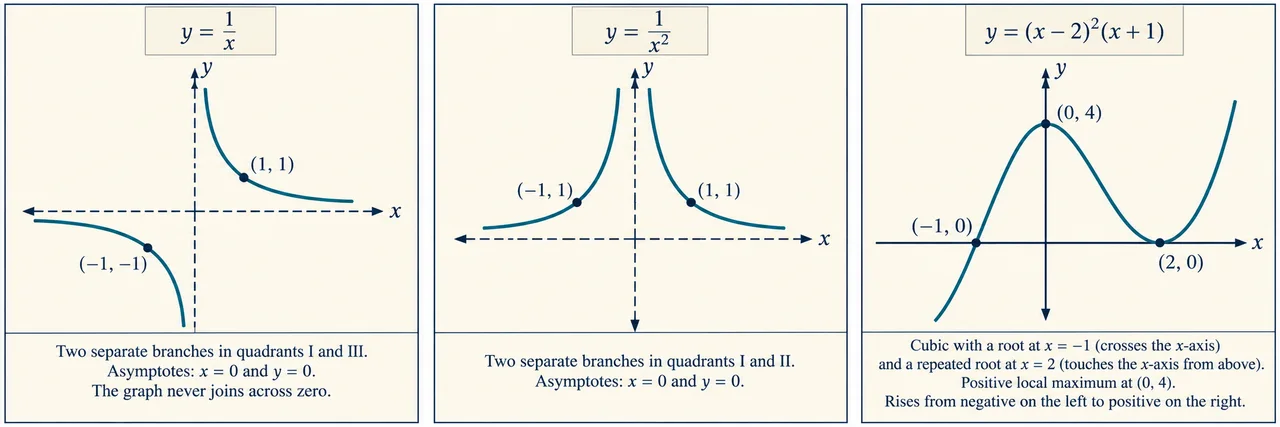
The reciprocal y = 1/x is undefined at zero and has two branches. As x approaches zero from the positive side, y increases without bound; from the negative side, it decreases without bound. As |x| grows, y approaches zero. The lines x = 0 and y = 0 are vertical and horizontal asymptotes. For y = 1/x², both branches are positive. An asymptote describes limiting behaviour, not an extra line belonging to the curve.
For y = 3/(x − 2) + 1, the asymptotes are x = 2 and y = 1. The x-intercept is −1 and the y-intercept is −1/2, obtained by setting the other coordinate to zero. Equating two functions locates intersections; a direct-proportion rule y = kx gives a line through the origin, whereas inverse proportion y = k/x gives a reciprocal curve. More demanding proportional modelling is reserved for the final lesson.
The reciprocal panels separate 1/x, an odd function with opposite signs on either side of zero, from 1/x², an even positive function. Both exclude zero and approach the axes without reaching them. A raster curve is schematic evidence of shape, not a method for measuring limits or exact values. The marked ±1 points anchor the sign and symmetry interpretations.
For C(x)=(x−2)²(x+1), a neighbourhood of −1 has positive squared factor, so the sign changes with x+1 and the graph crosses. Near 2, x+1 remains positive and the square stays nonnegative, so the graph touches from above. Expand C=x³−3x²+4 to check the y-intercept 4. Transfer: −(x−2)²(x+1) touches from below at 2 and crosses downward at −1. Leading-coefficient sign changes the orientation; root multiplicity alone does not tell you above or below.
Use printed formulas and features to compare graph families. The raster is schematic rather than a calibrated coordinate plot; verify intercepts, symmetry and asymptotes algebraically where the formula permits them.
Worked example: Describe the key features of y = 2/(x + 1) − 3.
The denominator is zero at x = −1, giving the vertical asymptote.
For large |x| the reciprocal term approaches zero, so y = −3 is the horizontal asymptote.
Set x = 0 to obtain y = −1. Set y = 0 to obtain x = −1/3.
Answer: Domain x ≠ −1; asymptotes x = −1, y = −3; intercepts (0, −1) and (−1/3, 0).
Check your understanding: Does y = (x − 2)²(x + 1) cross or touch at each root?
Answer: It touches at x = 2 and crosses at x = −1.
Why: The double factor at 2 does not change sign; the simple factor at −1 does.