Restrict a domain so that a rule can be reversed
By UK A Level Mathematics · independent study · myAudience
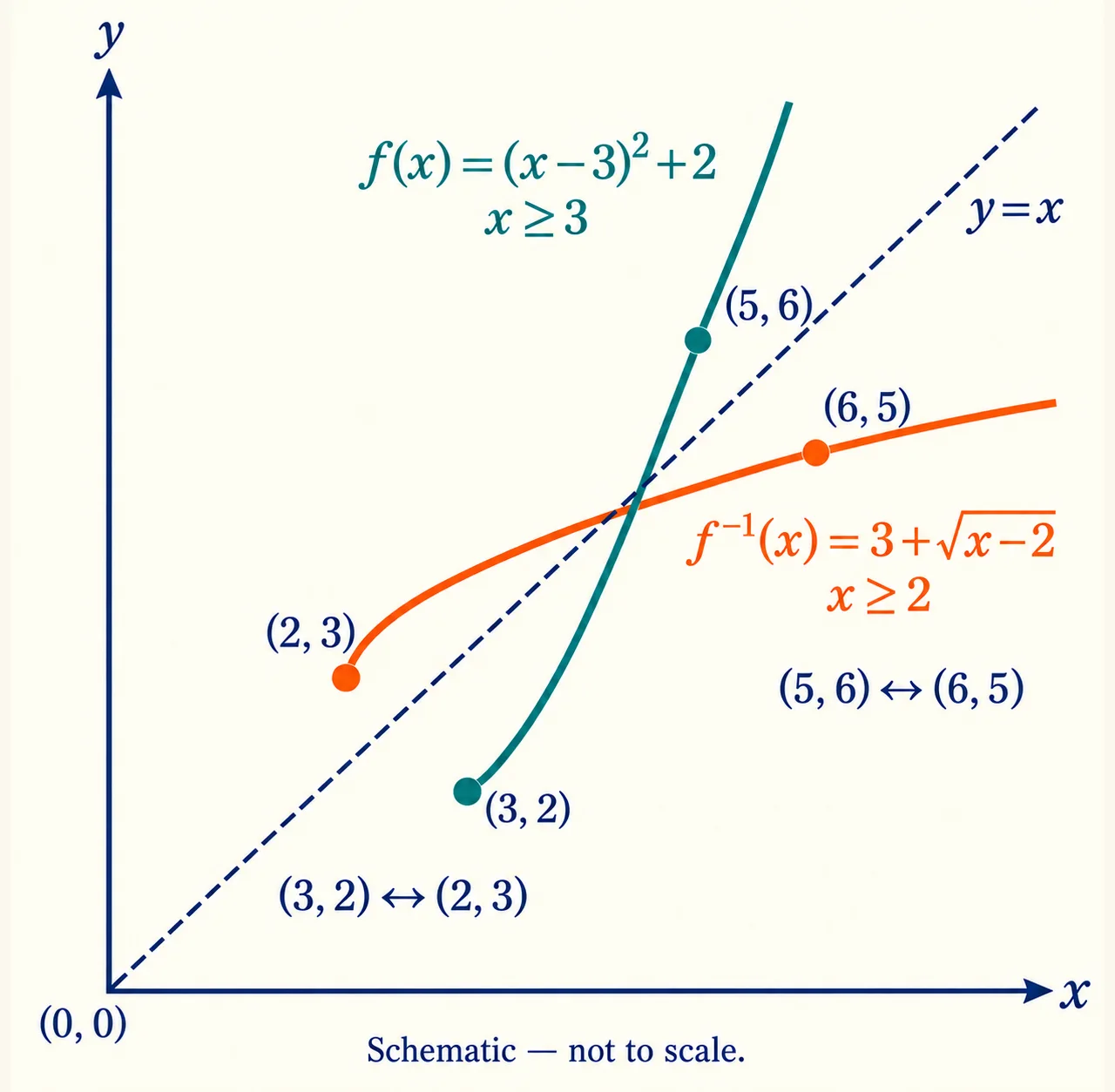
Original myAudience generated mathematics illustration; not a documentary photograph. Diagram geometry is schematic, not a calibrated measurement. · Original generated project artwork; no source textbook or exam-board figures reused.
Restrict a domain so that a rule can be reversed
An inverse function reverses a function on its range. If f sends a to b, f⁻¹ sends b back to a. The inverse notation does not mean 1/f(x), which is a reciprocal. To have an inverse function on its range, f must be one-to-one on its stated domain: different allowed inputs must give different outputs. Composition and domain/range vocabulary are prerequisites.
The square function on all real numbers is many-to-one, so reversing it would send 4 to both −2 and 2. Restricting the original domain to x ≥ 0 removes that ambiguity, and the inverse is √x on x ≥ 0. Restricting instead to x ≤ 0 produces the inverse −√x. The formula used for the inverse therefore depends on the domain, not just the original algebraic expression.
To find an inverse, write y = f(x), solve for the original input x in terms of y, then rename the inverse input. In y = 4x − 7, solving gives x = (y + 7)/4, hence f⁻¹(x) = (x + 7)/4. For a nonlinear rule, choose the sign consistent with the original domain. Swapping letters alone cannot decide which branch is valid.
The original domain becomes the inverse range, and the original range becomes the inverse domain. A point (a, b) on f becomes (b, a) on f⁻¹, so their graphs are reflections in y = x. This geometric relation includes domain restrictions: reflecting only the selected branch gives the graph of its inverse, not necessarily the reflection of an unrestricted curve.
Check both compositions on their proper domains. For f(x) = (x − 3)² with x ≥ 3, the inverse is 3 + √x for x ≥ 0. Then f⁻¹(f(x)) = 3 + |x − 3| = x because x ≥ 3, and f(f⁻¹(x)) = x for x ≥ 0. The generated mapping plate illustrates one case of this principle; its single arrows are examples of a continuum, not a complete list of allowed inputs.
For f(x)=(x−3)²+2 on x≥3, solving y=f(x) gives x=3+√(y−2); the plus sign encodes the original branch. The inverse has domain y≥2 and range x≥3. In the reflection image the endpoint (3,2) becomes (2,3), while (5,6) becomes (6,5). These exact coordinate swaps support reflection in y=x. They do not prove injectivity by themselves; strict increase of the square on x−3≥0 does.
Transfer: restrict the same formula to x≤3. Its inverse becomes 3−√(x−2), domain x≥2, range at most 3. The original range is unchanged but the inverse output differs. For the right branch, f⁻¹(f(x))=3+|x−3|=x precisely for x≥3. Forgetting the absolute value in √((x−3)²) falsely claims the right-branch inverse works on the entire parabola.
Compare each pair of reflected coordinates: an inverse swaps input and output, so a restricted domain must become the inverse range. The reflection plate is schematic; rely on the printed coordinates and formulas rather than measuring slopes.
Worked example: Find the inverse of f(x) = (x − 3)² + 2 with domain x ≥ 3, including its domain and range.
The minimum output is 2, so the range of f is [2, ∞).
Solve y − 2 = (x − 3)². Since x ≥ 3, x − 3 = √(y − 2).
Rename the inverse input: f⁻¹(x) = 3 + √(x − 2).
Answer: f⁻¹(x) = 3 + √(x − 2); domain [2, ∞), range [3, ∞).
Check your understanding: If f(x) = x² has domain x ≤ 0, what is f⁻¹(25)?
Answer: −5.
Why: The inverse must return the original nonpositive input. The positive square root would return a value outside the chosen domain.