Read modulus graphs as piecewise rules
By UK A Level Mathematics · independent study · myAudience
Original myAudience generated mathematics illustration; not a documentary photograph. Diagram geometry is schematic, not a calibrated measurement. · Original generated project artwork; no source textbook or exam-board figures reused.
Read modulus graphs as piecewise rules
The modulus |u| is the distance of the real number u from zero, so its value is nonnegative. Its piecewise definition is u for u ≥ 0 and −u for u < 0. This definition lets you replace a modulus expression with ordinary linear rules on carefully chosen intervals. You need signed numbers, inequalities and the transformation point rules.
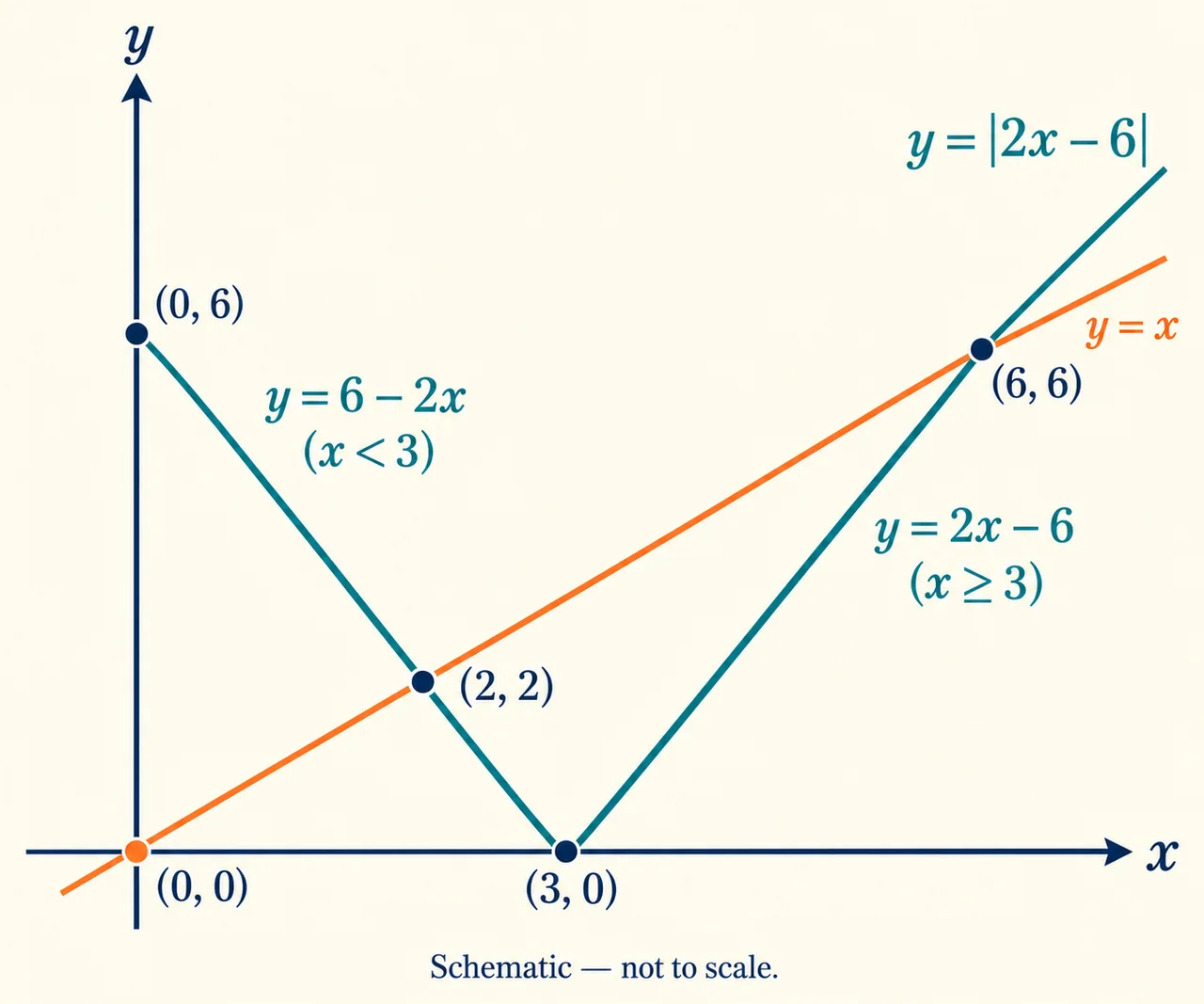
For y = |2x − 6|, the inside expression changes sign at x = 3. The graph follows 6 − 2x for x < 3 and 2x − 6 for x ≥ 3, giving a V with vertex (3, 0). The slopes are −2 and 2. The modulus acts on the entire expression: |2x − 6| is not 2|x| − 6.
For a general y = |f(x)|, keep every part of the original graph on or above the x-axis and reflect the parts below it upward. Inputs and roots stay fixed; outputs become nonnegative. For y = |f(−x)|, first reflect the input graph in the y-axis, then apply the output modulus. These transformations can create corners even when the original function is smooth.
Solve a modulus equation by checking its sign cases or by using the distance interpretation. For |2x − 6| = 4, the inside can be 4 or −4, giving x = 5 or x = 1. For |2x − 6| = −4 there is no real solution because the left side is nonnegative. Squaring indiscriminately would conceal this essential condition and could create false answers.
In an equation such as |2x − 6| = x, the right side must first satisfy x ≥ 0. Then solve each linear branch and keep only candidates in its branch interval. For inequalities, use the piecewise rules or view the answer as where one graph lies above the other. Clearly indicate endpoints; strict inequalities exclude points where the graphs meet.
The specialist V has vertex (3,0), left arm 6−2x and right arm 2x−6. Its intersections with y=x are (2,2) and (6,6). Solving each linear branch and then checking x<3 or x≥3 explains why these are valid. The initial observation x≥0 follows from the nonnegative left side. Taking “plus or minus” without branch checks hides this logic.
Transfer: classify |2x−6|=k. For k<0 there is no real solution. At k=0 only x=3. For k>0 the solutions are 3−k/2 and 3+k/2. If inputs are restricted to x≥0, the left solution survives only for k≤6, while the right one always survives. Thus k>6 has only one admissible solution. Check k=8: x=−1 and 7 algebraically, only 7 contextually. The graph's symmetry does not override an asymmetric domain.
Follow the piecewise branches of the modulus plate. The turning point is where the expression inside the modulus changes sign; split the domain there and check that both pieces agree at the boundary.
Worked example: Solve |2x − 6| = x.
Require x ≥ 0. For x ≥ 3, solve 2x − 6 = x to obtain x = 6.
For 0 ≤ x < 3, solve 6 − 2x = x to obtain x = 2.
Both satisfy their branch conditions and the original equation.
Answer: x = 2 or x = 6.
Check your understanding: Solve |x − 4| < 3.
Answer: 1 < x < 7.
Why: Distance from 4 is less than 3 exactly between 4 − 3 and 4 + 3; equality at the endpoints is excluded.