Use a function model and test its limitations
By UK A Level Mathematics · independent study · myAudience
Original myAudience generated mathematics illustration; not a documentary photograph. Diagram geometry is schematic, not a calibrated measurement. · Original generated project artwork; no source textbook or exam-board figures reused.
Use a function model and test its limitations
A mathematical model represents a situation using selected variables, relationships and assumptions. It is useful because it makes a question calculable; it is limited because the situation may contain effects the relationship omits. This lesson draws together equations, functions, domains and proportional graphs. Its invented examples are teaching models, not measured scientific data or evidence about any real service.
Suppose a small workshop estimates the time T in minutes to pack n identical items by T(n) = 8 + 0.4n. The constant represents setup time and the coefficient is an assumed time per item. The contextual domain is nonnegative integer n within the workload for which the estimate is credible. The line does not represent fractional items, and a nonzero intercept means total time is not directly proportional to item count.
A fixed job shared among identical workers may instead be modelled by T(w) = 60/w for positive integer w. The invariant wT = 60 describes inverse proportion, assuming equal rates and perfect sharing. Its graph is reciprocal, not linear in w. It predicts ever smaller times as workers are added, exposing a limitation: communication, space and an irreducible setup time could prevent the predicted saving.
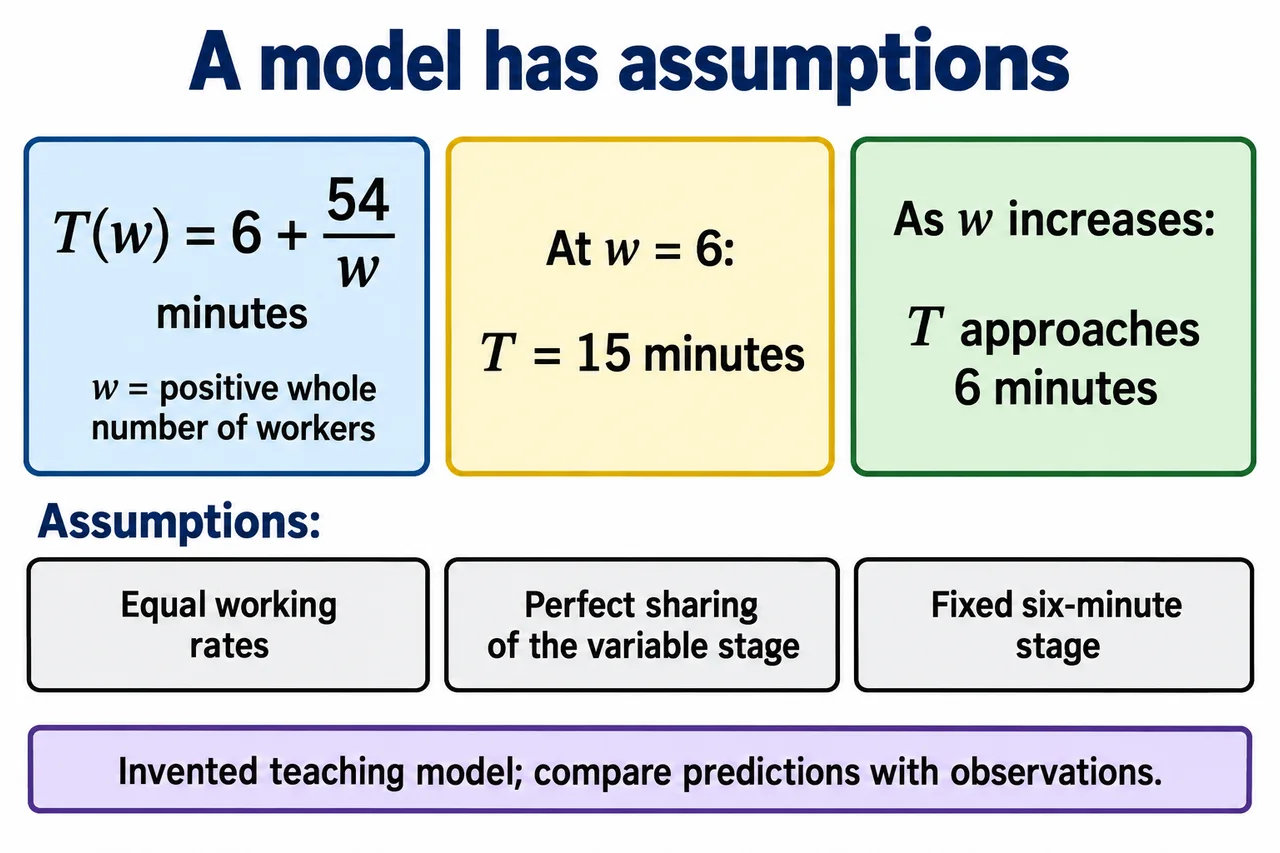
A refinement T(w) = 6 + 54/w separates a fixed six-minute stage from a shareable stage. It has horizontal asymptote T = 6, so its predictions respect the assumed fixed stage. This does not prove the refinement is accurate. Compare predictions with independent observations, examine deviations and revise assumptions if needed. Algebra explains the model consequence; evidence is needed to judge the model choice.
When reporting a solution, include units, domain and the interpretation of rounding. If a model asks for a minimum whole number of workers, rounding down can fail to meet a deadline. Do not extrapolate to an unlimited workforce merely because the formula allows it. Full function modelling also requires trigonometric and exponential settings, and broader unstructured problem-solving tasks; both remain pending outside this foundations cohort.
For the invented T(w)=6+54/w minutes with positive integer workers, a deadline d≤6 is impossible for finite w because 54/w>0. For d>6, T≤d requires w≥54/(d−6); take the least integer satisfying this lower bound. With d=14, the bound is 27/4 and the minimum is 7, giving T(7)=96/7 minutes while T(6)=15 fails. Rounding to the nearest integer is not the rule; meeting the inequality is.
Transfer: if at most eight workers fit the room, the fastest permitted prediction is T(8)=51/4 minutes. A twelve-minute deadline is infeasible even though the unrestricted formula permits w≥9. The result exposes a capacity assumption, not a reason to report nine available workers. Actual measured packing rates, coordination and uncertainty would be needed to validate this model; none are supplied here.
Identify the variables, assumptions and feasible domain beside the model illustration. Mathematical outputs outside the physical constraints must be rejected even if the algebra is correct; fitting one situation is not validation in every context.
Worked example: Under T(w) = 6 + 54/w minutes, find the minimum positive integer w giving T(w) ≤ 15.
For w > 0, 54/w ≤ 9 implies w ≥ 6.
The smallest permitted integer is 6. T(6) = 15 and T(5) = 16.8.
Interpret the answer only under the assumptions of identical rates, perfect sharing of the variable stage and a fixed six-minute stage.
Answer: 6 workers within the stated model.
Check your understanding: In T(n) = 8 + 0.4n minutes, is doubling n guaranteed to double T?
Answer: No. T(10) = 12 while T(20) = 16.
Why: The fixed setup term remains 8. Only the variable contribution is directly proportional to n.