Radians and a constrained sector
By UK A Level Mathematics · independent study · myAudience
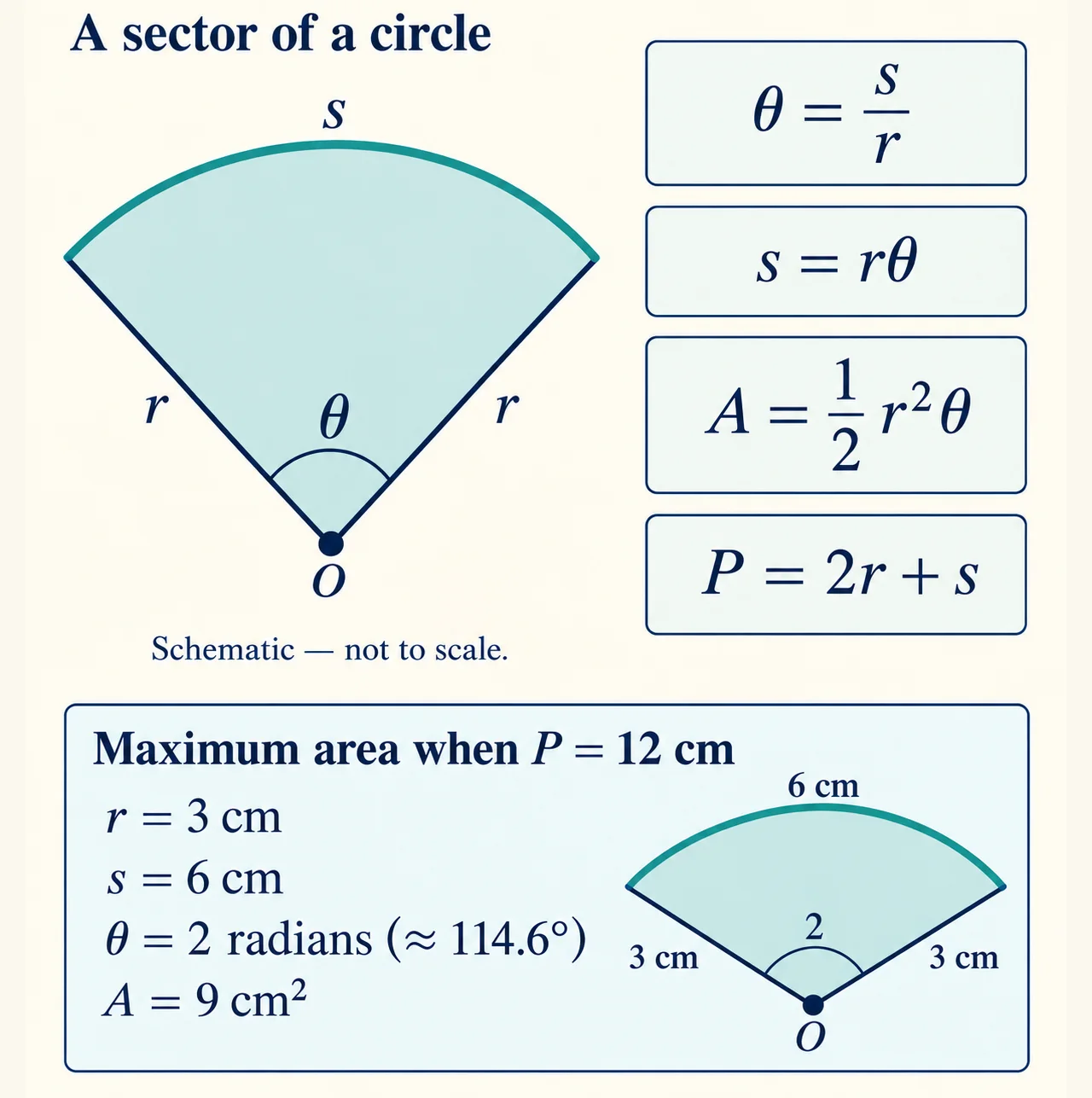
Original myAudience generated mathematics illustration; not a documentary photograph. Diagram geometry is schematic, not a calibrated measurement. · Original generated project artwork; no source textbook or exam-board figures reused.
Radians and a constrained sector
A radian measures the ratio of circular arc length s to radius r: θ=s/r. Both lengths must use the same unit, and r>0. A full turn has arc 2πr, hence angle 2π radians. This ratio explains why the same angle has different arc lengths on different circles. Entry skills are circumference, fractions, square completion and quadratic ranges. Vocabulary: radius, arc, sector, perimeter, radian. Degrees remain valid but must be converted before using s=rθ.
A sector's fraction of a circle is θ/(2π), so its area is πr² θ/(2π)=r²θ/2. This derivation uses 0<θ≤2π for a simple non-overlapping sector. The perimeter of a sector with two radial edges is 2 r+s, not s alone. For θ=2π the two coincident radial edges no longer form the outer perimeter of an ordinary disk; specify the geometry before applying the perimeter model. We use strictly 0<θ<2π below.
For an invented thin sector template with boundary length 12 cm, 2 r+s=12 and s>0 imply 0<r<6. The simple-sector restriction θ<2π also requires r>6/(1+π). Then A=rs/2=r(12−2 r)/2=6 r−r²=9−(r−3)². The largest value is 9 cm² at r=3 cm, s=6 cm, θ=2 radians. Because 2<2π, this candidate is a permitted simple sector. The nonnegative-square bound proves global optimality; a sequence of calculator trials would only suggest it.
The sector plate distinguishes the curved boundary from its two straight radii. Its θ label is an angle ratio, not a length in centimetres. Read the area card as a scaling statement: doubling the radius at fixed θ quadruples area but doubles arc length. In our fixed-perimeter problem θ changes as r changes, so that scaling cannot be used while holding all the other quantities fixed. This is the misconception that often hides in optimisation: deciding what is held constant matters before any algebra.
Transfer: if the design additionally requires 0<θ≤1, then (12−2 r)/r≤1 gives r≥4, alongside r<6. On [4,6), A=9−(r−3)² decreases as r increases. The maximum becomes 8 cm² at r=4, s=4, θ=1. The unconstrained optimum r=3 is excluded. Check a radius of 5: s=2, θ=2/5 and A=5, all admissible but below 8. The distinction between a valid stationary candidate and an admissible global optimum prepares calculus optimisation.
Distinguish radius, arc length and central angle in the sector illustration. Its worked obtuse2-radian angle matches the12cm-boundary example; the formulas require radians. This A Level-only plate is schematic, so use the given lengths rather than measuring the drawing.
Generalise rather than memorise the 12 cm example. For a fixed positive boundary P and 0 < θ < 2π, use s = P − 2r and A = Pr/2 − r² = P²/16 − (r − P/4)². The admissible radii satisfy P/[2(1 + π)] < r < P/2. The vertex r = P/4 is inside that interval, so the maximum is P²/16, with s = P/2 and θ = 2. Scaling P by a positive factor λ scales each optimal length by λ and optimal area by λ²; it does not change the optimal angle. This is a deduction from the model, not a measurement of the generated sector.
Now impose an angle cap 0 < θ ≤ α < 2π. The lower radius becomes P/(α + 2). If α < 2, this lies to the right of P/4, so area decreases over the permitted interval and the maximum is P²α/[2(α + 2)²] at θ = α. If α ≥ 2, the earlier θ = 2 optimum remains allowed. For P = 20 and α = 1 the formula gives 200/9 cm², agreeing with the check answer. A reasoned solution derives the radius restriction, tests whether the vertex is permitted and distinguishes a boundary optimum from a stationary one; no calculus rule or empirical design claim is assumed.
Worked example: For a simple sector with boundary 20 cm, find the maximum area and check its angle.
Use s=20−2 r; a simple sector requires 10/(1+π)<r<10.
A=10 r−r²=25−(r−5)².
At r=5, s=10 and θ=2, within 0<θ<2π.
Answer: 25 cm² at r=5 cm and θ=2 radians.
Check your understanding: Repeat the sector maximum with boundary 20 cm and θ≤1.
Answer: 200/9 cm² at r=s=20/3 cm and θ=1.
Why: The angle restriction forces r≥20/3, to the right of the quadratic vertex 5; area decreases on the allowed interval.