Recover every angle from a hidden quadratic
By UK A Level Mathematics · independent study · myAudience
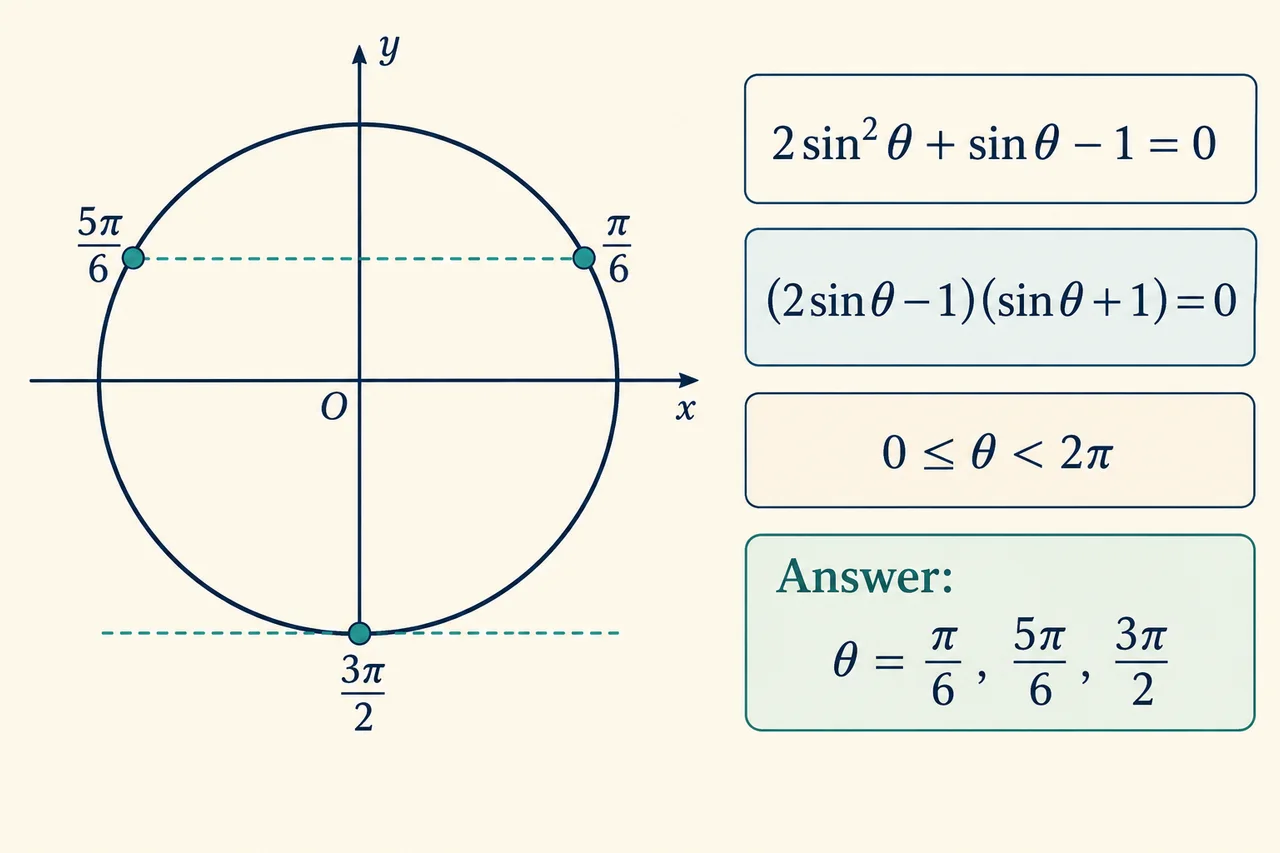
Original myAudience generated mathematics illustration; not a documentary photograph. Diagram geometry is schematic, not a calibrated measurement. · Original generated project artwork; no source textbook or exam-board figures reused.
Recover every angle from a hidden quadratic
On a unit circle the point at angle θ measured counterclockwise from the positive horizontal axis is (cosθ,sinθ). Thus sin²θ+cos²θ=1 follows from the circle equation. Both coordinates lie in [−1,1]; tanθ=sinθ/cosθ excludes cosθ=0. Sine and cosine repeat after 360°, while tangent repeats after 180°. The shared AS/A Level core below gives angles in degrees, as AS 5.4 requires. Entry skills are radicals, quadratic substitution and restricted domains. Radian equivalents are optional A Level context, not an AS prerequisite. A calculator’s principal inverse-sine value is one representative, not the entire solution set.
Solve 2 sin²θ+sinθ−1=0 for 0°≤θ<360°. Set u=sinθ∈[−1,1]. Factor (2 u−1)(u+1)=0, giving u=1/2 or−1, both admissible. The first value occurs at θ=30° and 150°; the second only at 270° in this interval. There are three distinct angles. The selected plate shows the optional A Level radian equivalents π/6,5π/6 and 3π/2. Its horizontal level y=1/2 cuts twice; y=−1 touches once. Circle geometry explains why two substitute roots need not give four angle roots; the radian labels are not needed to solve the degree task.
A denominator can forbid a solution even when the transformed quadratic accepts it. For (2 sin²θ+sinθ−1)/(sinθ+1)=0, first exclude sinθ=−1. The only roots on 0°≤θ<360° are 30° and 150°. Cancelling sinθ+1 gives an equivalent expression only on the original domain. Returning 270° silently repairs a hole and solves a different equation. A root of the numerator is not sufficient when its denominator is zero.
Transfer to a multiple angle: solve 2 sin²(2 x)+sin(2 x)−1=0 for 0°≤x<360°. Put θ=2 x, so 0°≤θ<720°, not 360°. Include two periods: θ=30°,150°,270°,390°,510°,630°. Divide by two to obtain x=15°,75°,135°,195°,255°,315°. Solve on the transformed interval first; dividing only the first three angles loses half the solutions. In optional A Level radian notation these are π/12,5π/12,3π/4,13π/12,17π/12,7π/4 on 0≤x<2π. The original interval governs the units and the permitted outputs.
Parameter reasoning: sin²θ=a on 0°≤θ<360° has no solutions for a<0 or a>1, two at a=0 (0°,180°), two at a=1 (90°,270°), and four for 0<a<1. At a=0,360° is excluded and must not be added. This count follows from circle intersections at heights±√a, not from assuming every inverse function has two outputs. The optional A Level interval 0≤θ<2π expresses the same turn. Exact values, wider sine/cosine/tangent graph practice and independently checked unseen equations remain incomplete.
The trig plate shows an optional A Level radian representation of the roots. The shared AS teaching and model answers in this lesson use degrees, as required by the current AS specification. Solve the algebraic equation in the trig value first, then enumerate every allowed angle in the stated interval; one inverse-calculator result is insufficient.
A separate transfer changes both interval and trigonometric value: solve 2 cos²x − cos x − 1 = 0 for −180° ≤ x < 180°. Factoring (2 cos x + 1)(cos x − 1) gives cos x = −1/2 or 1. The admissible angles are −120°, 0° and 120°, not the positive-turn list 120°, 240°, 360°. The half-open interval and cosine symmetry explain the enumeration. Substituting those exact cosine values establishes the original equation; a decimal inverse-calculator reading alone does not show that every permitted angle has been found.
If the same numerator is divided by cos x − 1, first exclude cos x = 1, leaving only −120° and 120°. If instead the angle is 3x on −180° ≤ x < 180°, solve on −540° ≤ 3x < 540° before dividing: cosine −1/2 occurs at −480°, −240°, −120°, 120°, 240°, 480°, and cosine 1 at −360°, 0°, 360°. The nine x-values are −160°, −120°, −80°, −40°, 0°, 40°, 80°, 120°, 160°. A strong response shows the transformed interval, rejects values outside the trigonometric range or original denominator domain, and recovers all periods. These degree examples remain AS-accessible; optional radian notation never becomes an entry prerequisite.
Worked example: Solve 2 cos²θ−3 cosθ+1=0 for 0°≤θ<360°, giving the shared-core answer in degrees.
Set u=cosθ∈[−1,1]. Factor (2 u−1)(u−1)=0.
u=1/2 gives 60°,300°; u=1 gives 0°.
Exclude 360° because the interval is half-open. Optional A Level radian equivalents are 0,π/3,5π/3.
Answer: 0°,60°,300°.
Check your understanding: Divide the same cosine numerator by cosθ−1. Which angles remain roots on 0°≤θ<360°?
Answer: 60° and 300° only.
Why: The original denominator excludes cosθ=1, removing 0°; cancellation does not restore this input. The half-open interval separately excludes 360°.