A derivative is a limiting slope, not a fraction at zero
By UK A Level Mathematics · independent study · myAudience
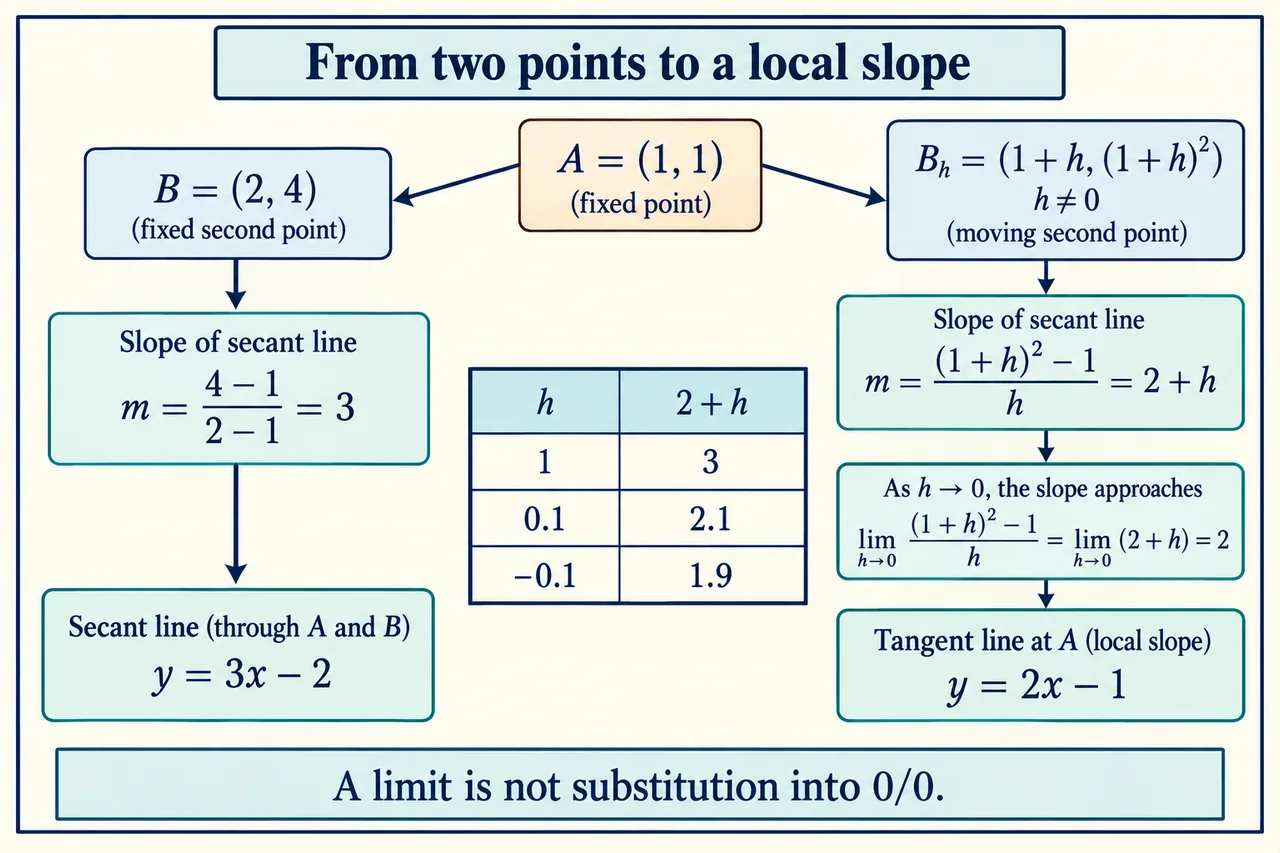
Original myAudience generated mathematics illustration; not a documentary photograph. Diagram geometry is schematic, not a calibrated measurement. · Original generated project artwork; no source textbook or exam-board figures reused.
A derivative is a limiting slope, not a fraction at zero
For a function f and an interior domain point a, the secant between (a,f(a)) and (a+h,f(a+h)) has slope [f(a+h)−f(a)]/h, for h≠0 and both inputs allowed. The derivative f′(a) is the limit as h tends to zero if the same finite value is approached from both signs. It measures local output change per input unit. Entry skills are polynomial expansion, graph slopes, domain restrictions and function notation. Vocabulary: increment, secant, tangent, difference quotient, limit, derivative. This definition does not guarantee every function has a derivative.
For f(x)=x², expansion gives [(a+h)²−a²]/h=2 a+h for h≠0. The difference from 2 a is exactly h, so for any desired slope error ε>0, choosing 0<|h|<ε makes the error less than ε. That proves the limit is 2 a. We cancelled a factor of h while retaining h≠0 and only then took a limit. Substitution into the original quotient at h=0 gives undefined 0/0, not zero, infinity or an actual secant of length zero.
At a=1 the plate separates a fixed-point branch A=(1,1), B=(2,4) from a moving-point branch B_h=(1+h,(1+h)²): the secant slope is 3 and its line y=3 x−2. The tangent is y=2 x−1 with slope 2. The table h=0.1 gives 2.1 while h=−0.1 gives 1.9, approaching the same value from opposite sides. Neither secant is the tangent. A tangent is defined by local limiting direction, not the claim that a line meets the curve exactly once; a tangent to another curve can cross it elsewhere.
For f(x)=x³, the quotient is 3 a²+3 ah+h². The error tends to zero because |3 ah+h²|≤3|a||h|+|h|². Thus f′(a)=3 a². At a=0 the tangent is horizontal, y=0, but x³ changes from negative to positive through zero. A zero derivative need not indicate a maximum or minimum. Transfer to |x| at zero: |h|/h is 1 for positive h and −1 for negative h, so no common two-sided derivative exists. The earlier V-graph illustrates this corner even though it is perfectly continuous.
Optional A Level application after the radians-sector lesson: A(r)=6 r−r² has difference quotient 6−2 r−h and derivative 6−2 r. On the simple-sector domain 6/(1+π)<r<6 this vanishes at r=3, agreeing with the completed-square optimum. Under θ≤1 the allowed r≥4 makes A′ negative throughout; the optimum sits on the boundary. This application is not an AS prerequisite. The shared first-principles core is already established by the polynomial examples above. The comparison does not prove general stationary-point tests or the derivative of sine.
Follow the secant plate from fixed A=(1,1) to moving B_h. The quotient is defined only when h≠0; its limit2 identifies the derivative at x=1 and the tangent y=2x−1. A finite table supports the limiting pattern but does not prove the limit by itself.
An optional extension, beyond the AS first-principles examples of small positive integer powers, checks whether the method survives outside the polynomial cases. For f(x) = 1/x and an interior point a ≠ 0, the difference quotient is [1/(a + h) − 1/a]/h = −1/[a(a + h)] for h ≠ 0 and a + h ≠ 0. As h tends to zero while staying sufficiently close to a, this tends to −1/a². At a = 2 the derivative is −1/4 and f(2) = 1/2, so the tangent is y − 1/2 = −(x − 2)/4. Cancelling h does not allow evaluation of f at its pole; a = 0 remains outside the original domain.
It is possible for a tangent to cross its curve, so “touches exactly once” is not a reliable definition. For f(x) = x³ − 3x at a = 1, the first-principles result gives derivative 3a² − 3 = 0 and f(1) = −2, hence tangent y = −2. Solving x³ − 3x = −2 gives (x − 1)²(x + 2) = 0: the tangent also meets the curve at x = −2. The repeated factor at 1 describes local contact, while the other intersection is elsewhere. A justified response distinguishes local limiting slope from global intersection count, derives the quotient with its restrictions and checks the tangent at the stated point; a finite table alone cannot prove a derivative.
Worked example: Differentiate 2 x³−x from first principles, then find the tangent at x=1.
Expand the difference quotient for h≠0: 6 a²+6 ah+2 h²−1.
The h terms tend to zero, giving f′(a)=6 a²−1.
At a=1, f(1)=1 and f′(1)=5; y−1=5(x−1).
Answer: f′(x)=6 x²−1; tangent y=5 x−4.
Check your understanding: Does x² on x≥0 have an ordinary two-sided derivative at the endpoint 0?
Answer: The right derivative is 0; the standard two-sided interior-point definition does not apply.
Why: Negative input increments are outside the domain. State the one-sided convention explicitly.