Information capacity and unambiguous storage units
By UK A Level Computer Science · independent study · myAudience
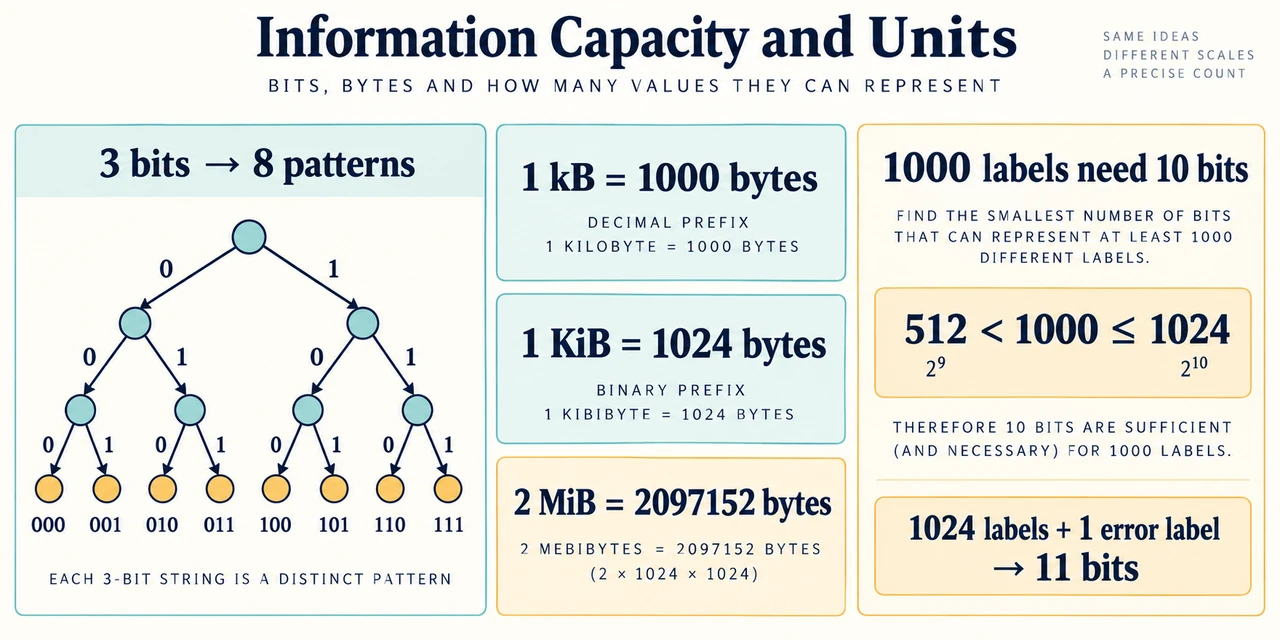
Original generated teaching illustration, built-in imagegen,2026-10-04; mathematical model,not documentary photograph. · Original generated artwork; operator provenance/rights and independent scientific acceptance pending.
Information capacity and unambiguous storage units
A bit has two possible states, while a byte groups eight bits. An n-bit field has two choices at each position, giving 2^n possible patterns by the multiplication principle. This counts representable labels, not necessarily numeric values with the same magnitude. Three bits can label eight colours or the integers zero through seven; the interpretation assigns patterns to meanings. If a protocol reserves a pattern for an error, only seven remain for ordinary labels. Capacity must be calculated after such reservations are specified.
Unsigned numeric maximum is 2^n −1 because zero uses one of the 2^n patterns. The minimum width for k distinct labels is the smallest integer n with 2^n≥k, not k itself and not the largest label's digit count in decimal. For 1000 labels, nine bits offer 512 and ten offer 1024, so ten suffice with 24 spare patterns. For 1024 labels ten bits are exactly sufficient; 1025 require eleven. An off-by-one error at a boundary can invalidate every maximum-size message even when small tests pass.
Storage capacity and transfer rate require different units. Bits and bytes differ by a factor of eight; a nominal megabit-per-second link is not a megabyte-per-second link. A theoretical time based on payload divided by rate omits headers, contention and retransmission unless included in the contract. This lesson's exact arithmetic describes defined budgets, not measured throughput. A byte count also says nothing by itself about whether compressed data can be decoded safely or how much expanded memory the application will need.
Decimal prefixes use powers of ten: kB means 1000 bytes, MB one million, GB one billion and TB one trillion. Binary prefixes use powers of two: KiB means 1024 bytes, MiB 2^20, GiB 2^30 and TiB 2^40. The symbols distinguish the conventions. Historically ambiguous labels are a reason to state the assumption, not permission to change units halfway through a calculation. A device advertised using decimal capacity can display a smaller number in binary units while containing the same count of bytes.
Two MiB contain 2×2^20=2,097,152 bytes. Expressed in decimal MB this is 2.097152 MB, not exactly two. Conversely,2,000,000 bytes are about 1.90735 MiB. Conversion changes the numerical label, not the physical quantity. Preserve enough digits for the decision being made: rounding a capacity upward before testing whether a file fits can incorrectly approve an oversized file. Show the integer-byte comparison first, then provide an approximate human-readable result.
A byte-aligned record may contain unused bits. If each of 1000 identifiers needs ten bits, packing them without padding requires 10,000 bits or 1250 bytes. Storing each identifier in a two-byte field instead uses 2000 bytes. Neither calculation includes metadata, alignment beyond that declared rule or an index. A reserved identifier could increase the necessary width at a power-of-two boundary. The smallest theoretical payload is not automatically the best representation: alignment may simplify indexing or validation, but those benefits require a concrete cost model.
For a fictional archive,1000 records of 2048 bytes each occupy 2,048,000 bytes. They fit in 2 MiB with 49,152 bytes left under a payload-only contract. If an additional 64 bytes of metadata accompany each record, total storage becomes 2,112,000 bytes and exceeds the budget by 14,848. This reversal shows why omission of overhead is a model assumption with consequences. Compression might reduce the average, but a capacity guarantee needs a maximum-size bound or a defined failure outcome when the bound is exceeded.
Reading the diagram: The concept plate's binary branching reaches eight leaves after three decisions, illustrating patterns rather than eight stored bytes. Its units panel keeps the 1000 and 1024 ladders separate, and its capacity comparison shows why an additional error label changes the required width at the 1024-pattern boundary. Read labels as exact stipulated sizes, not market performance claims. For unfamiliar storage problems, identify the payload structure, reservations, padding and overhead, then compare exact bytes. An argued representation choice should balance access, space and failure behaviour rather than equate fewer theoretical bits with universal superiority.
Worked example: A 2 MiB budget stores 1000 records of 2048 bytes. Re-evaluate after adding 64 metadata bytes per record.
Capacity=2×1,048,576=2,097,152 bytes.
Payload=1000×2048=2,048,000; margin=49,152 bytes.
Includingmetadata gives 1000×2112=2,112,000; excess=14,848 bytes.
Answer: Payload-only records fit; the specified metadata makes them exceed the same capacity. The budget did not change when its unit label changed.
Check your understanding: Design a field for 1024 ordinary labels plus one error label. Compare packed storage for 1000 such fields with a two-byte-per-field format, then evaluate whether an observed average compression ratio can guarantee that all records fit.
Answer: There are 1025 distinct labels, so ten bits with 1024 patterns fail and eleven bits with 2048 patterns suffice. Packed 1000 fields use 11,000 bits=1375 bytes if no other overhead is stipulated. Two-byte fields use 2000 bytes, leaving five unused bits in each field. The extra space can buy simple byte-aligned access, but speed must be analysed rather than assumed. An average compression ratio does not bound the worst-case encoded size. A guarantee needs a proven maximum plus headers or an explicit rejection/overflow policy; ordinary data may compress poorly or expand.
Why: A reserved outcome counts as a distinct label. Correct exact bit/byte arithmetic is necessary but insufficient without overhead and representation assumptions. Evaluate alignment and failure limits rather than proposing an unsupported performance claim.