Positive and negative normalisation without changing value
By UK A Level Computer Science · independent study · myAudience
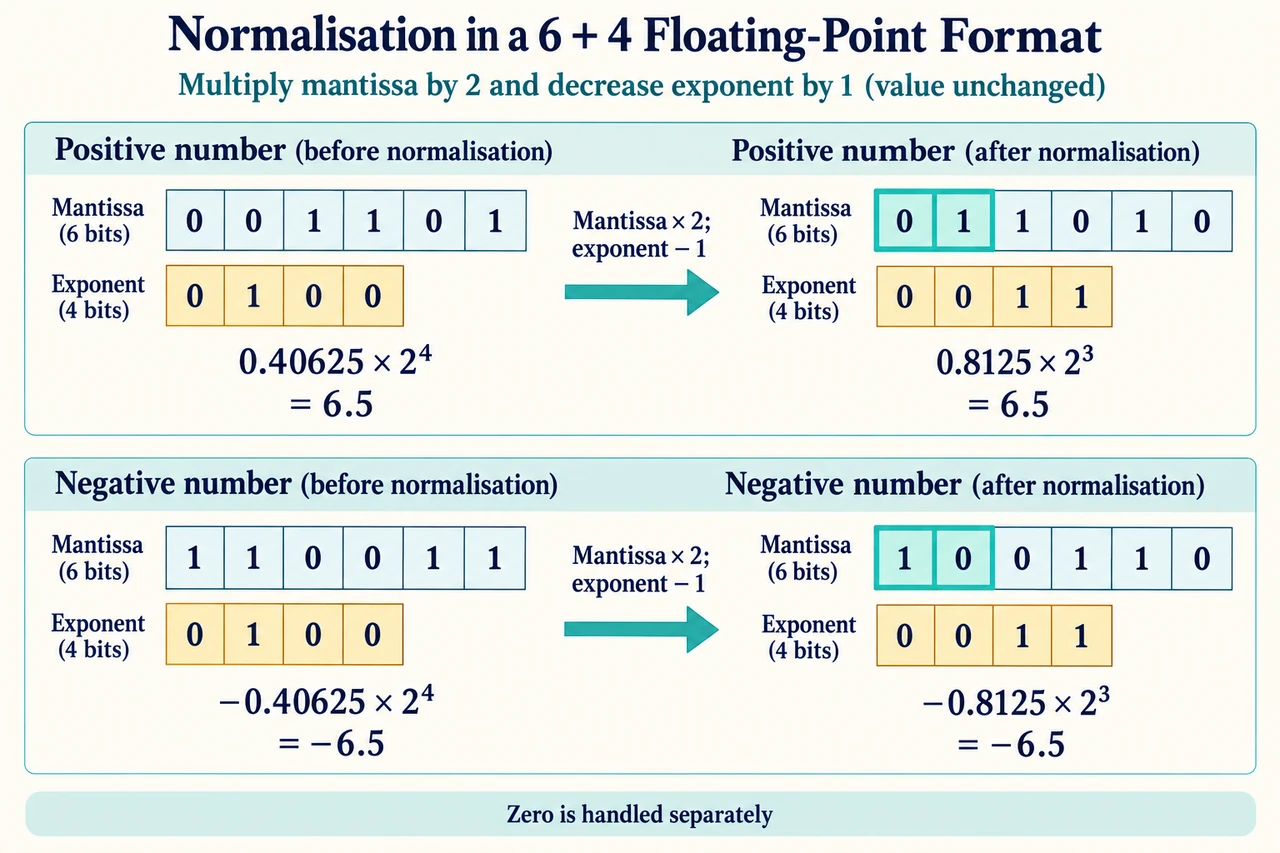
Original generated teaching illustration, built-in imagegen,2026-10-04; mathematical model,not documentary photograph. · Original generated artwork; operator provenance/rights and independent scientific acceptance pending.
Positive and negative normalisation without changing value
Normalisation chooses a consistent representation without changing the value. In this six-bit two’s-complement fractional mantissa, positive nonzero normalised patterns begin 01, and negative patterns begin 10. These conditions ensure that the sign bit and next bit differ. They are not an unsigned rule to make the first bit one, nor a demand that a negative value have a separate leading minus. Both tests follow from the chosen signed weights and binary-point position; another format would require its own conditions.
If the mantissa is multiplied by two while the exponent decreases by one, m×2^e=(2 m)×2^(e −1). Shifting a finite mantissa left can implement that multiplication only when the intermediate remains representable and no significant information is discarded. For an unnormalised 00 or 11 prefix, the redundant sign information can be shifted away while retaining the value. Check the resulting mantissa and exponent rather than claiming every possible shift is safe. Shifting an already normalised mantissa may overflow its field.
The positive unnormalised 001101 has raw 13 and mantissa 13/32=0.40625. At exponent 4 it denotes 6.5. Shifting left gives 011010, raw 26 and mantissa 0.8125; decrementing the exponent to 3 preserves 6.5. The exponent changes from 0100 to 0011. Keeping exponent 4 instead would double the represented value to 13. This simple error shows why moving mantissa bits and adjusting scale are one combined operation rather than independent cosmetic edits.
The negative example is deliberately not obtained by attaching a sign to the positive one. Pattern 110011 has signed raw −13 and mantissa −0.40625. At exponent 4 it denotes −6.5. Left shift within six bits gives 100110, raw −26 and mantissa −0.8125; exponent 3 preserves −6.5. Its initial 11 prefix is redundant negative sign information, while final 10 is normalised. Verify the signed sums at both ends: visual similarity or an unsigned interpretation of 51 and 38 would not prove value preservation.
Normalisation is asymmetric near zero because two’s complement is asymmetric. Positive normalised mantissas span 16/32 through 31/32. Negative ones span −32/32 through −17/32. The negative value −1 is normalised, but positive+1 is outside the mantissa field. A negative mantissa −0.5 begins 11 and normalises to −1 with an exponent decreased by one; positive+0.5 already begins 01. Treating the negative range as the exact mirror of the positive one produces incorrect limiting-value claims.
Zero does not satisfy either nonzero leading-bit rule. We handle it separately as 000000/0000, even though other exponent fields with a zero mantissa would also denote zero if allowed. Repeatedly shifting zero until a 01 appears would never terminate. A normaliser must test zero first, validate fields, then maintain the exact-value invariant while decreasing a bounded exponent. If the exponent would pass below −8 before a legal normalised form is reached, return a defined unavailable-normal-form result rather than wrap the exponent.
For example, raw mantissa 1 at exponent −8 denotes 1/. It is a valid unnormalised field pair but lies below the smallest positive normalised value of this model. Reaching a positive 01 prefix requires four left shifts and exponent −12, outside the four-bit exponent range. This demonstrates why allowing all unnormalised encodings changes the available set. Our later range claims concern canonical normalised nonzero values plus separately handled zero; they are not claims about every unconstrained pair of raw fields.
Reading the diagram: The plate's arrows show mantissa×2 and exponent −1 simultaneously for both 6.5 and −6.5. The positive after-prefix 01 and negative after-prefix 10 are highlighted; zero is labelled separate rather than forced into either branch. Interpret the transformation algebraically, not as a proof that every raw field has a permitted normalised equivalent. A rigorous unfamiliar transfer must preserve value at each step, check sign and exponent boundaries and explain what the interface reports when the declared normalised representation cannot accommodate the input.
Worked example: Normalise 001101/0100 and 110011/0100 in the 6+4 model, showing exact value preservation for both signs.
001101 means 13/32; with exponent 4 the value is 6.5. Shift to 011010 and lower exponent to 0011, giving 26/32×8=6.5.
110011 means −13/32; with exponent 4 the value is −6.5. Shift to 100110 and exponent 0011, giving −26/32×8=−6.5.
After-prefixes 01 and 10 satisfy their respective tests. Zero is not subjected to these nonzero tests.
Answer: 011010/0011 and 100110/0011 are the normalised equivalent pairs.
Check your understanding: Normalise 110000/0010, handle 000000/0111, and investigate 000001/1000. Explain why a normaliser cannot simply treat negative mantissas as signed positive magnitudes.
Answer: 110000 is raw −16, mantissa −0.5; exponent 2 gives −2. Shift to 100000 (−1) and exponent 0001, retaining −2 with a 10 prefix. Zero is returned as canonical 000000/0000. Raw 000001 at exponent 1000 gives 1/; reaching mantissa 010000 requires exponent −12, outside −8..7. Under the normalised-only contract it has no nonzero representation, so report under-range rather than wrapping. Two’s-complement negative leading weights and asymmetric bounds differ from sign-magnitude; ignoring them gives incorrect shifts and limiting values.
Why: Value preservation, leading-bit condition and legal exponent are separate obligations. A successful raw decode does not imply availability under a stricter canonical normalisation contract. Require a zero branch and meaningful boundary failure.