Nuclear energy: event scales, deposited energy and the output boundary
By How things work · myAudience
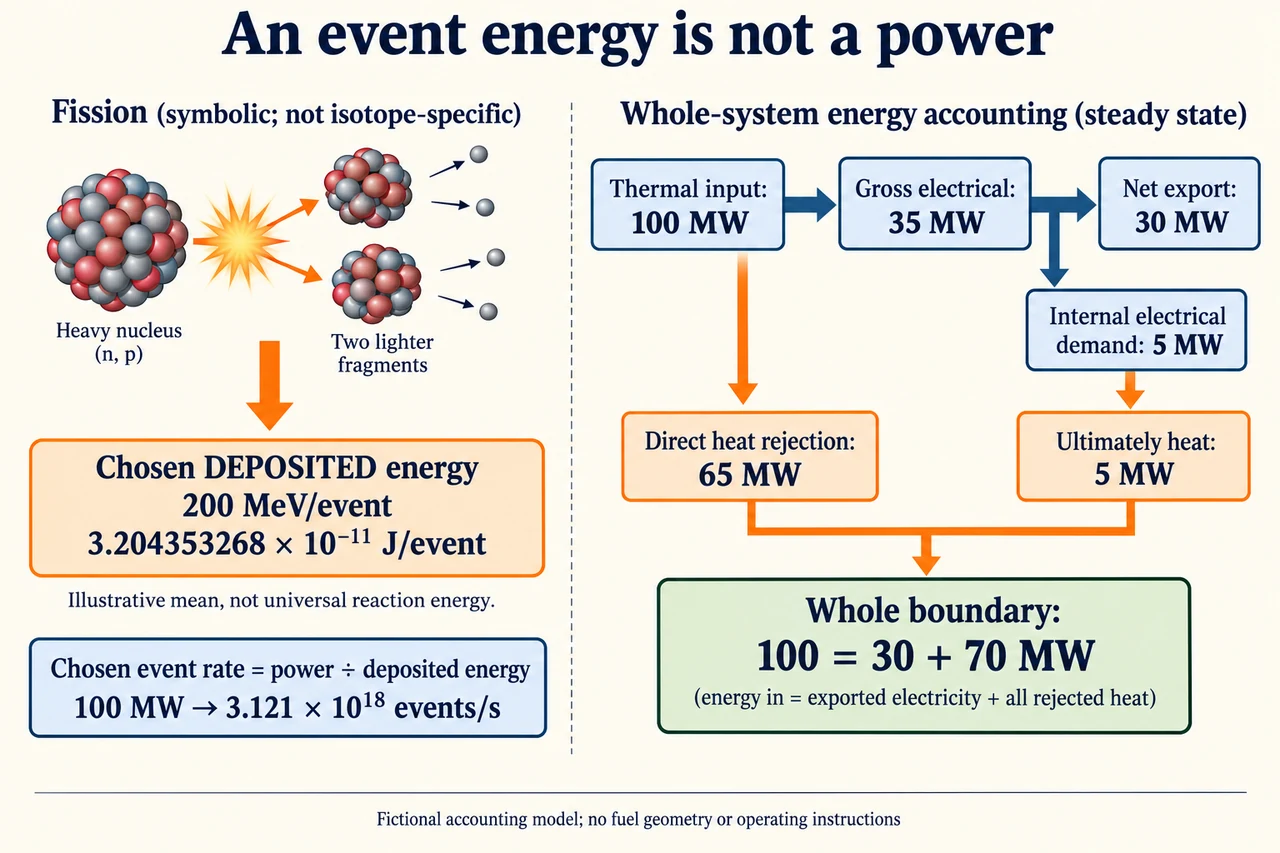
myAudience original rendered teaching illustration. Image: illustration, not a documentary photograph. · Operator-authored generated illustration; independent scientific acceptance pending.
Nuclear energy: event scales, deposited energy and the output boundary
Fission is a change in a nucleus, rather than the rearrangement of electrons that defines a chemical reaction. A heavy nucleus can split into smaller fragments and other particles; their motion and subsequent interactions transfer energy to surrounding matter. The rest-mass difference between a fully specified initial and final system relates to released energy through E = Δmc². Energy is conserved; a mass-energy conversion is not energy created from nothing. The plate's nucleus-and-fragment picture is symbolic, not an isotope-specific reaction equation: its coloured spheres do not provide atom counts, charge balance or a proposed fuel composition. The prior mechanism lesson explains the separate fluid circuits; this follow-up examines what an energy-per-event statement can actually predict.
An electronvolt is a unit of energy, not voltage, power or radiation dose. In the revised SI, 1 eV = 1.602176634 × 10⁻¹⁹ J exactly, and a megaelectronvolt is one million electronvolts. The NIST constants listing gives that exact conversion; it does not make a real fission event's energy exact. Choose a fictional mean deposited thermal energy of 200 MeV per event for the calculation, equal to 3.204353268 × 10⁻¹¹ J/event. This is the plate's declared accounting assumption, not a universal reaction energy or a measured reactor value. Actual release depends on the reaction products and timing, and some energy can escape the selected thermal boundary. Distinguish total nuclear energy released from the part deposited as useful thermal input.
Power is energy transferred per unit time. In a stipulated steady accounting model, thermal power P equals an event rate R times its chosen mean deposited energy Edep. Choose P = 100 MW = 100,000,000 J/s. Then R = P/Edep = 3.120754537… × 10¹⁸ events/s, rounded to 3.121 × 10¹⁸ in the plate. The unit cancellation is (J/s)/(J/event) = events/s; multiplying power by energy would give the wrong dimensions. This steady correspondence includes whatever delayed contribution the chosen accounting convention assigns per event; it does not predict a changing reactor's instantaneous event rate from a single thermal reading. Stored energy, decay of earlier products and changing inventories would require a time-dependent balance.
Trace the plate's right-hand boundary: stipulated thermal input 100 MW supplies a fictional conversion system producing 35 MW gross electricity and rejecting 65 MW directly as heat. Of the gross electricity, 5 MW supplies internal demands and 30 MW is exported. With those internal demands ultimately dissipating within the same whole-system boundary, total heat rejection is 65 + 5 = 70 MW, so 100 = 30 + 70. Gross electrical fraction is 35%, net export fraction 30%. Counting the internal 5 MW as additional exported service, or subtracting it twice from an already net figure, misstates the boundary. This is an original accounting example, not an actual plant efficiency, full fuel-cycle balance or verified operating configuration.
A unit-scale transfer illustrates both the usefulness and the limit of mass-energy equivalence. With exact c = 299,792,458 m/s, the chosen 200 MeV corresponds to Δm = E/c² = 3.565323843… × 10⁻²⁸ kg per event. That is a mass-equivalent of the chosen energy, not the mass of fuel consumed, the number of atoms in a fuel assembly or a way to infer an isotope inventory. At 100 MW the thermal energy in one chosen steady hour is 100 MWh = 3.6 × 10¹¹ J, not 100 megajoules. Converting units correctly is essential before comparing an event scale with an infrastructure service, but the calculation supplies no enrichment, material-production or reactor-construction information.
A sensitivity test changes the assumed mean deposited energy, not the measured power. If Edep is chosen as 190 rather than 200 MeV, the inferred steady event rate is 3.285004776… × 10¹⁸ events/s, a factor 200/190 = 1.052631… larger. At 210 MeV it would be 2.972147178… × 10¹⁸. Thus a 100 MW power account can remain unchanged while the inferred microscopic count varies with its energy model. Those endpoints are a hypothetical assumption range, not a confidence interval from reactor data. Exact SI conversion factors cannot eliminate uncertainty in deposited energy, delayed contributions, instrument readings or the adequacy of a chosen boundary. Report the physical assumptions alongside any attractive string of calculator digits.
An apparently better component can give a worse service result. Retain the chosen 100 MW thermal input, but suppose gross electricity increases from 35 to 36 MW while internal demands increase from 5 to 7 MW. Export becomes 29 MW, below the former 30; whole-system rejection becomes 71 MW if the same ultimate-dissipation assumptions hold. The event rate under the unchanged deposited-energy model remains the same because thermal input did not change. A claim of improved electricity supply based only on the gross generator percentage ignores the user-facing service boundary. For a real comparison, equivalent time windows, availability, conversion losses, heating value or other energy-input conventions and any useful heat exports would all need explicit treatment.
Evaluate the service without letting a microscopic energy number stand in for a public decision. Reliable electricity, financing, materials, cooling needs, workforce protection, waste stewardship and who receives the service enter different parts of the evidence. A large energy per event alone says nothing about cost, lifecycle emissions or the acceptability of a site. Communities need understandable accounts of uncertainty and responsibilities extending beyond the project's immediate operating years; future users and custodians are affected too. Separate established fission physics from an illustrative service model and from a proposal requiring regulatory and site evidence. The plate deliberately omits fuel geometry, protection systems and operating procedures. Image: illustration, not a documentary photograph.
Worked example: For the chosen 100 MW thermal boundary and 200 MeV deposited mean per event, calculate event rate, one-hour thermal energy and net electricity for gross 35/internal 5 MW. Then compare gross 36/internal 7 at unchanged thermal input.
Convert 200 MeV to 200 × 10⁶ × 1.602176634 × 10⁻¹⁹ = 3.204353268 × 10⁻¹¹ J/event.
Event rate = 100 × 10⁶ divided by that value = 3.120754537… × 10¹⁸ events/s, conditional on the chosen steady convention.
One hour carries 100 MWh = 100 × 10⁶ × 3,600 = 3.6 × 10¹¹ J.
Original export = 35 − 5 = 30 MW, whole rejection 65 + 5 = 70 MW; changed export = 36 − 7 = 29 MW, rejection 64 + 7 = 71 MW.
Unchanged thermal power and deposited-energy assumption leave event rate unchanged; the gross percentage does not determine net service.
Answer: Chosen event rate approximately 3.121 × 10¹⁸/s; thermal energy 100 MWh in one hour. Export falls from 30 to29 MW despite higher gross generation. Both whole-system balances conserve100 MW.
Check your understanding: A report uses the exact electronvolt conversion to claim an exact measured event rate. Under the explicitly hypothetical190–210 MeV deposited-energy range, derive the event-rate bounds and explain why the mass-equivalent Δm is not fuel consumption.
Answer: At fixed 100 MW, R is inversely proportional to Edep. Lower bound is 100 × 10⁶/(210 × 10⁶ × 1.602176634 × 10⁻¹⁹) = 2.972147178… × 10¹⁸/s; upper is 3.285004776… × 10¹⁸/s at 190 MeV. These are assumption bounds, not statistical confidence bounds. Exact conversion does not establish actual deposited energy or a valid transient model. E/c² represents the chosen energy-equivalent mass difference, not the initial reactant mass or fuel inventory; obtaining fuel consumption would require additional reaction and inventory evidence not supplied here.
Why: Match the measured/assumed quantity and boundary. Precision in a unit definition does not certify physical input assumptions or identify material consumption.