Geothermal heat: finite-source work and the inlet-temperature trap
By How things work · myAudience
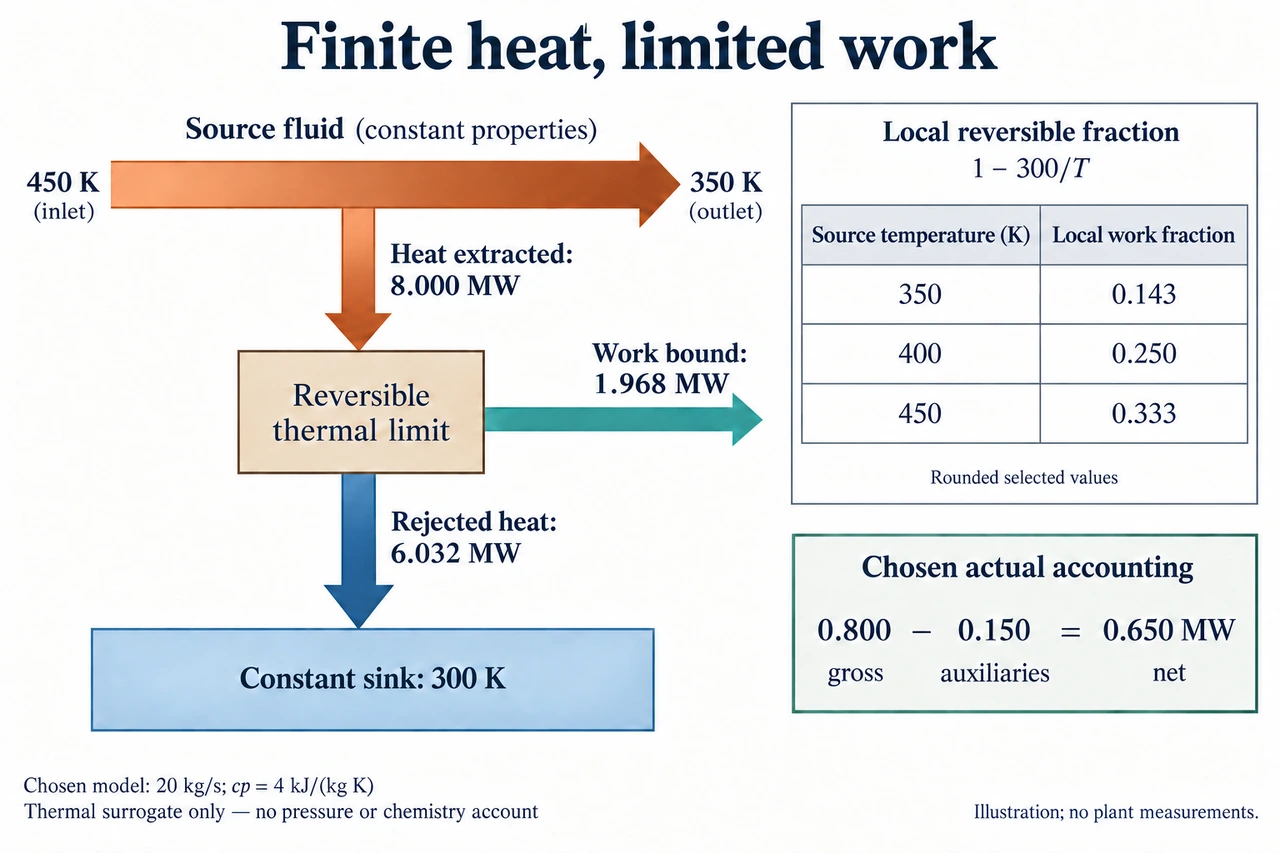
myAudience original rendered teaching illustration. Image: illustration, not a documentary photograph. · Operator-authored generated illustration; scientific model reviewed separately.
Geothermal heat: finite-source work and the inlet-temperature trap
A geothermal source can deliver substantial heat without converting most of it into electricity. The earlier mechanism lesson separates a binary plant's source fluid, secondary working fluid and cooling circuit; DOE describes that separation. This plate instead isolates a thermal accounting question. Choose a steady stream at 20 kg/s with a stipulated constant cp = 4 kJ/(kg K), cooling from 450 K to 350 K, and an environment represented by a constant 300 K sink. Treat this as a single-phase, constant-property surrogate: the numbers do not establish a real brine composition, pressure or feasible fluid state. Ignore pressure, kinetic, gravitational and chemical contributions to available work. No geothermal fluid flows into the sink on this diagram: its downward arrows denote heat transfer, and the right-pointing arrow denotes work.
Energy extraction is straightforward under those assumptions: Qdot = m cp (Tin − Tout) = 20 × 4 × 100 = 8000 kJ/s, or 8 MW. Useful work requires a second-law account. For reversible heat transfer from one constant-temperature source T to the constant sink T0, the Carnot fraction is 1 − T0/T. Absolute kelvins are essential; Celsius values cannot be inserted into this temperature ratio. Here the source stream cools, so different small heat transfers are supplied at different temperatures. Its inlet is not a reservoir that remains at 450 K while supplying the entire 8 MW. The plate's inset therefore lists selected calculated local fractions: about 0.143 at 350 K, 0.250 at 400 K and 0.333 at 450 K. That table describes a thermal limit, not measured turbine performance.
Imagine infinitely many reversible stages, each matched to an infinitesimal segment of the source's cooling path, rejecting heat to the same constant sink. Write the magnitude of extracted heat from a small positive cooling interval as dQdot = m cp dT when integrating from the outlet temperature up to the inlet. The corresponding work bound is dWdot = (1 − T0/T)dQdot. Integrating gives Wdot_max = m cp[(Tin − Tout) − T0 ln(Tin/Tout)]. The logarithm's argument is dimensionless. This construction removes finite temperature-approach losses and other irreversibilities by assumption; it is an upper bound on this defined thermal contribution, not instructions for constructing a reversible plant. Cooling below the chosen sink would need a different account and cannot be treated as a continuation of the same positive-work integral.
With m cp = 80 kW/K, the bracket is 100 − 300 ln(450/350) = 24.6056715… K, so the bound is 1.9684537… MW. Its fraction of extracted heat is about 24.606%. The reversible heat rejection is 8 − 1.9684537… = 6.0315463… MW. The plate rounds these to 8.000 = 1.968 + 6.032 MW; the rounded equality closes without inventing lost energy. Applying the inlet fraction to the whole transfer instead gives 8(1 − 300/450) = 2.6666667… MW. That exceeds the correct bound by about 0.698213 MW, or 35.47% of the correct bound. The mistake assigns the colder portions of extracted heat the greater work quality of the inlet. Conversely, applying the outlet fraction to everything gives 1.142857… MW, a lower comparison, not the exact integral.
Now keep the chosen actual accounting separate from that reversible construction. Stipulate gross electricity of 0.800 MW and auxiliaries of 0.150 MW, leaving 0.650 MW net export. These are invented example values, not a demonstrated plant operating at these temperatures. Gross output is about 40.64% of the thermal work bound, while net export is 8.125% of extracted heat. The two ratios have different denominators and boundaries; neither is established fuel-to-electricity efficiency. Do not subtract auxiliaries from the theoretical work bound and announce the result as actual output. Pumping, generator conversion, heat-transfer approaches and other actual losses must be represented explicitly in an observed plant account. The separate outlined panel on the plate preserves that distinction rather than mixing its chosen gross and net numbers into the ideal heat arrows.
The sink matters even when the extracted energy is unchanged. Change only the model sink to 320 K, retaining the source endpoints, flow and stipulated cp. The extracted heat remains 8 MW, but the integral becomes 80[100 − 320 ln(450/350)] kW = 1.5663506… MW. Both source endpoints still exceed the sink. The derivative of the work bound with respect to sink temperature is −m cp ln(Tin/Tout), approximately −20.105154 kW/K here, so a 20 K rise removes about 0.402103 MW of thermal work availability. This linear sink dependence follows from this restricted constant-property model. It is not a claim that a real plant's gross output must decline by that exact amount: cooling equipment, pressures, controls and auxiliary demand can also change. A useful transfer answer separates an unchanged heat quantity from reduced work quality and from unknown actual output.
Why not simply extract still more heat? In the same mathematical surrogate, lowering the source outlet toward the sink adds progressively less available work per unit of heat. Very small temperature approaches can require large exchanger conductance, while additional pumping or altered source conditions can affect net electricity. Real geothermal fluid can also have composition-dependent scaling and corrosion constraints, so the selected outlet is not a maintenance recommendation. A proper comparison would use measured mass flow, appropriate enthalpy and composition data, compatible equipment limits, inlet and outlet states, sink conditions and auxiliary electricity. Our prescribed constant cp is a teaching simplification that makes the original derivation visible; it does not replace property data or certify an achievable process. A calculation that closes energetically can still be unsuitable as a practical design.
Decision evidence should follow the service being compared. A higher gross electrical number may require greater source heat extraction, pumping, cooling demand or maintenance; equal delivered electricity is a different boundary from equal source flow. Identify which communities gain reliable service and which carry water, drilling, noise or land-use burdens before asserting a lifecycle benefit. DOE's environmental discussion is configuration-specific and includes dated scenarios; it does not establish universal zero-water or zero-lifecycle-impact geothermal electricity. The worked example tests the finite-source derivation, and the check tests whether a proposed warmer-sink comparison preserves its assumptions. The plate's arrows, selected-value table and separate actual account are explained by those quantities rather than serving as a decorative plant portrait. Image: illustration, not a documentary photograph.
Worked example: Using the declared 20 kg/s, constant cp = 4 kJ/(kg K), 450 → 350 K source and 300 K sink, derive and calculate the thermal work bound, reversible rejected heat and inlet-Carnot overestimate. Then distinguish the chosen 0.800 MW gross/0.150 MW auxiliary account.
Heat extraction = 20 × 4 × (450 − 350) = 8000 kJ/s = 8 MW. The source is cooling, so its temperature does not stay at the inlet value.
Integrate m cp ∫[1 − T0/T]dT from 350 to 450 K: Wmax = 80[100 − 300 ln(450/350)] kW = 1.9684537… MW.
Reversible rejected heat = 8 − 1.9684537… = 6.0315463… MW. Thermal work fraction = 1.9684537…/8 = 24.6057…%.
Inlet-only approximation = 8 × (1 − 300/450) = 2.6666667… MW; excess = 0.6982129… MW, or 35.4701…% of the correct bound.
Chosen net = 0.800 − 0.150 = 0.650 MW. Gross/bound ≈ 40.6410%; net/extracted heat = 8.125%. The actual example values were stipulated, not inferred from the upper bound.
Answer: The restricted thermal bound is approximately 1.968 MW, with 6.032 MW rejected heat. Treating all heat as supplied at 450 K overestimates the bound by about 0.698 MW. The separately chosen actual account exports 0.650 MW; that figure is not guaranteed by the thermodynamic limit.
Check your understanding: A proposal raises the sink to 320 K but retains the same 450 → 350 K source and states that unchanged 8 MW heat implies unchanged work availability and 0.650 MW actual export. Evaluate each claim. Then explain why using Celsius in the Carnot ratios, or interpreting the limit as a complete brine exergy calculation, would fail.
Answer: Heat remains 8 MW in the stated constant-cp surrogate, but Wmax = 80[100 − 320 ln(450/350)] kW ≈ 1.566351 MW. Availability declines by about 0.402103 MW, so unchanged heat does not imply unchanged potential work. Actual export is not supplied by this new comparison: gross output and auxiliaries would require new evidence. Both endpoints remain warmer than the 320 K sink, retaining the intended integral domain. Carnot temperature ratios require absolute kelvins; changing the arbitrary zero of a Celsius scale changes an invalid ratio. Finally, this account deliberately excludes pressure, chemistry, kinetic and gravitational contributions and uses stipulated constant properties. It describes a defined thermal contribution, not a complete real-brine exergy analysis or a certified plant design.
Why: Preserve explicit boundaries, derive the finite-source limit, separate energy from work quality, and refuse to manufacture actual output from a theoretical bound.