Biogas yield: follow the material, not the wet tonnes
By How things work · myAudience
myAudience original rendered educational illustration. Image: illustration, not a documentary photograph. · Original myAudience illustration; retained generated asset provenance.
Biogas yield: follow the material, not the wet tonnes
A tonne of wet material is not a tonne of methane substrate. Water contributes mass and hydraulic flow, while mineral material can remain in the residue rather than become combustible gas. The earlier lesson explains anaerobic digestion and the engine-generator energy balance; this lesson asks what a deliberately simplified material account can establish before any efficiency claim. Choose a feed averaging 1,000 kg/day, with 20% dry material, of which 80% is represented as an organic glucose equivalent. These are invented fractions, not measured manure composition. Represent 75% of that organic equivalent as completely converted by the chosen net reaction. Keep the unconverted organic material, inorganic material and water in the remaining-material account. Nothing in this setup establishes the physical properties, suitability or safe treatment of an actual feed.
Use nominal classroom atomic masses C = 12, H = 1 and O = 16 g/mol, deliberately avoiding a false claim of exact evaluated molar masses. The net ideal reaction C6H12O6 → 3CH4 + 3CO2 balances six carbon atoms, twelve hydrogen atoms and six oxygen atoms. Its nominal mass account is 180 g of glucose equivalent → 48 g of methane + 132 g of carbon dioxide. The gases have equal mole counts: methane is 50% of these two dry product gases by mole, but only 48/180 = 26.667% of their combined mass. Equal mole fractions do not mean equal mass fractions because a CO2 molecule is heavier than a CH4 molecule. Real biogas contains other constituents and has a composition dependent on feedstock and process conditions; this symbolic glucose reaction is not a universal biogas composition prediction.
Chemical oxygen demand, COD, expresses susceptibility to a specified chemical oxidation in oxygen-equivalent units. EPA's CADDIS explanation distinguishes chemical oxidation from the microbial consumption represented by biochemical oxygen demand; its historical training manual also warns that the two tests need not agree. COD can include chemically reducing inorganic contributions, so it is not a direct mass of biodegradable organic matter, a volatile-solids fraction or guaranteed anaerobic methane yield. For the pure glucose surrogate only, C6H12O6 + 6O2 → 6CO2 + 6H2O requires nominally 192 g of oxygen equivalent per 180 g glucose. Complete oxidation of CH4 + 2O2 → CO2 + 2H2O requires 64 g per 16 g methane, a ratio of four. These are separate oxidation bookkeeping reactions. No oxygen is fed into anaerobic digestion by drawing or calculating this COD account.
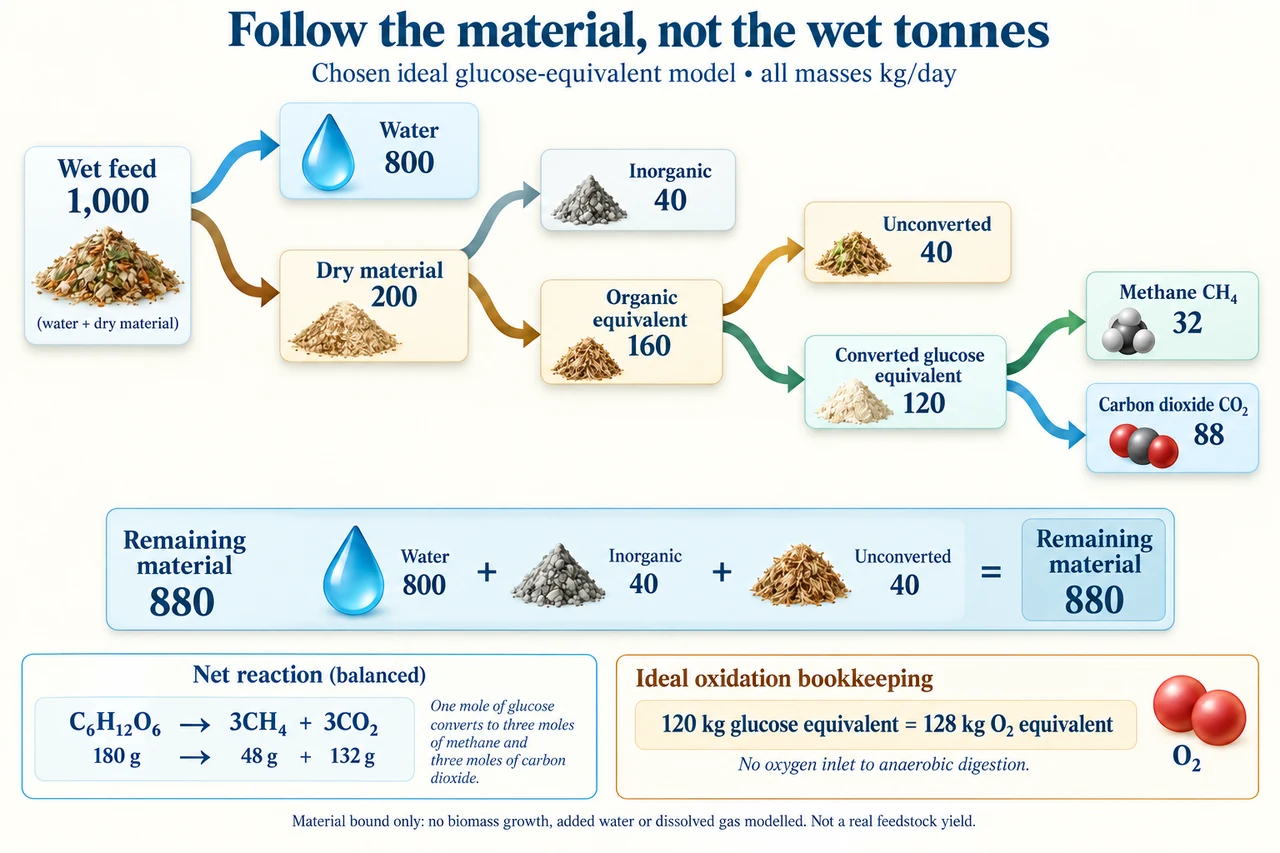
The chosen daily feed contains 200 kg dry material: 160 kg organic equivalent and 40 kg inorganic material. Convert 0.75 × 160 = 120 kg of glucose equivalent. Applying the balanced mass ratios gives 120 × 48/180 = 32 kg methane and 120 × 132/180 = 88 kg carbon dioxide per day. The remaining material is 800 kg water + 40 kg inorganic material + 40 kg unconverted organic equivalent = 880 kg/day. Thus 1,000 = 32 + 88 + 880 closes the selected overall material ledger. The converted glucose has 120 × 192/180 = 128 kg/day oxygen equivalent, matching 4 × 32 for the methane. This ideal chemical identity is not a laboratory COD removal result: actual biomass formation, soluble intermediate products, dissolved gas and added water have been excluded. Carbon, hydrogen and oxygen remain accounted for rather than being created by microbes.
Stoichiometry constrains an ideal endpoint, while a microbial system has rates, competing pathways and living biomass. A real organic mixture contains proteins, fats and differently degradable carbohydrates, not one glucose formula. Some substrate becomes cells or remains in intermediate products; feedstock chemistry and conditions can inhibit conversion. EPA's 2020 guide distinguishes indirect potential estimates from experimental methane-potential testing and notes that controlled laboratory results can overstate field performance. Do not label the chosen 75% conversion as a measured destruction efficiency or a universal biodegradable fraction. To apply the calculation to a real system, one would need representative feed and product measurements, credible elemental or chemical characterization, conversion evidence and a defined time window. A gas-volume comparison would additionally require consistent temperature, pressure, moisture and gas-composition treatment; it cannot silently be substituted for our product mass account.
Now dilute the invented feed: at 90% water, the same 1,000 kg/day supplies only 100 kg dry material. Retain the chosen 80% organic and 75% conversion assumptions. The converted glucose equivalent is 60 kg/day, giving 16 kg methane and 44 kg CO2. Doubling this dilute wet throughput to 2,000 kg/day restores the earlier 120 kg conversion and 32 kg theoretical methane, but that algebra does not establish unchanged real output. Choose a density of 1,000 kg/m³ and active volume of 20 m³ solely for the transfer exercise. Nominal hydraulic residence V/Q changes from 20 days at 1 m³/day to 10 days at 2 m³/day. Hydraulic residence describes liquid throughput; solids and organisms can have different retention depending on configuration. The two selected residence values are not performance or safety thresholds, and a material balance alone cannot decide whether microbial populations or conversion remain stable.
A credible comparison checks what is measured and what is inferred. Wet mass, dry material, an operational volatile-solids indicator, COD, methane mass and useful electrical service are distinct quantities with distinct uncertainties. A concentration decrease can arise from dilution without the same decrease in total daily load: concentration must be paired with representative flow and a common boundary. Compare time-matched influent, effluent and gas evidence, document sampling and calibrations, and state whether losses, dissolved products and accumulation are included. This is an evidence requirement, not a laboratory or plant operating recipe. Doubling dilute feed can add transport, pumping and residue-management burdens even when a chosen stoichiometric substrate amount is unchanged. Local water quality, nutrient handling, odour and affected users deserve their own evidence rather than being treated as automatically resolved by gas production.
Read the plate from each parent to its own children: wet feed separates into water and dry material; only the dry branch separates into inorganic material and organic equivalent; only the selected converted organic branch yields the two gases. Water, inorganic material and unconverted organic material contribute to the 880 kg remaining account. The independent COD card is a chemical-equivalent comparison, not an oxygen pipe into the biological process. When asked whether doubling dilute feed is a good design revision, a justified answer preserves the same theoretical material potential but requests kinetics, solids-retention, equipment, water and community evidence before endorsing it. Waste prevention may be preferable to creating additional feed for an attractive gas-output statistic. The diagram is a bounded educational model, not a construction drawing or a guarantee of digestate quality. Image: illustration, not a documentary photograph.
Worked example: Using the declared 1,000 kg/day glucose-equivalent surrogate, derive both gas masses, the remaining material and the oxygen-equivalent identity. Then test the claim that 50% methane in these two product gases means 50% of their mass.
Dry material: 200 kg/day; organic equivalent: 160 kg/day; converted: 0.75 × 160 = 120 kg/day. Keep water 800, inorganic material 40 and unconverted organic equivalent 40 separately.
Nominal balanced reaction: 180 g glucose → 48 g CH4 + 132 g CO2. Thus 120 × 48/180 = 32 kg CH4/day and 120 × 132/180 = 88 kg CO2/day.
Remaining material: 800 + 40 + 40 = 880 kg/day; total: 32 + 88 + 880 = 1,000 kg/day. Ideal oxidation equivalent: 120 × 192/180 = 128 kg O2-equivalent/day = 4 × 32. No oxygen inlet is implied.
There are 3 moles of each gas, so methane mole fraction is 3/6 = 50%; mass fraction is 48/(48 + 132) = 26.667%. Different molecular masses invalidate the 50%-mass claim.
Answer: The ideal model gives 32 kg methane, 88 kg CO2 and 880 kg remaining material per day, with 128 kg/day oxygen-equivalent bookkeeping. Its 50% dry two-gas mole fraction is 26.667% methane by product-gas mass. Neither is a measured real-biogas composition or guaranteed yield.
Check your understanding: The feed becomes 90% water. An adviser doubles wet throughput to recover the same gas output. Use the chosen density 1,000 kg/m³ and 20 m³ volume to evaluate this advice, identifying what the arithmetic can and cannot establish.
Answer: At 1,000 kg/day, 100 kg dry material × 0.8 organic × 0.75 conversion gives 60 kg glucose equivalent → 16 kg CH4 + 44 kg CO2. At 2,000 kg/day the original 120 kg conversion and 32 kg CH4 potential return under the same stipulated chemistry. Flow doubles from 1 to 2 m³/day, so nominal V/Q halves from 20 to 10 days. That does not prove unchanged conversion: kinetics and solids retention depend on configuration and evidence. Reject a universal failure threshold, request actual conversion/retention/flow/gas/auxiliary/digestate evidence, and weigh water and transport burdens. The advice preserves a theoretical material bound, not demonstrated gas service.
Why: The conversion proportion is stipulated for both material accounts; it is not a kinetic law. Extra water does not add carbon substrate, while increased volumetric flow can shorten hydraulic residence without establishing solids retention. The demanding step is to separate a stoichiometric equality from a causal performance forecast. A sufficient answer names the missing biological and hydraulic evidence, preserves all daily material balances, and evaluates water/transport/maintenance consequences rather than merely announcing 32 kg methane. In practice, methane measurement and the fate of residual material must be time-matched and uncertainty-aware. Neither COD nor wet-feed mass supplies that evidence on its own.