Weather, stored heat and the evidence behind a transmission limit
By How things work · myAudience
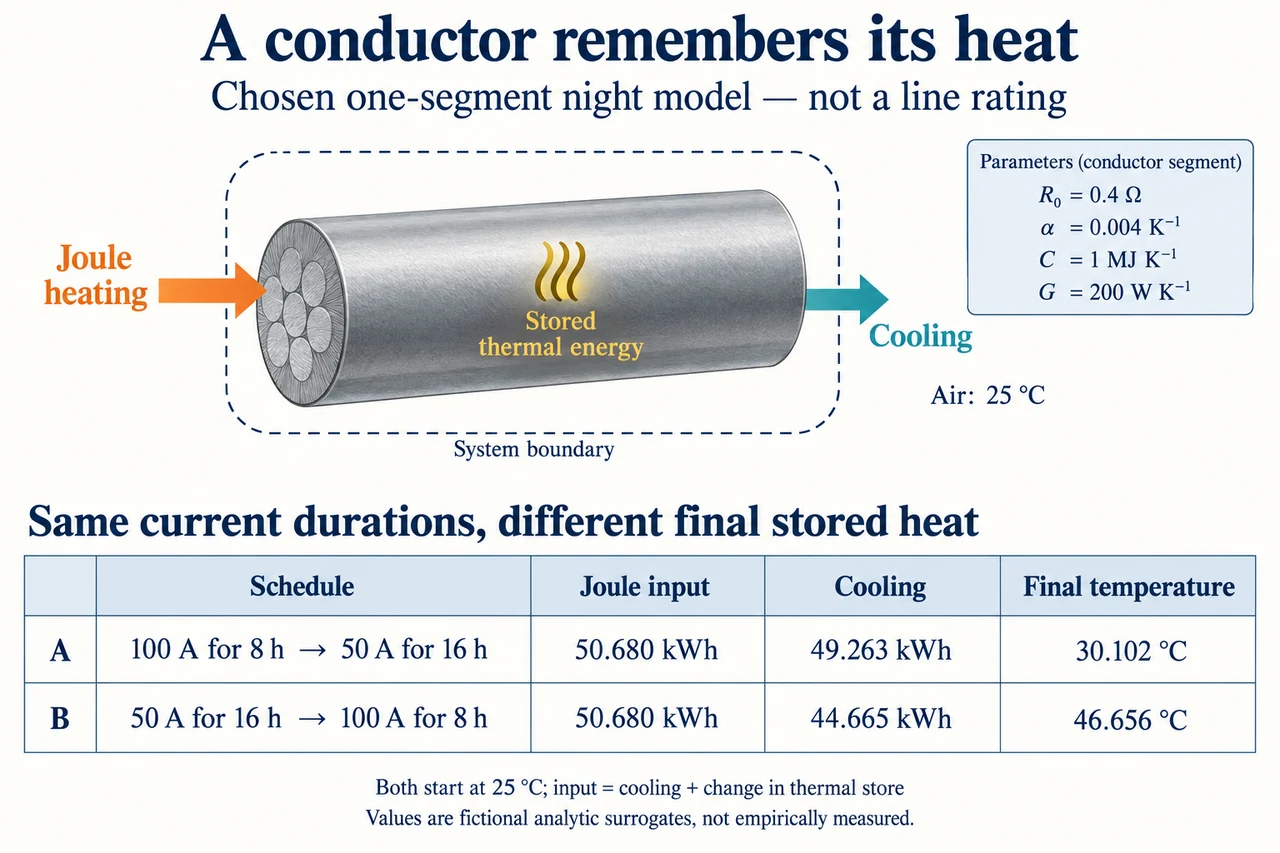
Image: illustration, not a documentary photograph. · Operator-authored generated illustration; scientific model reviewed separately.
Weather, stored heat and the evidence behind a transmission limit
Current heats a conductor, but current alone does not determine its temperature. The surrounding air, wind, radiation and sunlight influence how fast heat enters and leaves; the conductor also stores thermal energy. A change in current therefore does not ordinarily produce an instantaneous jump to a new steady temperature. Our plate isolates one conductor segment and follows the thermal energy remaining inside it. This is separate from the previous lesson's three-phase total electrical account. Real overhead-line ratings also depend on mechanical clearance, materials and other network constraints. A diagram that equates a calculated temperature with a universal safe current would hide those boundaries. Here the goal is to explain heat balance and the quality of evidence, not to issue a rating.
Declare an original night surrogate with no solar input and fixed ambient air at 25 °C. Let theta be conductor temperature rise above that ambient, measured in kelvins. Choose resistance R(theta) = 0.4(1 + 0.004theta) ohm for the whole selected segment, heat capacity C = 1,000,000 J/K, and linear cooling conductance G = 200 W/K. These numbers are fictional, not calibrated to a real span or extracted from the source report. Impose a constant RMS current during each stated interval. A positive theta gives outward cooling Gtheta, while I²R(theta) transfers electrical energy into heating. The chosen alpha is a resistance-temperature coefficient, not surface emissivity. The linear cooling term replaces several real heat-transfer mechanisms for this bounded mathematical exercise.
Conservation gives C dtheta/dt = I²R₀(1 + alpha × theta) − Gtheta. Collecting terms defines H = G − I²R₀alpha and yields C dtheta/dt = I²R₀ − Htheta. For the chosen positive-H cases, the steady rise is theta_ss = I²R₀/H and time constant tau = C/H. From an initial rise theta₀, the exact interval solution is theta(t) = theta_ss + (theta₀ − theta_ss)exp(−t/tau). At 100 A, H = 184 W/K, steady rise is 21.739130 K and tau is 5,434.782609 s. At 50 A, H = 196 W/K, steady rise is 5.102041 K and tau is 5,102.040816 s. These are consequences of the chosen coefficients. Positive H here does not prove that a real line is safe, and a failure of this linear equation outside its selected domain is not a real operating threshold.
Start at ambient and apply 100 A for eight hours, then 50 A for sixteen hours. The first interval ends at a rise of 21.630531 K, so the next interval must start from that warm state rather than reset to ambient. The final rise is 5.102247 K, corresponding to 30.102247 °C. To account for energy, integrate the rise: integral(theta dt) = theta_ss t + (theta₀ − theta_ss)tau[1 − exp(−t/tau)]. Joule input is I²R₀[t + alpha integral(theta dt)], and cooling is G integral(theta dt). First-interval input 34.260132 kWh equals cooling 28.251651 plus store gain 6.008481. In the second interval input 16.420228 equals cooling 21.011418 plus a negative store change −4.591190 kWh. Cooling can exceed contemporaneous input because previously stored heat is leaving.
Reverse the same durations: 50 A for sixteen hours followed by 100 A for eight hours. The final temperature is now 46.656018 °C rather than 30.102247 °C. Total cooling is 44.664800 kWh rather than 49.263070 kWh. Surprisingly, the total Joule input in both chosen profiles is 50.680360 kWh. For the first order the remaining thermal store is 1.417291 kWh, closing 50.680360 = 49.263070 + 1.417291. For the reversed order it is 6.015561 kWh, closing 50.680360 = 44.664800 + 6.015561. Equal current durations do not justify guessing equal endpoint temperature, nor does a changed temperature imply that every integrated quantity must change. This particular equality is demonstrated by the exact interval accounts; it is not asserted as a law for arbitrary weather, resistance models or schedules.
For an evidence-sensitivity transfer, apply 100 A for one hour from ambient. With G = 200 W/K the rise is 10.530166 K, so temperature is 35.530166 °C. If the chosen cooling conductance is halved to 100 W/K, the rise becomes 12.426553 K, giving 37.426553 °C. Its steady rise would be 47.619048 K, but that is not the one-hour observation. The first case has 4.093474 kWh Joule input, 1.168428 cooling and 2.925046 store gain; the reduced-cooling case has 4.104415 input, 0.652595 cooling and 3.451820 store gain. Slightly increased input reflects higher temperature-dependent resistance. A sensor reading of air temperature alone cannot identify the cooling coefficient or establish conductor temperature without further evidence.
The DOE-hosted NYPA report is a dated 2013 study, not a current operating standard. Its heat-balance discussion separates Ohmic and solar inputs, convection and radiation outputs, and transient storage; it also explains that inaccurate wind information can undermine monitoring estimates. A November 2025 DOE overview describes weather-informed line-rating work, but its project-specific capacity gains are not a guarantee for every route. Real wind speed and direction vary along conductors, clouds alter solar absorption, and surface conditions change radiative behaviour. A monitor at one convenient point may miss a more constrained location. Our night model excludes sunlight and nonlinear radiation, keeps ambient fixed and substitutes one cooling coefficient. It cannot establish mechanical sag, clearance or the thermal condition of an entire network.
A justified planning choice therefore needs more than a curve labelled dynamic. Compare the reliability and coverage of weather measurements, independent validation of the model, communication failures and a conservative fallback with alternatives such as reinforcement or managing demand. Distinguish energy lost, energy temporarily stored, temperature exposure and useful electrical service: they answer different questions. Our reversed schedules demonstrate that identical Joule input can coexist with different final thermal states, so an annual loss total alone cannot describe inspection or maintenance needs. Equally, a high endpoint in this fictional surrogate is not evidence of damage to real equipment. Access, costs and route impacts should be discussed with affected communities using actual location-specific evidence. The plate makes its chosen boundary and time order visible so a learner can challenge assumptions instead of mistaking an attractive illustration for a certified operating instruction. Image: illustration, not a documentary photograph.
Worked example: Trace both stated 24-hour schedules from 25 °C. Reconcile equal Joule totals with different final thermal stores and cooling, then evaluate the reduced-cooling one-hour transfer.
For each interval find H = G − I²R₀alpha, tau = C/H and the steady rise I²R₀/H. Carry the ending rise into the next interval. The order 100 A for 8 h then 50 A for 16 h ends at 30.102247 °C; the reverse ends at 46.656018 °C. Resetting each interval to ambient would erase stored energy.
Integrate the temperature rise analytically. In the first order, the first block has 34.260132 kWh Joule input − 28.251651 cooling = 6.008481 store gain. The second has 16.420228 − 21.011418 = −4.591190 kWh store change. Over the day, 50.680360 − 49.263070 = 1.417291 kWh remains stored. Negative store change represents heat leaving, not negative heat capacity.
Reversing the blocks gives first-block 16.297608 − 14.880392 = 1.417216 kWh stored, then 34.382753 − 29.784408 = 4.598345 kWh additional stored energy. Total 50.680360 − 44.664800 = 6.015561 kWh remains. These chosen Joule totals coincide; no general invariance for different weather, parameters or schedules follows.
At 100 A for one hour from ambient, cooling conductance 200 W/K gives 35.530166 °C and the balance 4.093474 = 1.168428 + 2.925046 kWh. With conductance 100 W/K the temperature is 37.426553 °C and balance 4.104415 = 0.652595 + 3.451820 kWh. Its steady temperature 72.619048 °C is not the one-hour value. Neither number is a permissible rating.
Answer: Thermal history matters to endpoint temperature and stored energy, while integrated heating and cooling must each be calculated. The exact interval accounts agree with an independent numerical integration of the differential equation. That proves internal consistency of the chosen surrogate, not calibration, validation or safe operating limits for a real conductor.
Check your understanding: A learner claims cooling greater than Joule input violates conservation and equal current durations guarantee identical final temperature. Evaluate both claims with the chosen accounts.
Answer: In the second interval of the first schedule, 21.011418 kWh leaves by cooling while Joule input is 16.420228 kWh. Stored energy falls by 4.591190 kWh: 16.420228 = 21.011418 − 4.591190. Reversing durations gives a final 46.656018 rather than 30.102247 °C even though the chosen Joule totals match. Different final store balances different total cooling. This linear night surrogate does not certify a real line rating or a general equality for other schedules.
Why: Conservation applies to input, output and the change in stored energy together. Carrying initial temperature between intervals explains both larger cooling than concurrent input and the different endpoint states. Each result is conditional on the declared surrogate, not a calibrated real conductor.