Charge yield is not energy efficiency
By How things work · myAudience
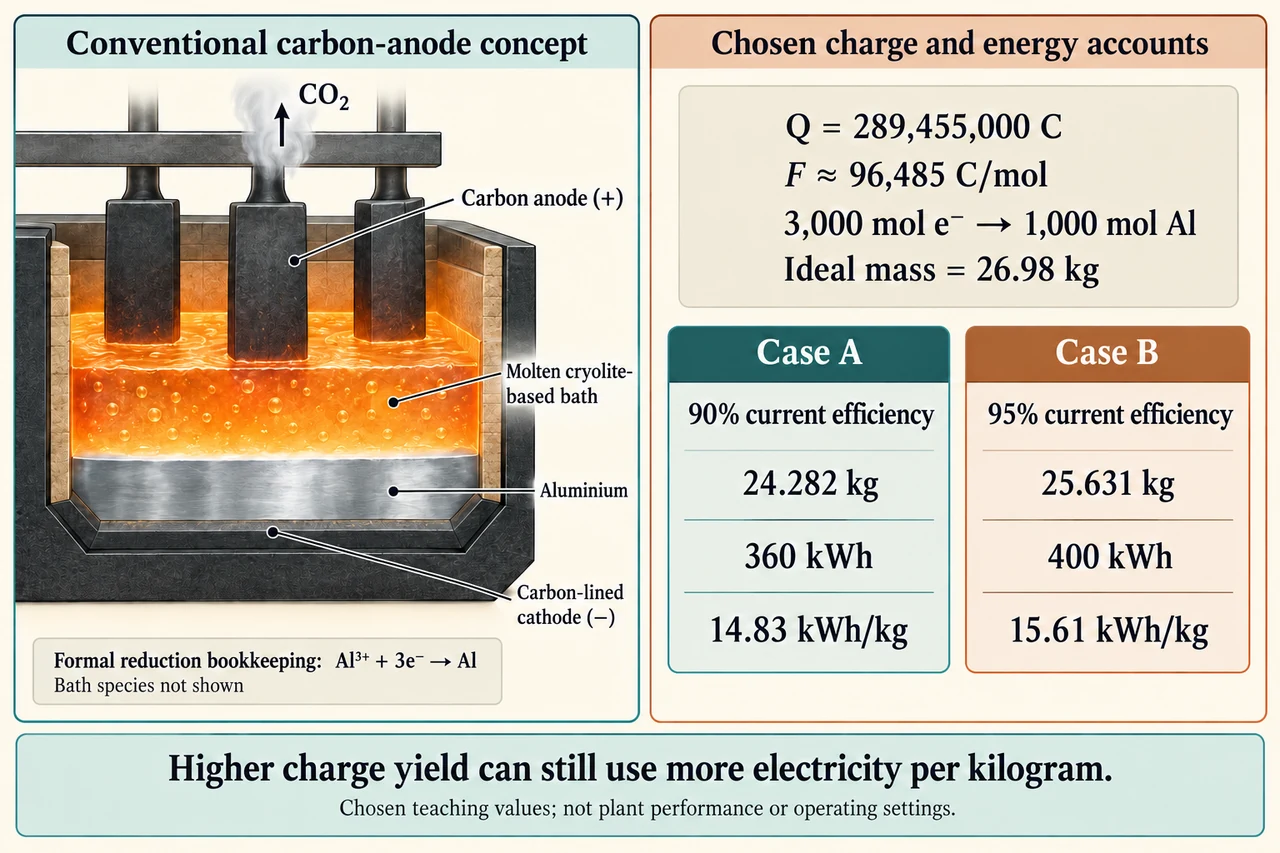
Image: illustration, not a documentary photograph. · Operator-authored generated illustration; scientific model reviewed separately.
Charge yield is not energy efficiency
Aluminium production contains several jobs with different inputs. Refining bauxite produces alumina; it does not yet produce aluminium metal. Conventional Hall–Héroult electrolysis then reduces aluminium-containing species in a molten cryolite-based bath. Start our accounting at the electrolysis stage: total electrical charge enters through an external circuit, electrical energy supplies the process, and recovered metal leaves. Mining, refining, electricity generation and subsequent fabrication sit outside this chosen boundary. That narrower account is useful for comparing charge yield, provided we do not quietly rename it a complete environmental assessment. The existing rock-to-metal illustration explains the overall sequence; the new plate separates its cell concept from a numerical ledger.
The ledger follows oxidation state rather than a complete chemical description of the bath. Formal reduction bookkeeping is Al³⁺ + 3e⁻ → Al: producing one mole of aluminium from aluminium in oxidation state +3 requires three moles of electrons. Actual dissolved species in the industrial electrolyte are more complicated than isolated aqueous Al³⁺ ions. Faraday's constant converts charge to amount of electrons. With charge Q in coulombs and F in coulombs per mole, Q/F has units of moles of electrons. Dividing by three and multiplying by aluminium's molar mass gives ideal metal mass. We explicitly round F to 96,485 C/mol and choose M = 26.98 g/mol; keeping gram and kilogram conversion visible prevents a thousandfold mistake.
A conventional carbon anode also participates chemically. The plate shows carbon anodes above the bath, an aluminium layer below it, and the carbon-lined cathode, with electrode signs appropriate to an electrolytic cell. Its CO₂ arrow belongs at the carbon anode; this is not an inert-anode model producing oxygen gas. A simplified overall atom balance is 2Al₂O₃ + 3C → 4Al + 3CO₂. Both sides contain four aluminium atoms, six oxygen atoms and three carbon atoms. This balanced reaction explains why changing the electricity source alone does not remove the conventional carbon-anode contribution. It is not a complete prediction of anode consumption or every gas: real process pathways, reactions and collection losses require separate evidence.
Define current efficiency η here as recovered aluminium mass divided by the mass predicted if all the supplied charge produced recoverable aluminium through the stated three-electron reduction. Our chosen 90% means m = 0.90 × m_ideal, not that 90% of electrical energy becomes useful chemical energy. Competing processes and changes in recoverable metal can affect this yield; the ratio by itself does not diagnose their cause. Nor does the unused charge automatically represent a matching percentage of heat. An energy-efficiency calculation would require a declared useful-energy numerator and relevant thermodynamic state data. The charge-based denominator and the energy-based denominator measure different quantities, even when both are described casually as efficiency.
Take a fictional batch with Q = 289,455,000 C. The rounded constant gives Q/F = 3,000 mol of electrons, hence 1,000 mol of ideal aluminium. Multiplying by 26.98 g/mol gives 26,980 g, or 26.98 kg. At the chosen 90% current efficiency, recovered mass is 24.282 kg. These are teaching totals, not a recommended current, voltage or production schedule. In the plate, the ideal ledger precedes the two case cards; it must not be read as a third actual output. If we independently choose 360 kWh of electrical input for Case A, specific electricity is 360/24.282 ≈ 14.83 kWh/kg. The word specific means per unit mass, not a specially certified operating condition.
Now compare Case B at the same total charge with a chosen 95% current efficiency and 400 kWh electrical input. Its output is 26.98 × 0.95 = 25.631 kg. More metal is recovered from the same charge, yet electricity per kilogram is 400/25.631 ≈ 15.61 kWh/kg, higher than Case A's 14.83. The model deliberately allows energy input and recovered fraction to change independently; it asserts no physical cause such as a hotter bath. Its counterexample is enough to refute the universal statement that improved current efficiency always reduces specific electricity. Before selecting a real option, ask whether output quality, electrical measurement boundaries, auxiliary loads and production intervals are comparable. The two cards show those declared values, not a measured plant trial.
Measurement bounds provide a different kind of caution. Suppose, solely for a second fictional calculation, the reported metal mass has a ±0.5% bound and charge has a ±1% bound. Hold the rounded constants fixed. Since η is proportional to mass divided by charge, its lowest permitted value uses the lower mass and higher charge: 0.90 × 0.995/1.01 ≈ 0.8866. Its highest uses 0.90 × 1.005/0.99 ≈ 0.9136. Thus the chosen bounds permit approximately 88.66–91.36%, not a statistically established confidence interval. Adding the percentages without regard to numerator and denominator would miss the exact calculation. This range also cannot distinguish measurement error from a particular metallurgical loss mechanism; that needs observations designed around competing explanations.
A process choice must survive more than one favourable ratio. Carbon-anode consumption, bath and lining condition, interruption risk and product quality create material and maintenance questions, but this conceptual lesson does not supply repair instructions or acceptable equipment limits. Environmental decisions also involve electricity generation, mining/refining residues and the distribution of costs to workers and neighbouring communities. A well-supported comparison would disclose output quality, energy and material boundaries, uncertainty, and independently checked maintenance and exposure evidence. Someone may reasonably favour lower electricity per kilogram, another may prioritise reliable supply or a lower process-emission pathway; either must explain the trade-off and what evidence could change the decision. Neither the illustrated cell nor our chosen numbers certify a plant. Image: illustration, not a documentary photograph.
Worked example: A fictional aluminium electrolysis batch receives 289,455,000 C and 360 kWh. Use explicitly rounded F = 96,485 C/mol, M = 26.98 g/mol and a chosen 90% recovered-metal current efficiency. Derive ideal and recovered mass, specific electricity, and explain why the current-efficiency percentage cannot be used as energy efficiency.
Charge-to-amount conversion: n(e⁻) = Q/F = 289,455,000/96,485 = 3,000 mol. Units C/(C/mol) reduce to mol.
The formal Al(III) reduction requires three moles of electrons per mole of Al, so ideal n(Al) = 3,000/3 = 1,000 mol.
Ideal mass = 1,000 × 26.98 = 26,980 g = 26.98 kg. This is a charge-based prediction, not a third measured product stream.
Recovered mass = 0.90 × 26.98 = 24.282 kg. The remaining difference from the ideal prediction is not an identified physical residue or a known heat percentage.
Specific electrical input = 360 kWh/24.282 kg = 14.8257969 kWh/kg, or 14.83 kWh/kg to two decimal places. Electrical input alone is not a complete lifecycle account.
Compare only like boundaries: η is recovered mass divided by charge-predicted mass. Energy efficiency would instead need a specified useful-energy output and energy input, including relevant state information. Therefore η = 90% does not justify a 90% energy-efficiency label or 36 kWh heat-loss estimate.
Answer: Ideal aluminium is 26.98 kg; recovered aluminium is 24.282 kg; specific electrical input is about 14.83 kWh/kg. Current efficiency is a charge-to-recoverable-metal yield. Neither chemical-energy efficiency nor the source of the difference can be determined from the supplied data.
Check your understanding: At the SAME total charge, an alternative fictional batch has 95% current efficiency and 400 kWh electrical input. Compare its mass and electricity per kilogram with the original, then evaluate the claim “95% proves this option uses less energy and is environmentally better”. Include the separate ±0.5% mass/±1% charge bounds on the original yield.
Answer: Alternative mass = 0.95 × 26.98 = 25.631 kg. Specific electricity = 400/25.631 = 15.60610199 kWh/kg, approximately 15.61, versus 14.83 originally. Output rises by (0.95/0.90 − 1) × 100 ≈ 5.56%, while electricity per kilogram rises by ((400/360) × (0.90/0.95) − 1) × 100 ≈ 5.26%. Thus increased charge yield does not demonstrate lower specific electricity, still less complete environmental superiority. These chosen changes supply no causal account of why energy increased. Compare equal useful quality and declared electrical/auxiliary boundaries before attributing benefits. With the separate specified measurement bounds, original η_min = 0.90 × 0.995/1.01 ≈ 88.66% and η_max = 0.90 × 1.005/0.99 ≈ 91.36%. These are extreme-input bounds, not a probability distribution. A decision needs additional material, grid, process-emission and community evidence; a high charge-yield card cannot replace it.
Why: The transfer changes yield and input energy together while preserving the same charge. It requires correct electron stoichiometry, dimensional conversion, comparison of distinct denominators and a bounded decision rather than the memorised claim that higher efficiency is always better.