Recycling yield meets an alloy-quality constraint
By How things work · myAudience
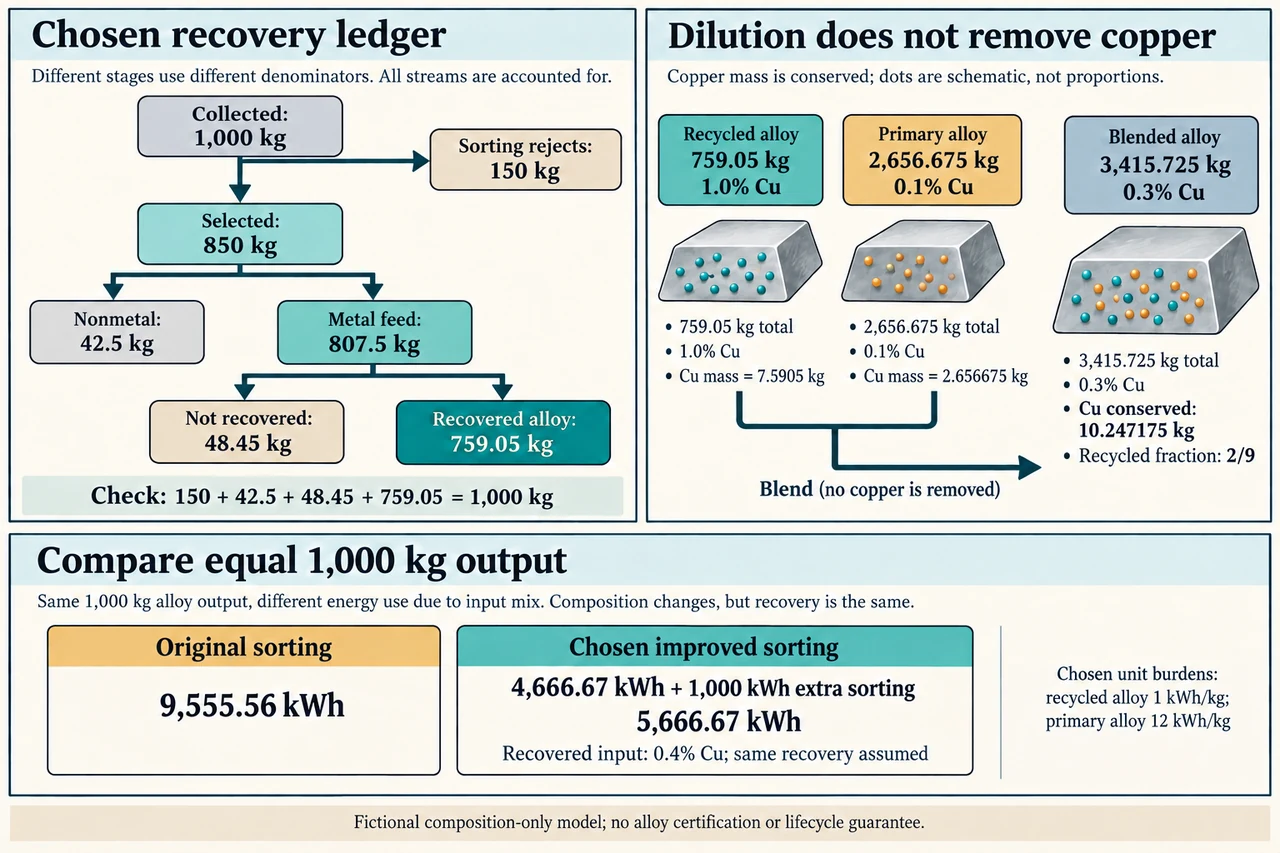
Image: illustration, not a documentary photograph. · Operator-authored generated illustration; scientific model reviewed separately.
Recycling yield meets an alloy-quality constraint
A recycling system must specify what it is trying to deliver. A kilogram collected at a household is not necessarily a kilogram of recovered alloy, and recovered alloy is not automatically suitable for every new product. Composition matters alongside collection and recovery. Our fictional comparison follows collected scrap into recovered alloy, then blends that alloy with a lower-copper primary alloy to reach a chosen copper fraction. It teaches mass conservation and denominator choice, not a certified industrial grade. The broad introductory plate shows why remelting is a different route from ore extraction; the new plate adds the quality constraint that determines how much recovered material can enter the chosen final output.
Begin with 1,000 kg collected. Sorting sends 150 kg to a separate rejected stream, leaving 850 kg selected. Declare that selected stream to contain 95% metal-bearing alloy by mass, so it includes 807.5 kg metal and 42.5 kg nonmetal. A separately chosen 94% metal recovery yields 759.05 kg alloy and leaves 48.45 kg of metal outside the recovered output. The four terminal masses sum to 1,000 kg: 150 + 42.5 + 48.45 + 759.05. “Not recovered” does not mean physically annihilated; it may remain in a residue or another stream that needs investigation. We have assigned masses for bookkeeping without specifying actual dross chemistry, disposal routes or recoverability. The plate's arrows distinguish branches, preventing the selected 850 kg from being counted twice.
Copper is an alloying element, not intrinsically an unwanted impurity in every aluminium application. The problem arises when the available composition exceeds a specified target for a particular output. Chemical sorting can retain useful distinctions between streams; simple melting does not make every elemental composition reset to pure aluminium. The 2023 commissioned melt-purification review describes limits to interchangeability and different refining or dilution approaches. That supports a bounded lesson about constraints, not the claim that copper can never be removed by any technology. Our calculation chooses dilution and does not model purification. It also checks only copper content: strength, corrosion, other elements, manufacturing history and product-service performance remain separate requirements.
Let recovered alloy mass be m_r with copper fraction c_r and added primary-alloy mass be m_p with fraction c_p. A target fraction c_t gives c_r m_r + c_p m_p = c_t(m_r + m_p), because incoming copper remains in the mixture. Rearranging yields m_p = m_r(c_r − c_t)/(c_t − c_p). Fractions must use one basis: 1.0% becomes 0.010, not 1.0 in the equation. A physically useful positive result requires the target to lie between the two input fractions. If both inputs exceed the target, adding them cannot reach it. This mathematical feasibility check is valuable before accepting a calculator output; it still says nothing about certified mechanical performance.
Choose recovered c_r = 0.010, primary c_p = 0.001 and target c_t = 0.003. Using all 759.05 kg recovered alloy requires 759.05 × (0.010 − 0.003)/(0.003 − 0.001) = 2,656.675 kg primary alloy. Final mass is 3,415.725 kg. Copper arrives as 7.5905 kg in the recovered input and 2.656675 kg in the primary input, giving 10.247175 kg; dividing by final mass gives exactly 0.003 in this chosen arithmetic. Nothing removed the recovered copper: dilution increased total mass. The final recycled fraction is 759.05/3,415.725 = 2/9, about 22.22%, despite the earlier 94% metal-recovery ratio. Their denominators answer different questions. The plate keeps incoming ingots and final mixture separate to make that distinction visible.
For a second account, choose process-input burdens of 1 kWh per kilogram of recovered alloy and 12 kWh per kilogram of primary alloy. These are fictional unit burdens, not measured plant or global industry values. Our full mixed output then carries 759.05 + 12 × 2,656.675 = 32,639.15 kWh. An equal-mass all-primary comparator carries 12 × 3,415.725 = 40,988.7 kWh. The chosen reduction is 8,349.55 kWh, or 11/54 ≈ 20.37%, rather than a universal 95% claim. Assume for this limited calculation that the comparator can be adjusted to the same target composition without further mass or energy burden. Complete functional equivalence is still unverified. Electricity generation, transport, sorting and other lifecycle burdens must not be silently included in these narrow process numbers.
Now change the recovered copper fraction to a chosen 0.004 while explicitly holding recovered mass at 759.05 kg. This imagined better separation does not establish that a real sorter maintains yield. Primary addition becomes 379.525 kg and output 1,138.575 kg; process input is 759.05 + 12 × 379.525 = 5,313.35 kWh. Comparing this smaller batch directly with the former 32,639.15 kWh would confuse less output with better performance. Normalize both to 1,000 kg final output under the declared linear unit-burden model: original 9,555.56 kWh, improved 4,666.67 kWh. Add a chosen extra sorting burden of 1,000 kWh per 1,000 kg final output, producing 5,666.67 kWh for the improved option. These are the equal-output cards in the illustration, not a forecast of a sorting installation.
The conditional energy preference can reverse if improved sorting rejects more metal, supplies too little suitable material, consumes more energy than assumed or produces a product with a shorter useful life. A limited-demand case also leaves inventory: using the original high-copper pool for only 1,000 kg target output needs 222.222 kg recycled alloy and 777.778 kg primary alloy, leaving about 536.828 kg of recovered pool for another use. That stock is not a new processing loss. Allocate its upstream burden transparently; charging it fully to this product and again to a later one double-counts energy. Fair comparison includes sorting work, safe residue management, access to collection and burdens on mining communities. Explain which evidence supports a choice and what would reverse it rather than treating collection tonnage as sufficient proof. Image: illustration, not a documentary photograph.
Worked example: A fictional 1,000 kg collection loses 150 kg to sorting rejects; the remaining stream is 95% metal-bearing alloy and metal recovery is 94%. Recovered alloy contains 1.0% Cu, primary alloy 0.1%, and the fictional target is 0.3%. Use all recovered alloy. Find mass routes, required primary addition, final copper/recycled fractions, and compare chosen process energy with an equal-mass all-primary output at declared burdens 1 and 12 kWh/kg. Assume composition adjustment of the comparator has no extra burden; no mechanical equivalence is certified.
Selected stream = 1,000 − 150 = 850 kg. Metal feed = 0.95 × 850 = 807.5 kg; nonmetal = 42.5 kg. Recovered alloy = 0.94 × 807.5 = 759.05 kg; metal outside recovered output = 48.45 kg. Four terminal routes sum to 1,000 kg.
Conserve Cu: 0.010 × 759.05 + 0.001m_p = 0.003(759.05 + m_p). Rearranging gives m_p = 759.05 × 0.007/0.002 = 2,656.675 kg. Fractions are mass fractions; target lies between the inputs.
Output = 759.05 + 2,656.675 = 3,415.725 kg. Cu = 7.5905 + 2.656675 = 10.247175 kg; 10.247175/3,415.725 = 0.003. Dilution changes concentration, not the copper mass from the recovered input.
Final recycled mass fraction = 759.05/3,415.725 = 2/9 ≈ 22.22%. Earlier 94% metal recovery used 807.5 kg metal feed as its denominator; these are different measures.
Chosen mixed process energy = 759.05 × 1 + 2,656.675 × 12 = 32,639.15 kWh. Equal-mass primary comparator = 3,415.725 × 12 = 40,988.7 kWh; chosen saving = 8,349.55 kWh = 11/54 ≈ 20.37%.
Normalize output if demand differs: mixed energy per kilogram = 86/9 ≈ 9.55556 kWh/kg. This does not include the complete lifecycle or establish equivalent durability, strength or corrosion behaviour; those need separate measurements and an explicit comparator.
Answer: 759.05 kg alloy is recovered; using all of it requires 2,656.675 kg primary alloy. Final 3,415.725 kg contains 0.3% Cu and about 22.22% recycled material. With the chosen narrow unit burdens, equal-mass energy saving is about 20.37%; this is neither a global recycling statistic nor full lifecycle proof.
Check your understanding: A fictional improved sorter supplies the SAME 759.05 kg recovered alloy at 0.4% Cu. Retain primary 0.1% and target 0.3%. Find addition, output and process energy, compare both options per 1,000 kg output, and include 1,000 kWh extra sorting burden per 1,000 kg final output. Explain the changed assumptions that could reverse the preference. Also account for unused recovered stock if original-sorting demand is only 1,000 kg.
Answer: Improved primary addition = 759.05 × (0.004 − 0.003)/(0.003 − 0.001) = 379.525 kg; final output = 1,138.575 kg. Copper is conserved: 3.0362 + 0.379525 = 3.415725 kg = 0.003 × 1,138.575. Chosen process energy = 759.05 + 12 × 379.525 = 5,313.35 kWh, or 14/3 ≈ 4.66667 kWh/kg. Per equal 1,000 kg output, original = 9,555.56 kWh; improved = 4,666.67 + 1,000 = 5,666.67 kWh, a modeled reduction of 3,888.89 kWh. Same recovery and linear scale are deliberate assumptions, not proven sorter behaviour. Rejecting more metal, different electricity or transport burdens, limited scrap supply or unequal product life/performance could change the result; request matched measurements. If original demand is only 1,000 kg, the required recycled fraction 2/9 gives 222.222 kg recovered alloy and 777.778 kg primary; approximately 536.828 kg recovered stock remains. It is inventory, not destroyed mass. Unit-burden allocation must partition upstream energy consistently between used and unused stock; counting a whole batch now and again later would be double-counting.
Why: The transfer requires elemental conservation, fraction-versus-percent conversion, a feasible mixing target, equal functional output and explicit burden allocation. It also requires a conditional judgment supported by missing evidence, rather than equating high collection or recovery with an unrestricted environmental claim.