Temperature lift: an energy balance is not a performance guarantee
By How things work · myAudience
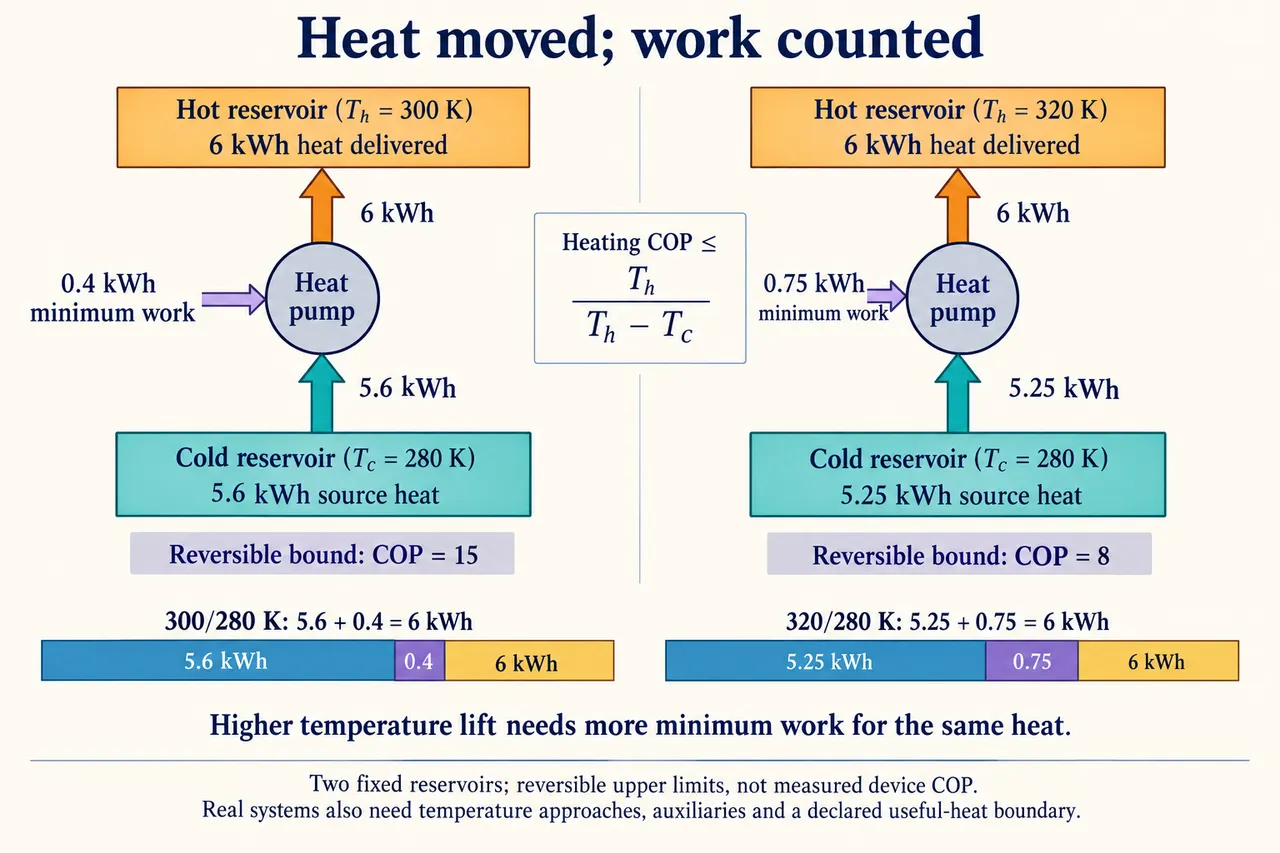
Original myAudience educational illustration. Image: illustration, not a documentary photograph. · myAudience educational illustration; no measured product performance or installation qualification is implied.
Temperature lift: an energy balance is not a performance guarantee
A heat pump answers a service question: how much useful heat reaches the place that needs it, and what inputs are required? The heat delivered can include energy transferred from a colder source as well as energy associated with electrical work. That is why a heating coefficient of performance can exceed one without energy appearing from nothing. Define the useful delivery point and observation period before calculating a ratio. A kilowatt is a rate, while a kilowatt-hour is an amount of energy. A building, refrigerant cycle and complete heating installation are different boundaries; a result measured for one must not be silently assigned to another.
In a vapour-compression heating system, an evaporator transfers source heat into refrigerant, compression raises pressure and requires work, a condenser releases heat to the destination, and expansion prepares the lower-pressure stage. A throttling device reduces pressure irreversibly; it is not a turbine providing useful work back to the compressor. Heat transfer needs suitable temperatures on either side of an exchanger, so the refrigerant and the air or water it contacts do not necessarily share one temperature. These are mechanism descriptions, not instructions for charging refrigerant or choosing operating pressures. The plate below is deliberately a reservoir-and-energy model, not a validated diagram of every commercial cycle.
Consider an ideal cyclic device exchanging heat only with two reservoirs at fixed absolute temperatures. Let Qh be heat delivered to the hot reservoir, Qc heat extracted from the cold reservoir, and W net work supplied to the cycle. Neglect changes in stored energy over a complete cycle. Conservation gives Qh = Qc + W. Heating COP is Qh/W at this cycle boundary. If the temperatures are Th and Tc, in kelvin, the total reservoir entropy change is Qh/Th minus Qc/Tc. A physically allowable complete cyclic process cannot make that total negative. This adds a performance restriction that the energy balance alone does not provide.
Rearrange the entropy inequality: Qc cannot exceed Qh × Tc/Th. With W = Qh − Qc, the least permitted work is Qh × (Th − Tc)/Th. Therefore heating COP cannot exceed Th/(Th − Tc). Equality is the reversible two-reservoir limit, which no ordinary installation should be presumed to achieve. The temperature difference may also be expressed in Celsius, but the absolute temperature in the numerator must be in kelvin. Using 27 divided by 20 instead of 300 divided by 20 would change the physical meaning. This upper limit is not a measured efficiency curve, a rated product claim or evidence that a particular heat pump meets a household demand.
Our original comparison supplies six kilowatt-hours to a 300 K hot reservoir from a 280 K cold reservoir. The reversible COP bound is 300/20 = 15, requiring at least 0.4 kWh of work and leaving 5.6 kWh supplied by the cold reservoir in the reversible case. Raise the hot reservoir to 320 K while keeping the source at 280 K and the delivered heat at 6 kWh. The bound becomes 320/40 = 8, minimum work becomes 0.75 kWh, and reversible source heat becomes 5.25 kWh. The lift doubles, but minimum work rises by a factor of 1.875 because the hot absolute temperature also changes. A real COP of three would instead require 2 kWh of work to deliver the six, with four supplied by the source in this simplified balance.
Reservoir temperatures must be distinguished from advertised outdoor and room temperatures. The source exchanger may need to operate colder than the surrounding source, and the destination exchanger hotter than the fluid or air receiving its heat. Finite approaches increase the lift seen by the actual cycle. Compression, throttling and other irreversible processes also prevent an unqualified reversible result. Fans, pumps and controls may add electricity that the narrowly defined cycle COP excludes. Their heat may reach the useful destination, the source or elsewhere; an installation account must state what happens rather than add an arbitrary auxiliary input while pretending every boundary is unchanged.
Lowering a required delivery temperature can reduce the thermodynamic lift, but that does not by itself guarantee comfortable rooms. A heat emitter must still deliver sufficient power under those conditions, and building demand varies with weather, ventilation and use. A high reversible bound supplies neither a compressor capacity nor a seasonal energy estimate. The 2024 national-laboratory study cited here investigated two selected systems under particular laboratory conditions; its stated limits exclude treating its results as an annual rating, a universal product comparison or a carbon-cost analysis. This lesson does not adopt a textbook’s broad claim that heat pumps become generally unusable below one outdoor temperature. Equipment, conditions and the evidence boundary matter.
The worked auxiliary example adds an auxiliary input to expose the difference between a cycle bound and a service ratio. If the six useful kilowatt-hours exclude any useful contribution from an added 0.2 kWh of fan or pump energy, even the reversible 300/280 K cycle needs at least 0.6 kWh of complete input. The ratio is then at most ten, before any other losses. If auxiliary heat joins the useful output, that numerator and boundary require a different account. Neither result proves a device achieves the reversible cycle. Image: illustration, not a documentary photograph. Its arrows and bars explain the fixed-reservoir model; no refrigerant settings, installation recommendation or household savings are inferred from them.
Worked example: Compare cyclic heating between fixed reservoirs: case A has Th = 300 K and Tc = 280 K; case B has Th = 320 K and Tc = 280 K. Each delivers 6 kWh. Derive reversible COP and minimum work; compare a stipulated real cycle COP of three. State what the model does not establish.
Define heat and work at the cyclic boundary. Qh = Qc + W assumes no net stored-energy change and no other heat exchange. The two reservoirs have fixed kelvin temperatures. Total reservoir entropy change Qh/Th − Qc/Tc must be nonnegative. Therefore Qc ≤ QhTc/Th and W ≥ Qh(Th − Tc)/Th. Heating COP ≤ Th/(Th − Tc), with equality only for the reversible limit.
For case A, the lift is 300 − 280 = 20 K. The COP upper bound is 300/20 = 15, and minimum work is 6/15 = 0.4 kWh. In the reversible balance, source heat is 6 − 0.4 = 5.6 kWh. This is an upper performance bound for the stipulated reservoirs, not evidence of an actual compressor’s capacity, electricity meter reading or seasonal result.
For case B, the lift is 320 − 280 = 40 K. COP is bounded by 320/40 = 8 and work by at least 6/8 = 0.75 kWh. Reversible source heat is 6 − 0.75 = 5.25 kWh. The same useful heat needs more minimum work. Although lift doubles, the minimum-work factor is 0.75/0.4 = 1.875 because the absolute hot temperature changes too.
If a real cycle is stipulated to have COP three while delivering 6 kWh, its input work is 6/3 = 2 kWh and its source contribution is 4 kWh in the same simplified energy balance. This is compatible with both reversible upper limits, but it has not been derived as a manufacturer’s specification. Actual cycle temperatures, irreversibilities and equipment limits require additional evidence.
For the transfer case, add a separately stipulated 0.2 kWh auxiliary input that contributes no heat to the six useful kilowatt-hours. Even the reversible case A then uses at least 0.4 + 0.2 = 0.6 kWh, so the complete service ratio is at most 6/0.6 = 10. This is a different denominator from the cycle COP of 15.
The conclusion is conditional. Finite temperature approaches and irreversible losses can lower achieved performance; an auxiliary heat contribution to useful delivery would change the numerator too. A reversible bound neither guarantees comfortable rooms nor establishes how much heat a device can supply per hour. Preserve absolute-temperature and meter boundaries before evaluating a proposed heating decision.
Answer: Case A reversible COP upper bound is 15, minimum work 0.4 kWh and reversible source heat 5.6 kWh. Case B gives eight, 0.75 kWh and 5.25 kWh. A stipulated real COP of three requires 2 kWh work and 4 kWh source heat for the same six useful kilowatt-hours. Including a non-useful 0.2 kWh auxiliary input limits case A’s complete service ratio to ten. These are conditional bounds and balances, not real equipment capacity or seasonal guarantees.
Check your understanding: A different two-reservoir cycle delivers 8 kWh between Th = 310 K and Tc = 275 K. A separate 0.25 kWh auxiliary input contributes no heat to the useful output. Derive the minimum cycle work and the largest possible complete useful-service ratio. Would either value guarantee actual heating capacity or achieved performance?
Answer: The reversible cycle COP bound is 310/35 = 62/7. Minimum work is 8 × 35/310 = 28/31 ≈ 0.903226 kWh; reversible source heat is 220/31 ≈ 7.096774 kWh. Complete input is at least 28/31 + 1/4 = 143/124 ≈ 1.153226 kWh. Useful service ratio is at most 8/(143/124) = 992/143 ≈ 6.937063. Irreversibility and finite temperature approaches can lower achieved performance. This upper limit supplies no heat-output capacity and guarantees neither actual COP nor sufficient room heating.
Why: Apply the entropy-derived bound to new absolute temperatures and a new useful-heat amount, then include the separately non-useful auxiliary input. The cycle COP and complete service ratio have different denominators; neither establishes power capacity.