Charge counts reactions, not a pile of electrons
By How things work · myAudience
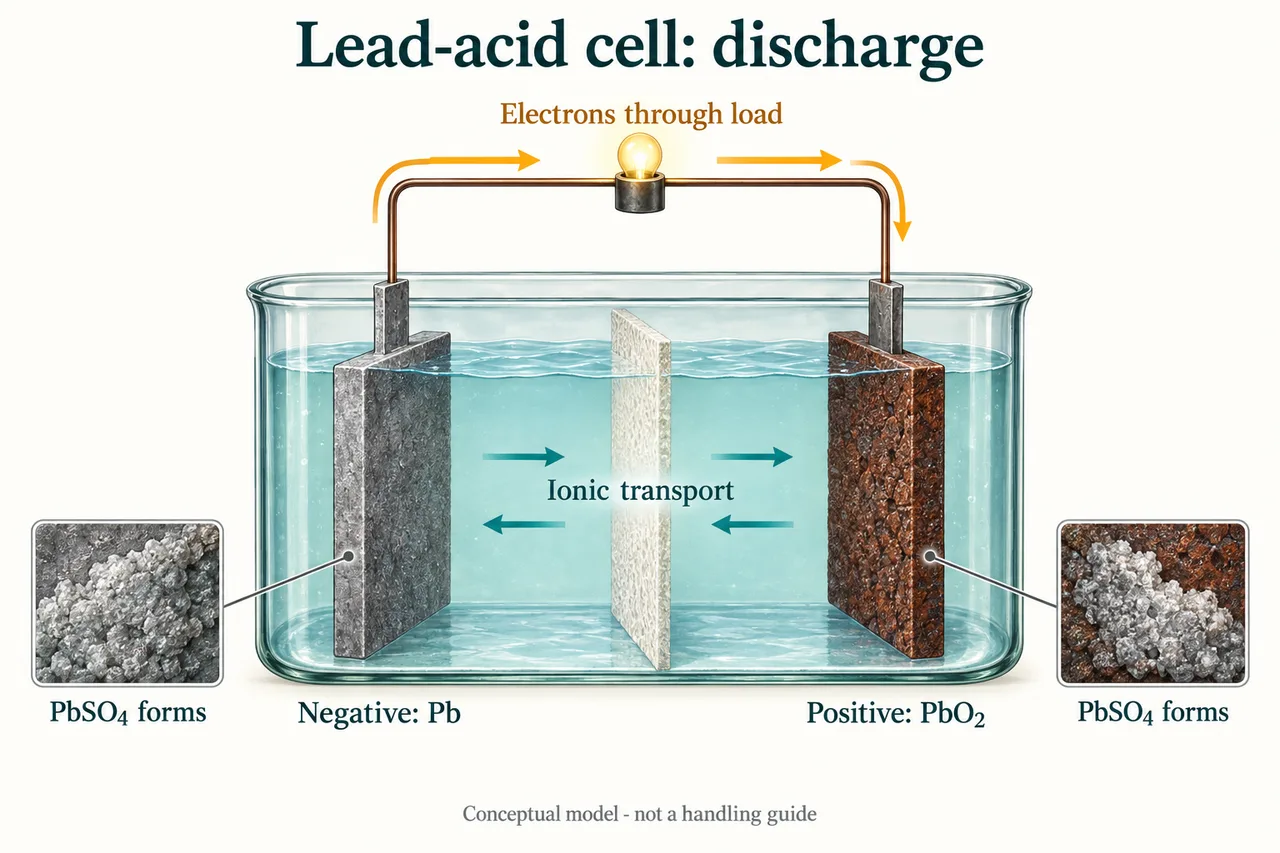
myAudience original rendered teaching illustration. Image: illustration, not a documentary photograph. One conceptual discharging cell separates external electron transfer from internal ionic transport; material insets show lead sulfate forming at both plates. · Operator-authored generated illustration; scientific model reviewed separately.
Charge counts reactions, not a pile of electrons
Imagine following an electric charge all the way back to the materials supplying it. A lead-acid cell is not a tank from which stored electrons are simply poured. During discharge, its two electrodes support complementary chemical changes, and the external circuit transfers electrons between them through a load. We will account for that transfer in moles of reaction, then check whether enough reactants remain. Our boundary is one ideal cell and its desired chemical reaction. It excludes self-discharge, gas-producing reactions, inaccessible material and a voltage cutoff. That makes the calculation an upper-bound chemical model, not a promise about a real battery.
Use electrode names carefully. In discharge, the negative lead electrode is oxidised: Pb + HSO4− → PbSO4 + H+ + 2e−. The positive lead-dioxide electrode is reduced: PbO2 + HSO4− + 3H+ + 2e− → PbSO4 + 2H2O. The first produces the two electrons that the second consumes; they are the same transferred electrons, not two independent charges to add. In these equations the negative electrode is the discharge anode and the positive is the discharge cathode. Under charging, the desired reaction reverses and the oxidation/reduction roles reverse. Using fixed negative/positive plate names avoids silently carrying discharge role labels into charging.
Add the half-reactions before counting quantities. Cancelling electrons and one H+ gives Pb + PbO2 + 2HSO4− + 2H+ → 2PbSO4 + 2H2O; the acid inventory can equivalently be written as two H2SO4 formula units. The resulting overall equation is Pb + PbO2 + 2H2SO4 → 2PbSO4 + 2H2O. This is bookkeeping for sulfuric-acid equivalents, not a claim that dissolved acid consists only of intact H2SO4 molecules. One mole of reaction consumes one mole of each electrode reactant and two moles of acid equivalents. It forms one mole of PbSO4 on each electrode and two moles of water. The atoms and net charge balance.
Let ξ, measured in moles, represent how far the overall discharge reaction proceeds. The transferred charge is Q = 2Fξ, because each mole of overall reaction transfers two moles of electrons. Use F = 96,485 C per mole of electrons as the declared rounded teaching constant. One ampere is one coulomb per second, so constant-current discharge gives Q = It when time is in seconds. Divide by 3,600 to express coulombs as ampere-hours. None of these operations requires voltage. Watt-hours, by contrast, require the terminal voltage over the discharge; adding an arbitrary nominal voltage would introduce a new assumption rather than follow from the chemical equation.
In our fictional ideal cell, initially accessible inventories are 0.080 mol Pb, 0.060 mol PbO2 and 0.100 mol acid equivalents. The permitted reaction extents are respectively 0.080, 0.060 and 0.100/2 = 0.050 mol. The smallest controls: acid limits the desired reaction to ξ = 0.050 mol, even though both plates contain unused reactant. That corresponds to 9,648.5 C, or about 2.68014 Ah. Adding more Pb alone would not raise this chemical ceiling. This limiting-reagent reasoning is more informative than saying a battery with more lead must always deliver more charge. Actual usable charge could still be smaller for limits excluded from the model.
Now discharge at 2.00 A for 0.750 h. The external circuit transfers 5,400 C, or 1.50 Ah, so ξ = 5,400/(2 × 96,485) ≈ 0.0279836 mol. The remaining inventories are about 0.0520164 mol Pb, 0.0320164 mol PbO2 and 0.0440328 mol acid equivalents. PbSO4 produced totals about 0.0559673 mol, split equally between the two plates; newly formed water is also about 0.0559673 mol. The positive electrode has not transferred an extra 5,400 C beyond the negative electrode. Both ends participate in the same circuit current. Doubling the charge because there are two plates would violate the electron accounting.
A series string exposes another tempting double count. If three identical ideal cells each undergo this discharge, the external string still transfers 1.50 Ah: the same current passes through each cell. Each cell nevertheless consumes its own reactants, so the string's acid consumption is three times the single-cell amount. Its electrical energy can exceed that of one cell because the string voltage is the sum of the cell voltages, not because ampere-hours are added. These are mathematical comparisons of identical model cells. They do not specify compatible components, a safe string or an installation method; real interconnections and protective controls require separate engineering evidence.
Finally, distinguish reaction reversibility from service recovery. An ideal reverse reaction of equal extent would restore these chemical inventories and reverse the external electron transfer. A real charge input need not all restore active material: other reactions and losses can occur, and some material may no longer be accessible. Measuring charge into a battery therefore does not establish equal recoverable charge or equal energy out. The model remains useful because it tells us what must balance if the desired reaction alone occurs, and shows exactly which observations would require a broader explanation. Treat images as conceptual teaching plates, never as permission to open, fill, rebuild or improvise charging of a lead-acid cell.
Worked example: Use the fictional inventories and 2.00 A for0.750 h profile above. Find transferred charge, reaction extent, remaining reactants and the chemical ceiling. Explain what changes for three identical cells in series.
Convert duration before using SI current:0.750 ×3,600=2,700 s. Thus Q=2.00 C/s ×2,700 s=5,400 C. Equivalently2.00A ×0.750 h=1.50 Ah. The two routes agree; using0.750 directly in Q=It with coulombs would miss a factor3,600.
Divide by F to count transferred electron moles:5,400/96,485≈0.05596725 mol. Then divide by the two electrons per overall reaction to obtain ξ≈0.02798362 mol. Do not multiply by two because two electrodes are shown: electron generation and consumption cancel when their reactions are combined.
Subtract ξ from each electrode inventory and2ξ from acid equivalents. The results are Pb≈0.05201638 mol, PbO2≈0.03201638 mol, acid≈0.04403275 mol. They are all nonnegative, so this extent passes the model's inventory constraints. Check those constraints before treating a requested discharge as feasible.
Count products:each electrode forms ξmol PbSO4, giving2ξ≈0.05596725 mol in total. Water formed is also2ξ. Equal numerical totals here follow from equation coefficients; they are different substances and are not interchangeable masses. Electron moles are charge bookkeeping, not a material deposited inside the electrolyte.
Compute the initial chemical ceiling from min(0.080,0.060,0.100/2)=0.050 mol. Multiply by2F:9,648.5 C; divide by3,600:2.6801389 Ah. Only about1.1801389 Ah of this ideal initial ceiling remains after1.50 Ah. This is not a manufacturer-rated remaining capacity or a guaranteed runtime.
For three identical series cells, keep external charge5,400 C and1.50 Ah. Multiply total material changes by three:acid consumption≈0.16790175 mol across the string. Energy cannot be calculated without voltage data. Series chemistry is repeated in separate cells; external current is shared along one path.
Answer: 1.50 Ah, ξ≈0.02798362 mol per cell, acid-limited initial ceiling≈2.68014 Ah; external string charge stays1.50 Ah while each cell's chemistry proceeds separately.
Check your understanding: A different fictional cell has0.040 mol Pb,0.090 mol PbO2 and0.160 mol acid equivalents. A learner requests3.00A for1.00 h and suggests doubling positive material to make it work. Is the discharge chemically possible, and would that change help?
Answer: Required Q=10,800 C and ξ≈0.05596725 mol. The available maximum is min(0.040,0.090,0.080)=0.040 mol, limited by negative Pb; maximum charge is7,718.8 C≈2.14411 Ah. The3.00 Ah request exceeds it and would give negative remaining Pb if accepted. More PbO2 does not change that minimum. The result rejects the request in the ideal model without inventing a voltage, recovery treatment or hardware modification.
Why: Locate the limiting reaction extent before converting to charge. This changed case shifts the bottleneck; a nonlimiting improvement cannot make the requested extent possible. Original invented inventories and access fractions do not diagnose a real cell or establish safe operation.