Why material present is not necessarily material usable
By How things work · myAudience
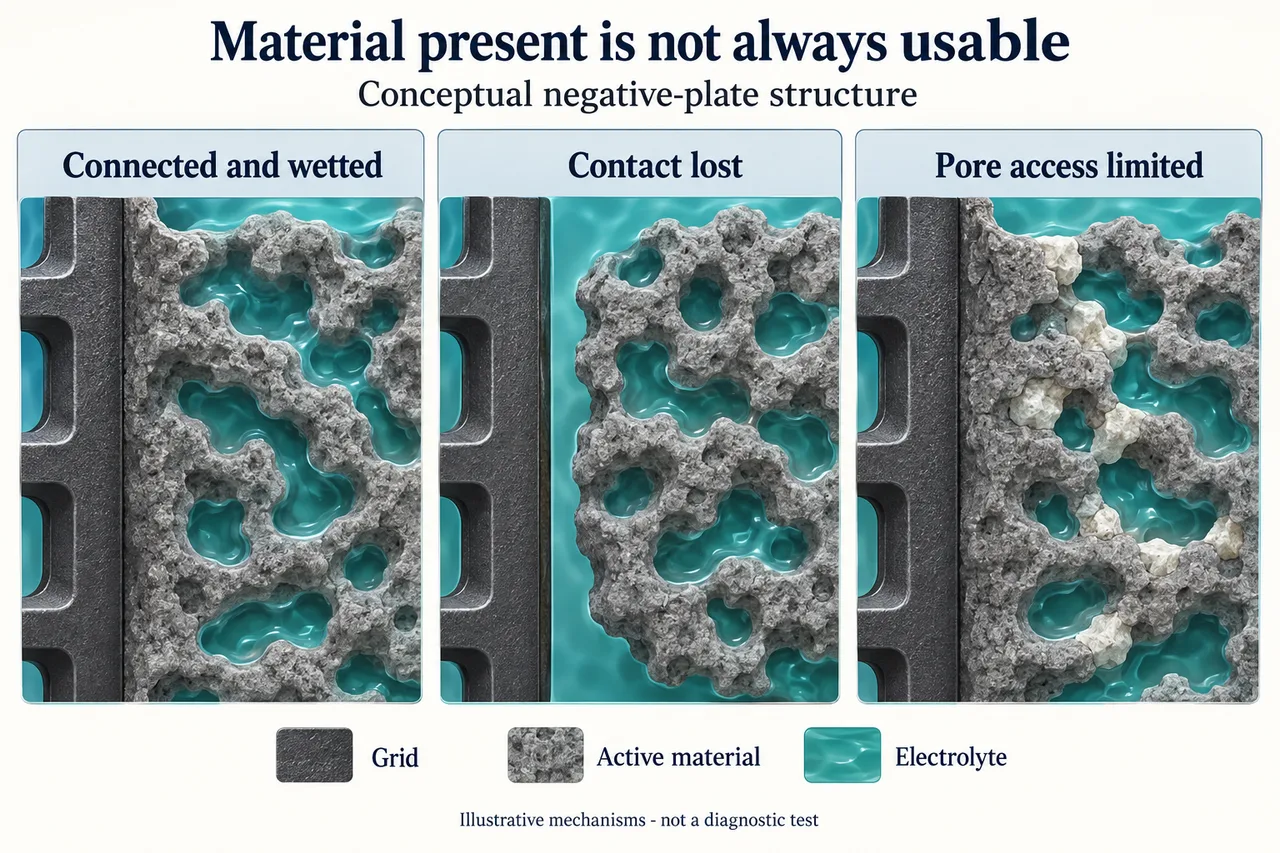
myAudience original rendered teaching illustration. Image: illustration, not a documentary photograph. Three conceptual negative-plate sections compare electrical connection and electrolyte access; they are separate possible mechanisms rather than a measured time sequence or diagnosis. · Operator-authored generated illustration; scientific model reviewed separately.
Why material present is not necessarily material usable
A chemical inventory calculation assumes that the counted reactants can participate. A real electrode has structure: active material needs an electronic connection to the current-collecting grid and ionic access through electrolyte. Material that remains physically inside a battery can fail one of those conditions. This is why an equation with the right atoms is necessary but insufficient to predict delivered capacity. We will examine a deliberately invented accessibility model, not fit a commercial battery or prescribe maintenance. It separates total stock from connected, reachable stock, then asks what a changed bottleneck would mean for an evidence-based comparison.
Picture a porous negative plate supported by a conductive grid. An electronically isolated patch cannot contribute normally through the external circuit even if electrolyte touches it. Conversely, material still connected to the grid may be poorly served by electrolyte pathways. The illustration distinguishes those mechanisms rather than labelling every pale crystal a permanent defect. Lead sulfate is an ordinary discharge product as well as part of some degradation processes. Its mere presence cannot diagnose harmful sulfation. A useful explanation needs the operating history, material morphology and evidence of impaired reaction or contact, rather than a before/after picture in which all sulfate is called damage.
The archived DOE primer describes coarse sulfate development and loss of active-material connectivity during prolonged storage or excessive discharge. Use this as historical background for a possible capacity-loss mechanism, not a modern universal recovery guarantee. Other processes, including loss of electrolyte access or mechanical separation, can also constrain service. A lower output observed once does not identify its cause. Higher current or changed temperature can alter the capacity measured to a voltage endpoint without proving permanent material loss. A valid comparison therefore specifies current profile, temperature, initial charge state and cutoff consistently, then separates the measured result from an explanation that still needs evidence.
Define our toy accessibility factors as assumptions, not percentages that any real chemistry must obey. The fictional cell contains0.300 mol Pb,0.400 mol PbO2 and0.800 mol acid equivalents. We assume0.80 of Pb,0.95 of PbO2 and0.90 of acid inventory are effectively accessible during the stated comparison. That gives0.240 mol negative reactant,0.380 mol positive reactant and0.720 mol acid. The allowed extent is min(0.240,0.380,0.720/2)=0.240 mol. Its ideal charge ceiling is about12.8647 Ah. Total inventories alone would instead give min(0.300,0.400,0.400)=0.300 mol, or16.0808 Ah. The difference is caused by the invented accessibility assumptions, not validated failure-rate data.
The required fictional service now corresponds to 0.250 mol reaction, about13.4007 Ah. The initial toy cell fails because negative access permits only0.240 mol. Compare two hypothetical model changes independently. Improving positive accessibility from0.95 to 1.00raises availablePbO2from0.380 to 0.400 mol but leaves the0.240 mol negative bottleneck untouched. Improving negative accessibility from0.80 to 0.90instead raises availablePbto 0.270 mol; the new minimum is0.270 mol, so the0.250 molrequirement passes the chemical account. Neither comparison authorises a treatment or guarantees terminal voltage, temperature or durability. It shows why fixing a nonlimiting part need not improve the stated performance constraint.
Passing the account is not the same as diagnosing a battery. Suppose two fictional tests, at the same stated temperature and endpoint, deliver2.0Afor5.0 h and5.0Afor1.6 h. Those results are10.0 Ah and8.0 Ah; a20percent smaller measured charge in the faster test does not establish20percent permanent loss. If another correctly matched low-rate comparison later returns10.0 Ah, the original observation alone cannot show an irreversible decrease. If it returns8.0 Ah, a persistent difference merits investigation, but sulfation is still one candidate rather than a confirmed diagnosis. The conceptual accessibility factors must not be fitted casually to either result and presented as measured microscopic fractions.
Construction changes what monitoring and maintenance evidence can be obtained. Flooded and valve-regulated designs share the underlying desired reaction but differ in electrolyte arrangements and gas management. A label implying reduced routine maintenance is not proof that gas release, heating or failure are impossible. The1995 primer is explicitly an archived educational reference, not today's applicable installation or test standard. This lesson supplies no charging setpoints, disassembly, acid addition, equalisation or recovery procedure. Engineers must use current product documentation and applicable requirements; learners can compare supplied records and assumptions without handling corrosive electrolyte or exposing lead-containing material.
Evaluate a material choice across its full service boundary. A more accessible electrode might deliver a larger charge in a particular test but cannot by itself establish longer life, better energy efficiency, lower cost or less harm to workers. Collection and controlled material recovery are part of the system, especially when lead and acid are involved. EPA's current household-battery guidance directs lead-acid batteries to designated retailer or household-hazardous-waste routes rather than ordinary rubbish or municipal recycling. For a fictional comparison, list the evidence still required: repeatable duty-specific output, relevant degradation history, safe professional service provision and an effective end-of-life route. Useful access to backup electricity and protection of people handling its materials both matter.
Worked example: Use the invented inventories/access factors above. Determine the initial accessible extent and charge ceiling. Compare improving either positive accessibility to 1.00 or negative accessibility to 0.90against a0.250 mol required extent.
Keep physical stock separate from effective stock. Negative availability is0.300×0.80=0.240 mol; positive is0.400×0.95=0.380 mol; acid availability is0.800×0.90=0.720 mol. Each factor has been supplied as a teaching assumption. There is no inference that a voltmeter or capacity test directly measured these three microscopic fractions.
Convert stocks to the same reaction-extent basis before comparison. Acid requires2molper1mol overall reaction, so its extent limit is0.720/2=0.360 mol. Negative and positive coefficients are1, giving0.240 and 0.380 mol. The minimum is0.240 mol; simply comparing the raw0.720 mol acid with one plate would mix unlike stoichiometric requirements.
Convert the permitted extent to charge:Q=2×96,485×0.240=46,312.8 C, or12.8646667 Ah. The requirement0.250 molcorresponds to48,242.5 C, or13.4006944 Ah. Their difference is1,929.7 C≈0.536028 Ah. This shortfall is in the toy chemical ceiling, not a predicted shortfall of real delivered energy.
Change the positive factor alone to 1.00. The extent limits become0.240,0.400 and 0.360 mol. Their minimum remains0.240 mol, so charge remains12.8646667 Ah. The model explains a zero benefit for this particular requirement even though available positive reactant has increased. Other duties or failure mechanisms could still respond differently.
Instead change only the negative factor to 0.90. Limits become0.270,0.380 and 0.360 mol, givingQ=52,101.9 C=14.47275 Ah. This exceeds13.4006944 Ah, so the requirement passes this restricted account. It does not establish that any real process can attain the assumed improvement or that a battery should be modified.
Restore the boundary statement when drawing a conclusion: negative accessibility was initially limiting; the chosen model change shifts that limit from0.240 to 0.270 mol. Cutoff, reaction rate, transport details, gas reactions and temperature remain outside the calculation. Meeting a molar-inventory inequality is a reason to examine those constraints, not permission to ignore them.
Answer: Initial ceiling12.8646667 Ah fails the13.4006944 Ah request. Positive improvement alone leaves it unchanged; hypothetical negative-access improvement gives14.47275 Ah andpasses only the chemical account.
Check your understanding: A new fictional cell has0.400 mol Pb,0.400 mol PbO2 and 0.400 mol acid equivalents, with accessibility factors0.90,0.80 and 0.80respectively. Required extent is0.180 mol. Would improving either electrode factor to 1.00 help? What happens if only acid accessibility rises to 0.95?
Answer: Initial limits are0.360,0.320and(0.400×0.80)/2=0.160 mol. Acid limits charge to8.5764444 Ah; the0.180 molrequest needs9.6485 Ah. Improving either plate factor alone leaves the0.160 mol acid limit unchanged. Raising only acid access to 0.95gives0.190 mol extent and10.1845278 Ah, above the request. This is a conditional model result, not advice to add acid or open a cell; the failure of an electrode-only change follows from the new limiting reagent.
Why: Locate the limiting reaction extent before converting to charge. This changed case shifts the bottleneck; a nonlimiting improvement cannot make the requested extent possible. Original invented inventories and access fractions do not diagnose a real cell or establish safe operation.