Community solar: two ledgers, one household
By How things work · myAudience
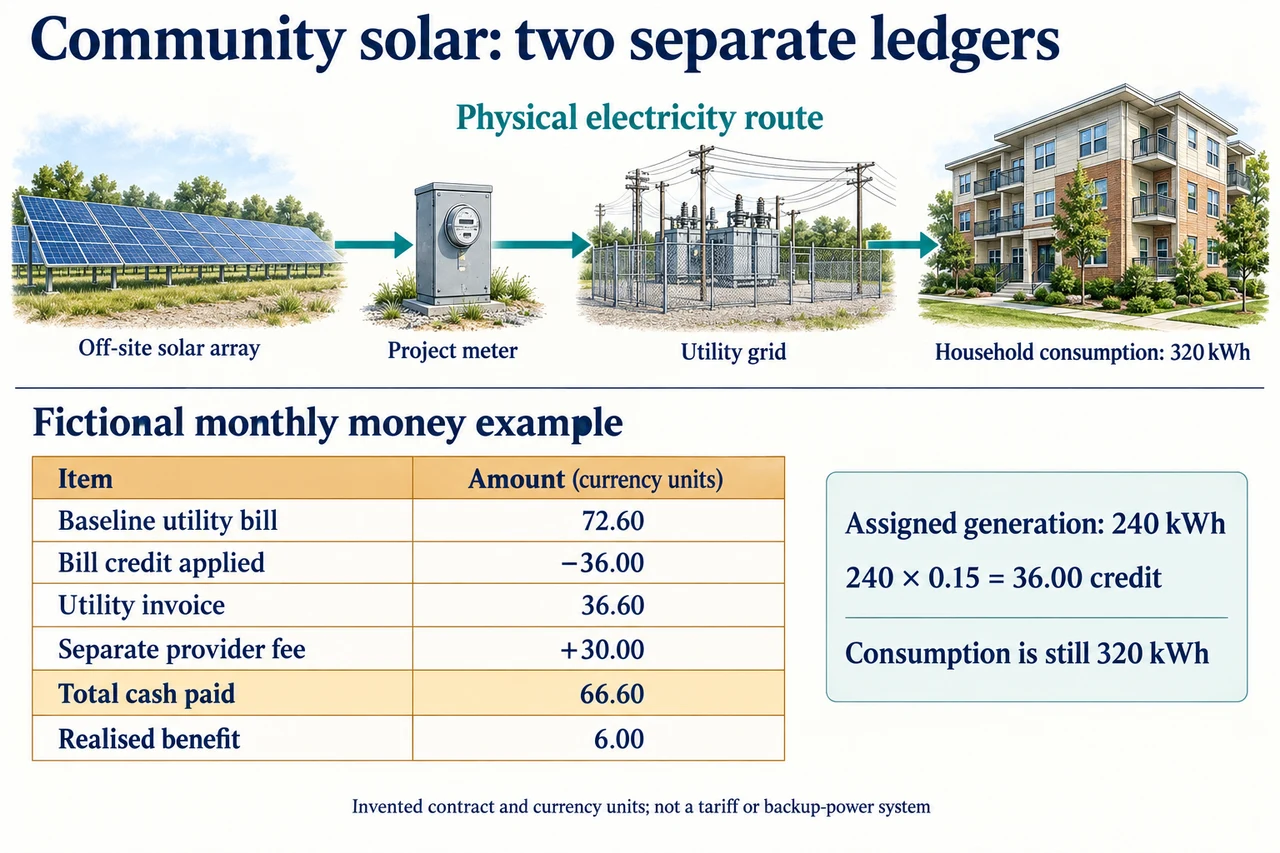
Image: illustration, not a documentary photograph. Off-site grid participation and a separate fictional money ledger; arrows are schematic, not exclusive electron paths or quantitative power flows. All rates and fees are invented, and no backup power is implied. · Operator-authored generated teaching illustration; original invented financial model, not a tariff or documentary image.
Community solar: two ledgers, one household
A renter wants to participate in solar generation and reduce the money needed for ordinary electricity service, but cannot decide what is installed on the building’s roof. Those are two related needs, not one engineering requirement. Participation might support an off-site generating project without changing the apartment’s wiring; lower expenditure depends on the arrangement’s actual charges and credits. Start by naming the people involved: the resident uses electricity and pays bills, a project operator maintains generation, a subscription provider administers an agreement, and a utility supplies service and accounts for credits. A landlord, other customers and people near the project may also be affected. Success for one participant does not establish success for all of them.
Draw a physical boundary before calculating savings. In the arrangement considered here, an off-site solar project supplies metered electrical energy to the utility grid, and the apartment continues receiving electricity through its ordinary utility connection. The resident’s assigned share is an accounting allocation of the project’s output; it is not a dedicated stream of identifiable electrons routed only to that home. Draw a separate financial boundary around the subscription and bill-credit arrangement. A statement can report generation assigned to the resident and a monetary credit even when household consumption has not fallen. The Department of Energy describes these off-site, grid-connected arrangements, while Illinois Shines explicitly distinguishes the bill benefit from a change in electricity entering the home. Physical supply and financial allocation therefore need different ledgers.
Our worked example deliberately invents a contract rather than reproducing a tariff. The household consumes 320 kWh during one month; its assigned project generation is 240 kWh. Eligible consumption is charged at 0.18 currency units per kWh, a fixed charge is 15 currency units, and assigned generation earns 0.15 currency units per kWh of bill credit. A separate provider fee is 30 currency units. In this chosen model credits offset only eligible variable charges, never the fixed charge, and cannot be paid out as cash. Real agreements may use other rules. Multiplying assigned generation by its credit rate produces money, not a reduction of the household’s meter reading: consumption remains 320 kWh, not 80 kWh. Every rate and unit must stay attached to its own quantity.
Without this subscription, the modelled utility bill is 320 × 0.18 + 15 = 72.60 currency units. Assigned generation issues 240 × 0.15 = 36 currency units of credit. All 36 can be applied because eligible variable charges are 57.60. The resulting utility invoice is 36.60, but this is not the household’s entire expenditure: the separate 30 provider fee makes total cash paid 66.60. Compared with the same household usage without the subscription, the realised benefit is 6 currency units. This comparison holds consumption and ordinary rates constant so it isolates the subscription’s effect. Calling the 36 credit a 36 saving would omit the provider fee; calling the lower utility invoice the final bill would cross the financial boundary halfway through the calculation.
Percentages can be correct yet answer different questions. The 6-unit benefit divided by the 36-unit credit is about 16.67%; this describes the difference between credit face value and provider fee in the original month. Dividing the same 6 by the 72.60 baseline household bill gives about 8.26%; this describes the reduction in total modelled expenditure. Neither percentage establishes the arrangement’s annual outcome. Fees, assigned output, consumption and treatment of unused credits may change it. Protection rules also belong to particular programmes: the dated Illinois Solar for All page describes a fee ceiling of half the credit value for its income-eligible community-solar programme. Our invented 30 fee exceeds half of 36, so this example must not be presented as an Illinois Solar for All offer or a compliant illustration of that programme.
Low consumption reveals why issued credit is not always immediate benefit. Suppose consumption falls to 100 kWh while assigned generation and the provider fee stay unchanged. Eligible charges are only 18, so just 18 of the 36 credit can be used now. The fixed 15 and provider 30 still require 45 in cash, compared with a 33 baseline: this month costs 12 more. In the chosen rollover version, the unused 18 becomes a monetary credit balance, not stored electrical energy. Next month, 300 kWh creates 54 eligible charges. The new 36 credit plus the earlier 18 can then offset all 54, leaving 45 total cash paid against a 69 baseline. Together, the two months save 12. That conclusion depends on the stated ability to carry and use the balance.
Change just one rule and the outcome reverses. If the first month’s unused 18 expires instead of rolling over, the second month has only its new 36 credit. Its utility invoice becomes 33 and the provider fee adds 30, giving 63. The two-month total is then 108 rather than the 102 baseline, a loss of 6. A larger nominal allocation did not guarantee lower spending; expiry prevented part of its value being realised. Illinois Shines encourages prospective participants to examine unused credits, charges, cancellation and moving between service areas, while Illinois Solar for All describes possible monthly rollover. Those sources do not make our invented rules universal. Useful evidence is the actual applicable agreement and utility treatment, communicated in a language and payment format the participant can use, not an isolated headline percentage.
Reopen the system boundary when the user’s need changes. If the priority is keeping essential equipment running during an outage, a credit balance is not backup power: it cannot supply an electrical load when the home’s connection is unavailable. DOE explains that backup operation involves appropriate solar-and-storage and inverter arrangements; participation alone establishes none of those capabilities. If the priority is fair access, examine roof independence alongside payment access, understandable disclosures, portability and who bears land-use or maintenance consequences. Do not treat generation, avoided household expenditure and resilience as interchangeable outputs. A sound decision process first identifies the desired service, then checks physical delivery, financial realisation and protections separately. The two ledgers make disagreements visible without requiring a universal verdict for or against community solar.
Worked example: Using the explicitly invented contract, calculate the first-month utility invoice, separate provider fee, total cash paid and realised benefit; distinguish the full-bill reduction from the credit-face percentage. Then reconcile the changed two-month rollover and expiry ledgers.
Establish the comparison boundary. Use the same 320 kWh household consumption, the same 0.18 currency/kWh rate and the same fixed 15 in both cases. The comparison excludes taxes, arrears and other discounts. This makes the 72.60 baseline a controlled model, not a prediction of anyone’s actual utility invoice.
Calculate eligible charges and total baseline separately. Consumption × ordinary rate gives 320 × 0.18 = 57.60 currency units. Adding the fixed 15 gives 72.60. Keeping these rows separate matters because the invented credit rule can offset the first row but cannot offset the fixed charge.
Calculate issued credit with its own rate. Assigned generation × credit rate gives 240 × 0.15 = 36 currency units. With no opening balance, available credit is 36. Applied credit is min(57.60, 36) = 36, leaving zero unused balance. Assigned generation never subtracts from physical consumption.
Complete both payment paths. The utility invoice is 57.60 + 15 − 36 = 36.60. The provider receives a separate 30. The household therefore pays 66.60 in total, and 72.60 − 66.60 = 6 is the realised benefit for this month. Both recipients must be inside the expenditure boundary.
State the denominator before reporting a percentage. The credit-face comparison is 6 ÷ 36 × 100 ≈ 16.67%. The full-bill comparison is 6 ÷ 72.60 × 100 ≈ 8.26%. Report the unrounded calculations before rounding display values; neither number should silently replace the other in a savings claim.
Reconcile the two-month rollover ledger. Issued credits total 36 + 36 = 72, applied credits total 18 + 54 = 72, and the final balance is zero. Cash payments are 45 + 45 = 90 against baselines 33 + 69 = 102. In the expiry alternative, 18 expires and only 54 is applied across the two months; payments total 108. The 18 difference between alternatives is exactly the lost credit value.
Answer: Without this subscription, the modelled utility bill is 320 × 0.18 + 15 = 72.60 currency units. Assigned generation issues 240 × 0.15 = 36 currency units of credit. All 36 can be applied because eligible variable charges are 57.60. The resulting utility invoice is 36.60, but this is not the household’s entire expenditure: the separate 30 provider fee makes total cash paid 66.60. Compared with the same household usage without the subscription, the realised benefit is 6 currency units. This comparison holds consumption and ordinary rates constant so it isolates the subscription’s effect. Calling the 36 credit a 36 saving would omit the provider fee; calling the lower utility invoice the final bill would cross the financial boundary halfway through the calculation.
Check your understanding: A learner argues: “Both months receive the same solar allocation, so the household must save money each month; the unused credit can also power the apartment during a blackout.” Keep the invented original rates, fixed charge and provider fee. Change consumption to 100 kWh and then 300 kWh. First assume unused credit rolls to the following month; then assume it expires after the first month. Calculate both two-month outcomes, reconcile credit value, and explain which parts of the learner’s statement fail.
Answer: In the first month, eligible charges are 100 × 0.18 = 18 and baseline expenditure is 33. Credit issued is 36, but only 18 applies. The household pays fixed 15 plus provider 30 = 45, losing 12 relative to baseline. With rollover the remaining 18 joins the next 36, so all 54 eligible charges on 300 kWh are offset. The second month costs 45 against baseline 69, saving 24. Across both months, 90 is paid against 102: a 12 benefit, even though the first month loses money. Credit reconciliation is 0 opening + 72 issued = 72 applied + 0 closing. With expiry, the first 18 unused credit is lost; second-month cash is 69 − 36 + 30 = 63. Together 108 is paid against 102, a 6 loss, with 72 issued = 54 applied + 18 expired. Both outcomes have identical assigned generation, so physical generation alone cannot determine cash benefit. The credit balance is denominated in currency and records a contractual right to an eligible bill adjustment, not kWh held in a battery; it supplies no outage power. Neither favourable two-month outcome nor unfavourable first month proves a real contract’s annual result.
Why: Physical household consumption, assigned generation and monetary bill adjustments occupy different boundaries. Count both payment recipients, respect eligible-charge caps, and conserve issued credit across applied, carried and expired value. Programme-specific protections and outage operation cannot be inferred from an invented credit model.