Titanium's magnesium loop: where material and energy accounts change
By How things work · myAudience
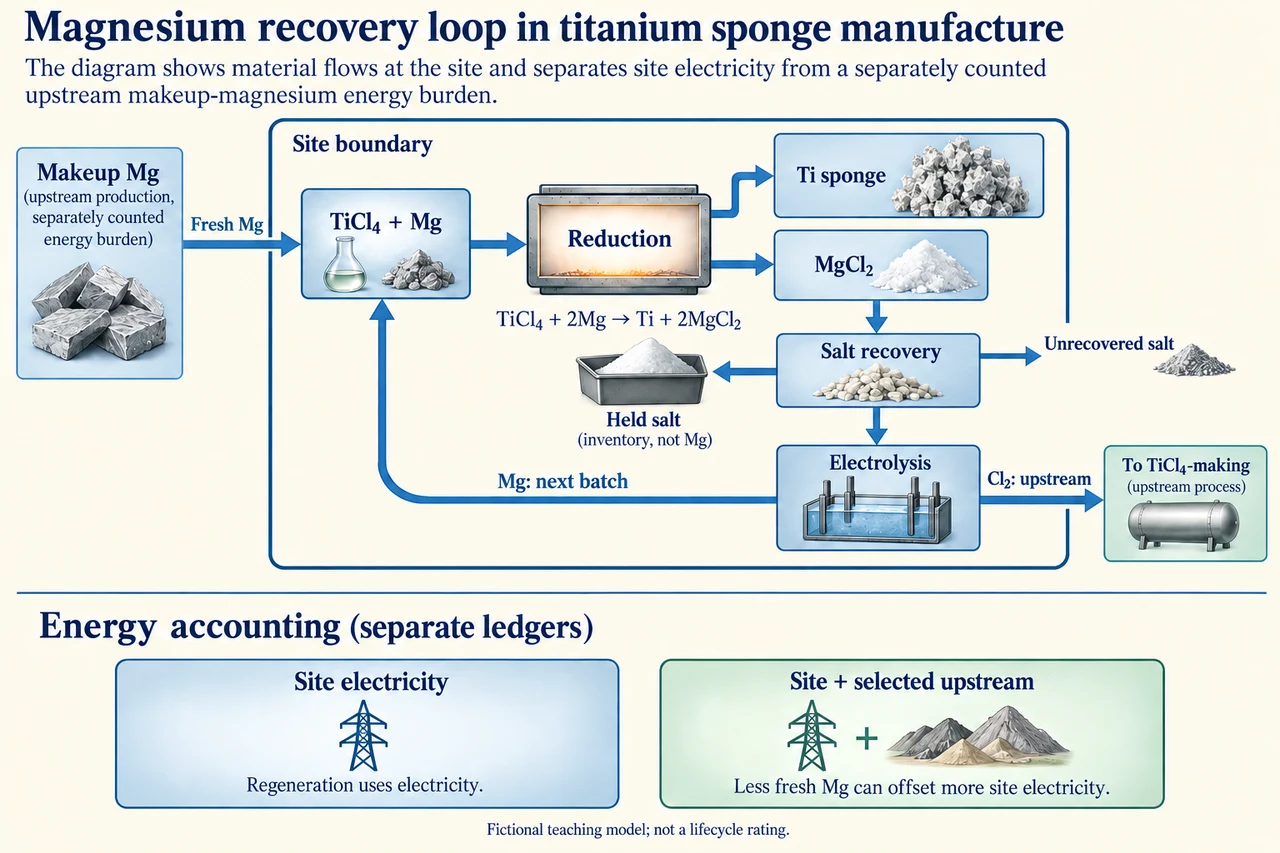
Image: illustration, not a documentary photograph. Conceptual material and selected-energy accounting; fictional model, not a plant recipe. · Operator-authored generated teaching illustration; original fictional material and selected-energy model, not a plant recipe or documentary photograph.
Titanium's magnesium loop: where material and energy accounts change
Titanium is useful because particular titanium materials can combine low density, useful strength and corrosion resistance, but a metal's name alone does not certify a component for an aircraft, an implant or another demanding use. Composition, processing history, defects and inspection also matter. Most titanium-bearing mineral use is associated with titanium dioxide pigment rather than titanium metal; the USGS separates those markets in its 2026 account of estimated 2025 activity. A useful learning question therefore starts with the desired material and service, rather than assuming every tonne of mined titanium becomes a metal part. Here we examine a much narrower question: how a magnesium recovery loop changes material needs and energy accounting during a conceptual Kroll-route titanium-sponge operation. We will keep ore extraction, preparation of titanium tetrachloride, later melting and fabrication separate from the chosen numerical boundary. That separation prevents a tidy process equation from becoming an unsupported claim about the whole supply chain. The quantities below are fictional teaching assumptions, chosen to expose the reasoning rather than to describe a named factory.
In the Kroll route, purified titanium tetrachloride, TiCl4, is reduced using magnesium, and titanium sponge is subsequently separated from magnesium and magnesium chloride. This is one part of a chain that begins with mineral resources and can continue through further metal processing into useful products. The atom-balanced ideal reaction is TiCl4 + 2Mg → Ti + 2MgCl2. One titanium atom goes to the metal product; the four chlorine atoms become two magnesium-chloride formula units; the two magnesium atoms supply those two units. This balance describes ideal reaction amounts, not a guarantee of complete conversion, successful separation or acceptable product purity. Our chosen rounded molar masses are Ti 47.867, Mg 24.305 and Cl 35.45 g/mol. On those explicit numbers, 1000 mol TiCl4 has mass 189.667 kg, the ideal magnesium requirement is 48.610 kg, ideal titanium output is 47.867 kg, and the salt product is 190.410 kg. Input and output mass both total 238.277 kg. A DOE historical study prints a reaction with an incorrect magnesium-chloride coefficient; we retain the source defect in the audit and use the balanced equation rather than copy it.
A reaction requirement and a fresh-purchase requirement are different quantities. If recovered magnesium can serve a later batch, the ideal 48.610 kg requirement can be met by a combination of regenerated magnesium and makeup magnesium. Regeneration does not create material from nothing: magnesium chloride is the feed, and the ideal regeneration relation MgCl2 → Mg + Cl2 conserves its atoms. The returned magnesium goes to a subsequent reduction batch. The chlorine stream belongs to a distinct potential upstream use in titanium-tetrachloride production; it does not enter the reduction reaction directly. Our selected energy ledger assigns no additional chlorine energy credit, so that stream cannot be credited a second time to improve the result. Neither salt capture nor conversion is assumed to be perfect. We define capture as the fraction of generated salt retained for the recovery system, and net conversion as the fraction of that captured salt actually converted in this batch-accounting interval. These are material-account fractions, not electrical current efficiency, product purity or a claim about a real regeneration cell.
For the original fictional case, capture is 95% and net conversion of captured salt is 90%. Of the 190.410 kg generated salt, 180.8895 kg is captured and 9.5205 kg is unrecovered by the selected loop. Of the captured salt, 162.80055 kg is converted and 18.08895 kg remains as held salt inventory. Held salt has not disappeared, and its magnesium has not already become returned metal. The converted 1710 mol of MgCl2 yield 1710 mol Mg and 1710 mol Cl2: respectively 41.56155 kg and 121.239 kg. Those masses sum exactly to the converted salt mass. The next ideal batch therefore needs 48.610 − 41.56155 = 7.04845 kg makeup magnesium. This steady repeating-batch account assumes the specified return is available for that next batch; starting an empty loop would require a different inventory account. The held and unrecovered fractions explain why fresh magnesium is still needed. Calling the system closed would hide these streams, and treating all captured salt as regenerated magnesium would overstate the return.
Recovering useful material can require electricity. We stipulate a fixed 500 kWh of selected site electricity for this batch, plus 9 kWh for each kilogram of regenerated magnesium. These chosen burdens are assumptions, not measured Kroll-process ratings or statements that regeneration is spontaneous. Original selected site electricity is therefore 500 + 9 × 41.56155 = 874.05395 kWh. The ideal titanium output is still 47.867 kg, so normalising this selected site total by output gives about 18.26 kWh/kg titanium. That quotient is not a complete titanium-production energy intensity: it omits stages deliberately left outside the boundary, and ideal output says nothing about certified usable-product yield. The model's 9 kWh/kg regenerated magnesium is also not an efficiency percentage; a meaningful electrical efficiency would need a defined useful-energy comparison and additional process information. Always label the numerator's included stages and the denominator's material basis before comparing two figures that happen to use the same units.
Now add only one chosen upstream contribution: 20 kWh per kilogram of makeup magnesium supplied to the site. Original makeup burden is 20 × 7.04845 = 140.969 kWh, giving a selected expanded total of 1015.02295 kWh. This enlarged ledger adds that one upstream burden to the site electricity; it does not become a full lifecycle assessment. Mining, preparation of TiCl4, transport and other unmeasured contributions remain outside it. Suppose capture improves to 98%, net conversion improves to 95%, and achieving that change adds 20 kWh of site electricity. The magnesium return rises to 45.25591 kg, makeup falls to 3.35409 kg, and selected site electricity rises to 927.30319 kWh. However, the reduced chosen upstream makeup burden is only 67.0818 kWh, so the expanded total falls to 994.38499 kWh. The same modification is an increase of 53.24924 kWh on the site ledger and a decrease of 20.63796 kWh on the expanded ledger. There is no contradiction: they answer questions about different included systems. Neither result by itself proves a lower carbon footprint or a commercially worthwhile investment.
Primary production and recycling also deserve separate accounts. Titanium scrap can be valuable, but scrap identity, contaminants and dissolved oxygen can affect which recovery route and final use are realistic. A 2022 university research paper demonstrates experimental deoxidation work and describes oxygen control as a challenge; its laboratory result does not establish a universal commercial route, present-day cost or certified aerospace-grade output. An object that looks like titanium in a generated illustration cannot supply those missing material tests. Reusing clean, identified manufacturing scrap and recovering mixed end-of-life material are different practical problems, with different sorting and quality constraints. Our MgCl2 regeneration loop is a process-reagent recovery loop within primary sponge production, not proof that a finished titanium component has been recycled. Avoid merging those two meanings of circularity. If a different route changes usable yield or purity, the comparison must be rebuilt on an equivalent usable-output basis rather than retaining our ideal 47.867 kg denominator unchanged.
The changed case can be tested without relying on a favourable slogan. It returns an additional 3.69436 kg of magnesium. Each extra returned kilogram adds our chosen 9 kWh regeneration burden but avoids 20 kWh makeup burden, leaving 11 kWh of potential expanded-ledger saving before the extra fixed site cost. The break-even extra site cost is therefore 11 × 3.69436 = 40.63796 kWh. At 20 kWh the changed case saves 20.63796 kWh; at 45 kWh it instead adds 4.36204 kWh to the same expanded ledger. That reversal exposes which assumption controls the decision. An ethical engineering comparison would also ask about workers, environmental releases, resource extraction, secure storage and treatment of unrecovered streams, evidence quality, and who bears the costs. Our account assigns no environmental harmlessness to held or unrecovered salt and offers no handling instructions. State the question, keep every stream and boundary visible, test changed assumptions, and seek actual operational evidence before making a real design or purchasing decision. A complete mass balance is essential reasoning, but it is not a safety approval.
Worked example: Using the stated molar masses, calculate the ideal 1000 mol reaction balance, original 95% capture/90% net-conversion return and makeup streams, and compare the original and changed selected energy ledgers. The changed case uses 98% capture/95% net conversion and an extra 20 kWh site cost. Explain why site and expanded-ledger rankings differ.
First balance atoms: TiCl4 + 2Mg → Ti + 2MgCl2. For 1000 mol TiCl4, require 2000 mol Mg and produce 1000 mol Ti and 2000 mol MgCl2. Using the declared masses, TiCl4 is 189.667 kg, Mg is 48.610 kg, Ti is 47.867 kg and MgCl2 is 190.410 kg. Both sides total 238.277 kg. These are ideal reaction amounts; no measured factory yield has been inserted.
Apply the original fractions to the salt, not to titanium output. Capture 0.95 ×190.410 =180.8895 kg; unrecovered salt is 9.5205 kg. Converted salt is 0.90 ×180.8895 =162.80055 kg, and held salt is 18.08895 kg. The three salt-account streams sum 190.410 kg. Conversion corresponds to 1710 mol salt: regenerate 41.56155 kg Mg and 121.239 kg Cl2. These two products sum 162.80055 kg, preserving the converted material account.
Use the magnesium return only once. Original next-batch makeup is 48.610 −41.56155 =7.04845 kg. Selected site electricity is 500 +9 ×41.56155 =874.05395 kWh. The chosen upstream makeup contribution is 20 ×7.04845 =140.969 kWh, so the selected expanded total is 1015.02295 kWh. No separate avoided-chlorine credit is added. The ratio 874.05395/47.867 is approximately 18.26 kWh/kg ideal titanium within the selected site boundary, not a whole-process rating.
Rebuild the changed salt streams: capture 0.98 ×190.410 =186.6018 kg; unrecovered 3.8082 kg; convert 0.95 ×186.6018 =177.27171 kg; held 9.33009 kg. The converted 1862 mol salt yield 45.25591 kg Mg and 132.0158 kg Cl2, whose total is 177.27171 kg. Makeup falls to 48.610 −45.25591 =3.35409 kg. Held 9.33009 plus unrecovered 3.8082 plus converted 177.27171 again sum 190.410 kg.
Include the extra fixed site cost in the changed site ledger:500 +20 +9 ×45.25591 =927.30319 kWh. Chosen upstream makeup energy is 20 ×3.35409 =67.0818 kWh. The selected expanded total is 994.38499 kWh. Changed minus original site energy is+53.24924 kWh, whereas changed minus original expanded energy is−20.63796 kWh. The rankings differ because one ledger counts the avoided upstream makeup burden and the other does not.
Test the decision threshold. Additional Mg return is 45.25591 −41.56155 =3.69436 kg. Net selected expanded saving before the extra site cost is(20 −9) ×3.69436 =40.63796 kWh. Thus an extra 20 kWh cost leaves 20.63796 kWh saved; an extra 45 kWh cost instead causes 4.36204 kWh more energy. This threshold holds only for the chosen burdens and unchanged ideal output. It neither supplies a commercial efficiency nor closes omitted lifecycle, quality or safety questions.
Answer: The original loop returns 41.56155 kg Mg and needs 7.04845 kg makeup; the changed loop returns 45.25591 kg and needs 3.35409 kg. Original site/selected-expanded totals are 874.05395/1015.02295 kWh; changed totals are 927.30319/994.38499 kWh. Site electricity increases 53.24924 kWh while the selected expanded ledger decreases 20.63796 kWh. Break-even extra site cost is 40.63796 kWh under the explicitly chosen burdens.
Check your understanding: A reviewer changes the added site cost from 20 to 45 kWh while keeping the 98% capture,95% net conversion and all other stated assumptions. They claim the larger magnesium return must still reduce the expanded total, and claim the held salt can also be counted as returned magnesium. Assess both claims and give complete changed energy totals.
Answer: The material streams do not change when only the added electricity changes: regenerated Mg remains 45.25591 kg, makeup 3.35409 kg, held MgCl2 inventory 9.33009 kg, unrecovered salt 3.8082 kg, and separate regenerated chlorine 132.0158 kg. The held salt has not been converted, so counting its magnesium as returned metal would both misidentify the chemical form and double-count material that remains in inventory. Site electricity is now 500 +45 +9 ×45.25591 =952.30319 kWh. Add the same 67.0818 kWh chosen upstream makeup contribution to get 1019.38499 kWh. Against the original 1015.02295 kWh expanded total, the change adds 4.36204 kWh. The extra 45 kWh exceeds the 40.63796 kWh break-even cost. A larger material return alone does not determine the selected energy ranking; the regeneration burden, makeup burden, extra fixed cost and boundary all matter. Ideal titanium output remains 47.867 kg in this hypothetical comparison. No claim about complete lifecycle energy, emissions, product grade or safe practical operation follows.
Why: A complete material account keeps captured, converted, held and unrecovered salt distinct. Selected site and upstream makeup energy boundaries can rank the same change differently; the threshold depends on explicitly stipulated burdens and unchanged ideal output, not a commercial lifecycle or purity claim.