Iron before steel: feed choice and the accounting boundary
By How things work · myAudience
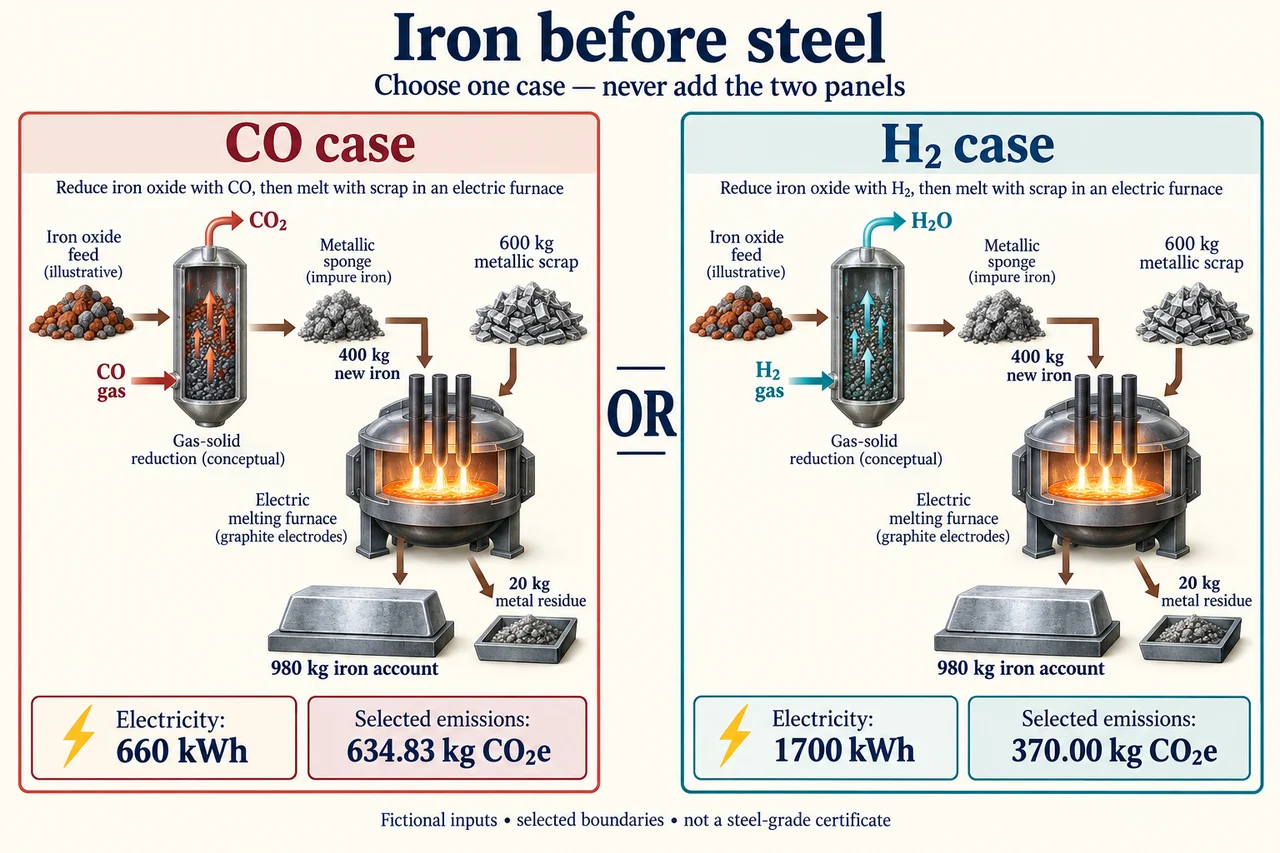
Image: illustration, not a documentary photograph. Exclusive alternative iron-component accounts; fictional inputs and selected boundaries, not a steel-grade certificate. · Operator-authored generated teaching illustration; scientific concept/model review retained separately.
Iron before steel: feed choice and the accounting boundary
A piece of scrap steel and a piece of iron ore do not enter a material process with the same chemical history. Much of the iron in an ore is combined with oxygen; metallic scrap has already passed through earlier extraction and manufacturing. A fair comparison begins by naming the service we want and deciding which parts of that history we count. Our service is a fictional batch containing 980 kg of recovered iron, before any claim about a finished steel grade. We compare two alternative ways of supplying the same iron component to a melting stage. Each starts with 600 kg of already-metallic iron in scrap and makes another 400 kg of iron from an ideal oxide. Choose either the CO case or the H2 case in the illustration, never both together. Their separate panels are alternative accounts of one batch, not two plants feeding an 800 kg stream. Actual steel requires verified composition, processing and properties; equal iron mass alone does not establish that equivalence.
Reduction removes oxygen from an iron compound through chemical reaction, rather than making that oxygen disappear through heating. Two useful ideal net equations are Fe2O3 + 3CO → 2Fe + 3CO2 and Fe2O3 + 3H2 → 2Fe + 3H2O. The first transfers oxygen to a carbon-containing gas; the second transfers it to hydrogen. Count the atoms on both sides before using either equation: each conserves two iron atoms and three oxygen atoms initially in the oxide, together with the atoms supplied by its reducing gas. Real direct reduction proceeds through intermediate oxides and depends on gas composition, equilibrium, transport and the evolving solid structure. A complete net equation does not provide a reaction speed or a reactor design. We stipulate pure Fe2O3, complete reduction and exactly consumed stoichiometric gas for this teaching account. Unreacted gas, gas recycling, gangue and operating conditions are outside it. The resulting sponge-like symbol represents an iron component for later processing, not a certified pure industrial feed.
Use the declared rounded atomic masses Fe 55.845, C 12.011, O 15.999 and H 1.008 kg per kmol of atoms. Producing 400 kg of new iron requires 400/(2 × 55.845) kmol of the net reaction. Its Fe2O3 input is 571.893634 kg, of which 171.893634 kg is oxygen. In the CO alternative, 300.940102 kg of CO enters and 472.833736 kg of CO2 leaves. The combined input equals 400 kg of iron plus that exhaust. In the hydrogen alternative, 21.659952 kg of H2 enters and 193.553586 kg of water leaves; this account closes too. Notice that CO2 mass is greater than the oxygen removed from the oxide: the incoming CO already contains carbon and oxygen. The 600 kg of metallic scrap joins the new iron after reduction. It does not need to pass through this ideal oxide reaction again. That bypass is the specific benefit represented here; it does not prove that actual scrap is clean, available without collection costs or suitable for every grade.
The melting-stage account begins with 1000 kg of iron component, not 1000 kg of ore. A stipulated 98% retention sends 980 kg of iron to the recovered product and 20 kg to a captured metallic-residue stream. Keeping that destination visible prevents a percentage from making matter vanish. This simplified remainder is not a model of actual slag chemistry, where oxygen and other materials would need their own inputs and outputs. Real scrap can contain alloying elements, coatings and unwanted constituents; reduced iron can contain pores, residual oxides and gangue. Subsequent refining and testing therefore matter even when the iron account closes. Original experimental research on hydrogen-based reduction measured residual hydrogen in particular reduced and melted samples, with different results across those stages. Those measurements cannot certify every future steel or remove concerns about downstream uptake and service conditions. Our batch does not include a steel specification, alloy additions or mechanical testing. The lesson explains an iron balance that can support a better question about a product, rather than claiming that balance alone answers it.
Next draw a separate boundary around selected electricity. The fictional meters allocate a common 500 kWh to melting and other specified electrical work, plus 0.4 kWh per kg of new iron in the CO case or 3.0 kWh per kg in the hydrogen case. These are invented site electrical components, not measured industry intensities, hydrogen-production electricity or complete route energy requirements. They give 660 and 1700 kWh for the original batch. With another explicitly supplied assumption, 75% of each electrical input becomes process electric heat and 25% leaves as rejected electric heat. Since 1 kWh equals 3.6 MJ, the CO component closes as 2376 = 1782 + 594 MJ; the hydrogen component closes as 6120 = 4590 + 1530 MJ. This is an account of the electrical contribution only. Reducing gases also have chemical energy, and reaction enthalpies, fuel heat and stored energy need additional terms in a full plant balance. Do not use the chosen electrical partition as a furnace efficiency rating or compare it directly with the separate 98% iron retention.
An emissions account asks another question: which releases and supplied burdens are included? Here the CO2 leaving the ideal CO reduction is counted as direct process CO2. Hydrogen reduction produces water in this equation, so that particular reaction contributes no CO2, but neither site is labelled emissions-free. A separate supplied tally adds 30 kg of CO2 from other site sources in both alternatives; its material-source streams are outside the simplified reaction account. Purchased electricity is assigned a hypothetical factor of 0.2 kg CO2e per kWh. We add it to the direct tally on a CO2-equivalent basis, giving 472.833736 + 30 + 132 = 634.833736 kg CO2e for CO and 0 + 30 + 340 = 370 kg CO2e for H2. Production of the imported gases, mining, scrap collection, transport, refining and later product use are omitted. No avoided-emissions credit is awarded to scrap. The lower selected tally is evidence about these chosen boundaries and assumptions, not a complete lifecycle comparison or a promise attached to the word hydrogen.
Now suppose the available metallic scrap falls to 300 kg while the iron charge remains 1000 kg. The missing 300 kg must be supplied as additional new iron, so the reduction requirement rises to 700 kg. Its gas demands and oxygen removal rise with it. If the supplied electricity factor also becomes 0.6 kg CO2e per kWh, the CO case uses 780 kWh and the hydrogen case 2600 kWh. Their selected tallies become 1325.459038 and 1590 kg CO2e, respectively. The ranking has reversed even though the hydrogen reduction equation still makes water. For any positive new-iron amount, equality occurs at the specific factor 0.4546478233 kg CO2e per kWh, obtained by dividing the CO2 saved per kg of new iron by the extra chosen electricity per kg. The new-iron amount cancels because these particular component rules are linear. At zero new iron, both alternatives reduce to the same selected remelting account; no positive-share threshold division is needed. Different meters, gas-supply burdens or product requirements would change the decision.
A useful technology comparison ends by asking what evidence is still missing. Established steel production includes ore-based and scrap-based routes, and their feed mixtures are not rigid opposites. Direct-reduced iron can join scrap in an electric furnace; ironmaking and steel refining remain distinct stages. The institute and original research sources used here explain specific gas-solid reduction and subsequent melting studies, not a universal claim that every emerging process is commercially ready or safe. A real community decision also involves electricity access, reliable scrap collection, ore and gas supply, employment, local pollution, worker protection and the eventual use of the steel. Those concerns cannot be collapsed into one invented carbon number. Keep the material, electrical and emissions boundaries visible, identify the assumptions that matter, and ask for verified site and product evidence before recommending equipment. Our illustration is an original conceptual account with separate alternatives and symbolic machinery. It contains no operating recipe or grade certificate. The worked problem supports learning and revision; it does not complete an assessment, a supervised practical or a safe design review.
Worked example: Compare exclusive CO and H2 ideal-reduction alternatives for 400 kg new iron plus 600 kg metallic iron scrap. Use the declared atomic masses, complete stoichiometric reduction, 98% Fe retention, common 500 kWh electrical component plus 0.4/3.0 kWh per kg new iron, supplied 75%/25% electrical heat partition, common 30 kg CO2 other-site tally and electricity factor 0.2 kg CO2e/kWh. Close the separate accounts and find the positive-new-iron equality factor.
Set the common service and the units first. Both alternatives use 1000 kg of iron component: 600 kg arrives as already-metallic scrap and 400 kg must be made from ideal Fe2O3. The reaction amount is 400/(2 × 55.845) kmol, because one net reaction produces two kmol of Fe atoms. Use the declared rounded atomic masses consistently. The choice is CO OR H2, not their sum. Actual scrap purity, ore gangue and final steel composition are not being inferred.
For that amount, Fe2O3 is 571.893634 kg. The CO equation needs 300.940102 kg CO and makes 472.833736 kg CO2: 571.893634 + 300.940102 = 400 + 472.833736 kg. The H2 equation instead needs 21.659952 kg H2 and makes 193.553586 kg water: 571.893634 + 21.659952 = 400 + 193.553586 kg. Calculate from full values before rounding. These are separate atom-balanced alternatives, with no double iron stream and no unaccounted disappearance of oxide oxygen.
Combine the 400 kg of newly reduced iron with 600 kg of metallic iron in scrap. The resulting iron charge is 1000 kg in either case. Apply the stipulated 98% Fe retention: product iron is 0.98 × 1000 = 980 kg and captured metallic residue is 20 kg. This denominator is already-metallic iron, not the larger oxide-plus-gas input. The residue is an explicit destination; it is not a selective impurity-removal claim or an actual slag model.
Read the selected electrical components separately from chemical energy. CO uses 500 + 0.4 × 400 = 660 kWh; H2 uses 500 + 3.0 × 400 = 1700 kWh. Convert with 3.6 MJ/kWh to 2376 and 6120 MJ. Under the supplied 75%/25% electrical split, they close as 1782 + 594 and 4590 + 1530 MJ. This component calculation conserves its stated electrical input; it does not close the complete reactor energy balance or certify a real furnace efficiency.
Add only the declared emissions components. With 0.2 kg CO2e/kWh, electricity contributes 132 kg CO2e for CO and 340 for H2. Add the ideal reduction CO2 and the separately supplied common 30 kg CO2 site tally. The totals are 634.833736 and 370 kg CO2e. Water is not counted as CO2, but omitted gas production is not thereby proven carbon-free. Neither scrap avoided burdens nor full lifecycle credits are included in this selected comparison.
Let m be positive new-iron mass and g the supplied electricity factor. The H2-minus-CO selected difference is m[(3.0 − 0.4)g − 3 × 44.009/(2 × 55.845)]. Setting it to zero gives g = 44009/96798 = 0.4546478233 kg CO2e/kWh. Below it H2 has the smaller chosen tally; above it CO does. This threshold is specific to the supplied meters and exclusions. At m = 0 both accounts coincide without dividing by the new-iron amount.
Answer: Each alternative supplies the same 980 kg recovered iron and 20 kg captured metallic residue. The original 400 kg new-iron requirement uses 571.893634 kg ideal oxide. CO consumes 300.940102 kg and yields 472.833736 kg CO2; H2 consumes 21.659952 kg and yields 193.553586 kg water. Both reaction masses close. Selected electricity is 660 or 1700 kWh, with electrical heat components closing as 2376 = 1782 + 594 MJ or 6120 = 4590 + 1530 MJ. At the supplied factor 0.2, the selected emissions totals are 634.833736 versus 370 kg CO2e. H2 is lower by 264.833736 kg CO2e in this account. The positive-new-iron equality factor is 0.4546478233 kg CO2e/kWh. No gas-production, full plant energy, lifecycle, purity or steel-grade result follows from these fictional inputs.
Check your understanding: Only 300 kg of metallic scrap is now available, but the iron charge remains 1000 kg. The supplied electricity factor becomes 0.6 kg CO2e/kWh; all other fictional assumptions stay fixed. Recalculate the material, electrical and selected emissions accounts. Does water production guarantee H2 still wins? Find equality and state what cannot be concluded.
Answer: Use 700 kg new iron and 300 kg scrap. Ideal oxide is 1000.81385979 kg; CO input is 526.64517862 kg and CO2 output 827.45903841 kg. Alternatively H2 input is 37.90491539 kg and water output 338.71877518 kg. Each reaction conserves mass. The common iron charge remains 1000 kg, with 980 kg recovered and 20 kg captured metallic residue. Selected electricity is 780/2600 kWh, or 2808/9360 MJ. Its stipulated electrical partitions are 2106 + 702 and 7020 + 2340 MJ. At 0.6 kg CO2e/kWh, the selected totals are 827.45903841 + 30 + 468 = 1325.45903841 kg CO2e for CO and 0 + 30 + 1560 = 1590 for H2. H2 is therefore 264.54096159 kg CO2e higher. Its reaction still produces water; the changed electricity burden reverses this chosen ranking. Equality remains at 44009/96798, about 0.4546478233 kg CO2e/kWh, for positive new-iron mass. These figures do not choose an actual plant or certify a grade. Gas production, ore preparation, collection, transport, refining, chemical heat and other lifecycle burdens remain unmodelled; real selection needs consistent site and product evidence.
Why: Net reduction chemistry, the already-metallic retention denominator, electrical-component heat and selected emissions are distinct accounts. Changing electricity supply can reverse a model ranking without changing the redox equation or certifying a real route.