Exponentials, logarithms and trigonometry: the input changes the gradient
By UK A Level Mathematics · independent study · myAudience
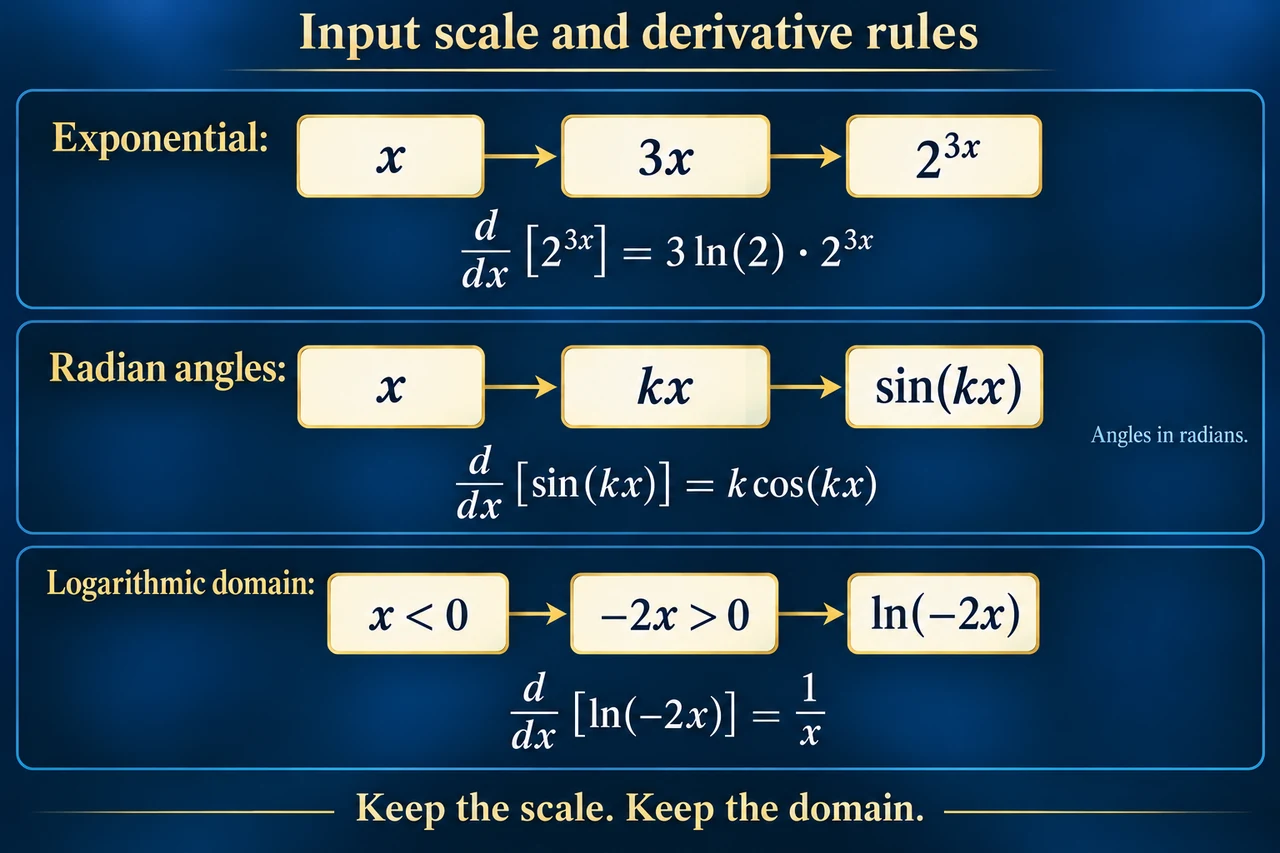
Image: illustration, not a documentary photograph. Scaled-input formulas are shown with stated real logarithm domains and radian trigonometric conditions; the image does not prove the underlying limits. · Original generated project artwork; no source textbook or exam-board figures reused.
Exponentials, logarithms and trigonometry: the input changes the gradient
A familiar derivative formula describes a particular function with a particular input. The derivatives of e^x, ln x, sin x and cos x cannot be copied unchanged after replacing x with 3x. A change in the input makes the same outer function move through its values at a different rate. Start by naming the outer function, the scaled input and the allowed real inputs. Then keep the scale in the calculation. We will work with constant scales; the general chain rule for an arbitrary inner function belongs to the next lesson. Even this restricted case can explain why two graphs with similar shapes have different gradients at corresponding points.
The exponential derivative can be understood through a difference quotient. For e^x, subtracting the original value from e^(x+h) factors out e^x, leaving e^x times (e^h − 1)/h. The known exponential limit of the latter factor is 1. Therefore the derivative is e^x. For e^(kx), the same calculation introduces the increment kh; factoring k outside the limiting quotient gives k e^(kx). If k = 0, the function is the constant 1 and the derivative is 0. These are real functions on every real x. This argument uses a known limit; it is not a construction of the exponential function or a proof of that limit from elementary algebra.
A different positive base carries a second factor. Write a^(kx) as e^(kx ln a), with a > 0. Its derivative is k ln(a) a^(kx). For example, differentiating 2^(3x) gives 3 ln(2) 2^(3x), rather than 3 times a power of x. An exponential has the variable in its exponent; the power rule applies to x raised to a constant exponent. If a = 1, ln a = 0 and the derivative correctly vanishes. A negative base does not give a real exponential defined for every real x, so it cannot be inserted into this rule without a different discussion of its domain. Positive bases less than 1 have negative logarithms and produce decay when k is positive.
For ln x, the real domain is x > 0 and the derivative is 1/x. One route uses ln(x+h) − ln x = ln(1+h/x), and the known limit ln(1+u)/u = 1 as u tends to zero. Scaling the input needs care: ln(kx) is defined only where kx > 0. For nonzero constant k its derivative is k/(kx) = 1/x on that domain. A negative scale is possible: ln(−2x) has domain x < 0 and derivative 1/x there. Cancelling k from the derivative does not cancel the original domain restriction. At k = 0 the logarithm is undefined, so there is no constant logarithmic function to differentiate. Domain checking comes before algebraic simplification.
Trigonometric derivatives use radians. The identity for sin(x+h) separates the quotient into a sin x term involving (cos h − 1)/h and a cos x term involving sin h/h. The two known radian limits are 0 and 1, giving derivative cos x. A corresponding identity gives the derivative of cos x as −sin x. Constant input scales then give d/dx sin(kx) = k cos(kx) and d/dx cos(kx) = −k sin(kx). For these sine and cosine functions every real x is allowed. If an angle were measured numerically in degrees, the limiting scale would change by π/180. Forgetting the angle unit can therefore produce a systematically incorrect gradient even when the symbolic expression looks familiar.
The tangent function has a more restricted domain. From its addition identity, tan(x+h) − tan x equals sin h divided by cos(x+h) cos x, whenever those expressions are defined. Dividing by h and taking the limit gives 1/cos²x, written sec²x. Thus d/dx tan(kx) = k sec²(kx) on intervals where cos(kx) is nonzero. For k ≠ 0, excluded inputs satisfy kx = π/2 + nπ for an integer n. A formula for a derivative at such an input does not turn a vertical asymptote into a tangent point. At k = 0, tan(kx) is the constant 0. This distinction between a valid limiting calculation and a missing point on the original curve is essential when constructing normals.
Combine these rules only after establishing a common domain. For f(x) = e^(2x) + 3 ln x − cos(πx), the logarithm restricts the whole function to x > 0. Its derivative is 2e^(2x) + 3/x + π sin(πx), using radian trigonometry. At x = 1 the point has height e² + 1 and the tangent gradient is 2e² + 3. The normal has gradient −1/(2e² + 3). Neither the logarithmic term being zero at 1 nor the sine term being zero makes its neighbouring behaviour disappear. To solve an unfamiliar case, distinguish powers from exponentials, retain the input scales, check the domain and evaluate the point separately from the derivative. Those checks matter more than the visual resemblance of two formulas.
Check with complete answer
Question: A learner differentiates h(x) = ln(−2x), declaring that the function cannot have negative real inputs and that its derivative is −2/x. Evaluate h and h′ at x = −1, and give the normal there.
Answer: The argument −2x must be positive, so this function requires x < 0. At −1 the argument is 2 and h(−1) = ln 2. The derivative is (−2)/(−2x) = 1/x, giving h′(−1) = −1. The normal gradient is +1 and its equation is y − ln 2 = x + 1. Negative x is allowed here because the argument of the logarithm is positive. The proposed derivative −2/x counts the input scale without dividing by the actual scaled argument.
Worked example: For f(x) = e^(2x) + 3 ln x − cos(πx), find the tangent and normal at x = 1. State the real domain and explain the factor π.
1. Both e^(2x) and cos(πx) are defined for every real x. The logarithm requires x > 0. The common domain is therefore x > 0, and 1 is an allowed tangent point.
2. Differentiate the exponential and logarithm: their contributions are 2e^(2x) and 3/x. The factor 2 records the constant scale of the exponential input; it is not an exponent lowered by the power rule.
3. The derivative of −cos(πx) is +π sin(πx). The initial minus sign and the cosine derivative's minus sign cancel. The factor π comes from changing the radian input at π radians per unit change in x.
4. Evaluate the original height: f(1) = e² + 0 − cos π = e² + 1. Evaluate the gradient independently: f′(1) = 2e² + 3 + π sin π = 2e² + 3.
5. The tangent is y − (e² + 1) = (2e² + 3)(x − 1). It passes through the calculated point, and its coefficient is the derivative evaluated at 1 rather than the original function value.
6. The finite nonzero gradient permits the negative reciprocal. The normal is y − (e² + 1) = [−1/(2e² + 3)](x − 1). Its gradient product with the tangent is −1, and both lines pass through the same point.
Answer: Domain x > 0; tangent y − (e² + 1) = (2e² + 3)(x − 1); normal y − (e² + 1) = [−1/(2e² + 3)](x − 1). All angles in the expressions are in radians.
Check your understanding: Change the function to g(x) = 2^(3x) + ln x + tan(πx). Find the tangent and normal at x = 1 and identify all excluded real inputs. Why is using the ordinary power rule on 2^(3x) wrong?
Answer: The logarithm requires x > 0. The tangent also excludes x = 1/2 + n for every integer n; only the positive excluded values affect the common domain. Thus 1 is allowed. The exponential derivative is 3 ln(2) 2^(3x), because its variable lies in the exponent, not in a base x raised to a fixed exponent. The other derivatives are 1/x and π sec²(πx). Therefore g(1) = 8 + 0 + 0 = 8 and g′(1) = 24 ln 2 + 1 + π. The tangent is y − 8 = (24 ln 2 + 1 + π)(x − 1). This gradient is finite and positive, so the normal is y − 8 = [−1/(24 ln 2 + 1 + π)](x − 1). Their gradient product is −1. Neither a cancelled symbol nor a finite answer at 1 allows evaluating a tangent at a missing logarithmic or tangent-function input.
Why: Combine these rules only after establishing a common domain. For f(x) = e^(2x) + 3 ln x − cos(πx), the logarithm restricts the whole function to x > 0. Its derivative is 2e^(2x) + 3/x + π sin(πx), using radian trigonometry. At x = 1 the point has height e² + 1 and the tangent gradient is 2e² + 3. The normal has gradient −1/(2e² + 3). Neither the logarithmic term being zero at 1 nor the sine term being zero makes its neighbouring behaviour disappear. To solve an unfamiliar case, distinguish powers from exponentials, retain the input scales, check the domain and evaluate the point separately from the derivative. Those checks matter more than the visual resemblance of two formulas.