Differentiating a construction: product, quotient and chain rules
By UK A Level Mathematics · independent study · myAudience
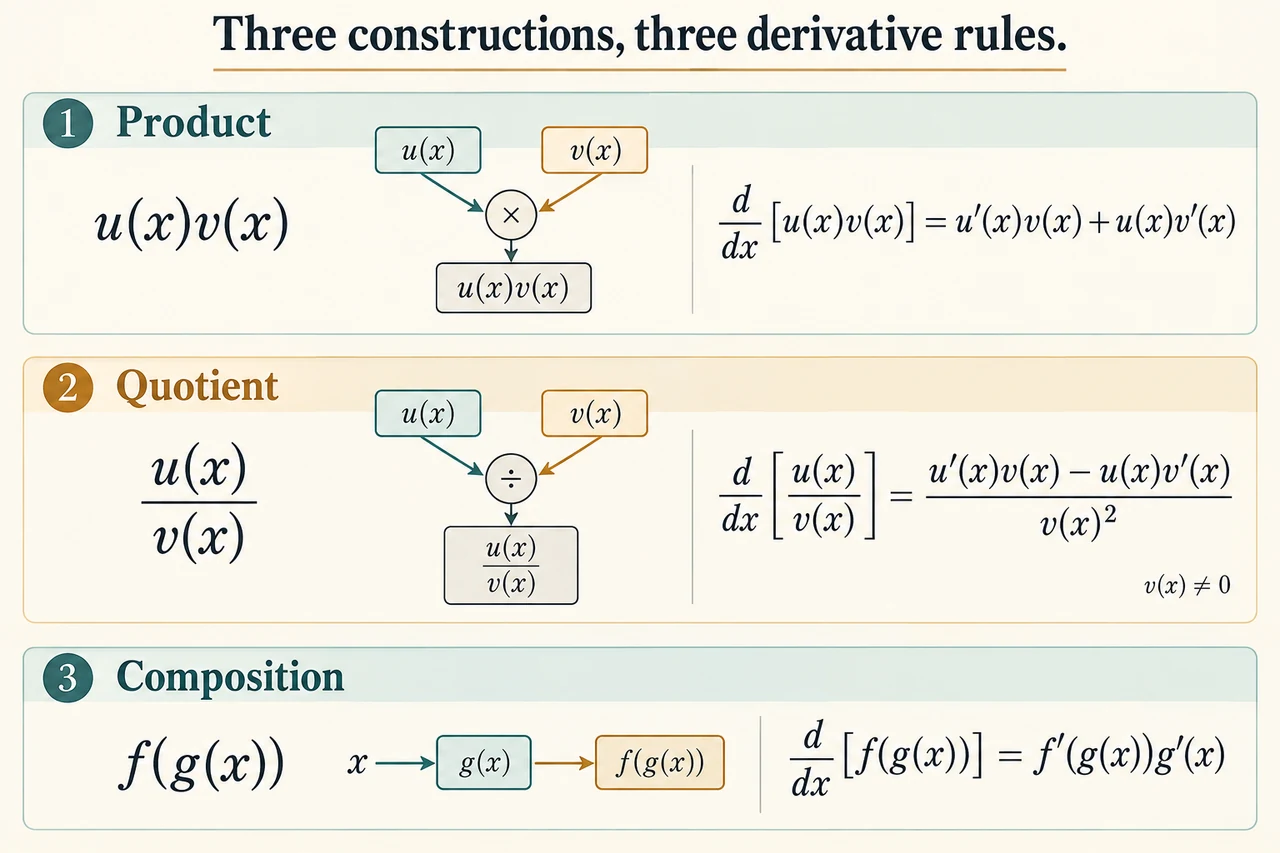
Image: illustration, not a documentary photograph. Schematic rule dependencies distinguish multiplication, division and composition. Formula domains and nonzero denominators are governed by the full explanation. · Original generated project artwork; no source textbook or exam-board figures reused.
Differentiating a construction: product, quotient and chain rules
A complicated expression often consists of familiar functions assembled by multiplication, division or composition. The differentiation rule follows that assembly. In x²e^(3x), two quantities depending on x are multiplied. In (x²+1)/(x−1), one is divided by another. In cos²(2x), the input is scaled, then passed through cosine, then squared. Identify those layers before writing a derivative. Treating a product as though the derivative simply multiplies the two individual derivatives loses terms; treating a quotient that way gives another generally false rule. A diagram of dependencies can help, but the final algebra and its domain still need to be checked.
For differentiable u(x) and v(x), the product rule is (uv)′=u′v+uv′. Both terms matter because each factor can change while the other is temporarily held at its local value. A short justification uses a difference quotient. Add and subtract u(x+h)v(x) in the numerator u(x+h)v(x+h)−u(x)v(x). It becomes u(x+h)[v(x+h)−v(x)]+v(x)[u(x+h)−u(x)]. Divide by h and take its limit as h approaches zero. Differentiability gives the two derivative limits and the continuity of u, yielding uv′+vu′. This argument states why the rule has two contributions rather than asking you to memorise an unexplained pattern.
Apply that rule to f(x)=x²e^(3x). Set u=x² and v=e^(3x), so u′=2x and v′=3e^(3x); the 3 comes from the scaled exponent. Therefore f′=2xe^(3x)+3x²e^(3x)=e^(3x)(2x+3x²). The function and derivative have all real inputs. Factoring is useful for analysing zeros because e^(3x) is positive everywhere, so f′ is zero at x=0 or x=−2/3. Those inputs alone do not establish a maximum or minimum. If asked for classification, test derivative signs and evaluate f for the heights. The product rule provides the derivative, not the complete answer to every subsequent question.
For a quotient u/v with v nonzero, the quotient rule is (u/v)′=(u′v−uv′)/v². The order of the subtraction matters. You can derive it by writing u/v=u·v^(−1), then applying the product and chain rules: u′/v−uv′/v². Combining those terms over v² gives the stated expression. The denominator restriction belongs to the original function. Cancelling a factor in a later expression does not restore an input at which the original denominator vanished unless a separate extended function is explicitly defined. Before simplifying, write the excluded values so that an algebraic cancellation cannot silently change the question.
Take g(x)=(x²+1)/(x−1), where x≠1. The quotient rule gives g′=[2x(x−1)−(x²+1)]/(x−1)²=(x²−2x−1)/(x−1)². Polynomial division provides an independent check: g=x+1+2/(x−1), so g′=1−2/(x−1)², which is the same expression on the original domain. At x=2 the point is (2,5) and the gradient is −1. The tangent is y−5=−(x−2); its perpendicular normal is y−5=x−2. These local lines do not claim that the whole rational curve is straight or that its excluded input x=1 has acquired a value.
For a composition F(G(x)), the chain rule is d/dx F(G(x))=F′(G(x))G′(x), provided the needed derivatives exist at the relevant inputs. The derivative of the outer function is evaluated at the inner function, then multiplied by the inner rate of change. For h(x)=cos²(2x), view the layers as x→2x→cos(2x)→[cos(2x)]². Differentiating the square gives 2cos(2x), the cosine contributes −sin(2x), and the inner scaling contributes 2. Thus h′=−4cos(2x)sin(2x)=−2sin(4x). Angles are in radians; otherwise the trigonometric derivative formulas require the corresponding conversion factor. Omitting either scale factor produces a plausible-looking but incorrect answer.
The rules can be combined, but there is no prize for using more of them than necessary. An expanded polynomial can often be differentiated term by term; a rational expression may simplify cleanly by division; a product may remain clearer in factored form. Choose a representation that makes the structure and domain visible, then check an independently simplified form or a suitable nearby numerical difference quotient. A numerical check can catch a sign or scale error at a tested input, but it is not a proof of a general identity and should avoid excluded points. Keep exact values while forming a tangent or normal; premature decimal rounding can hide the relationship between perpendicular gradients.
A changed quotient shows what must be reconsidered rather than copied. For G(x)=(2x²+3)/(x+2), the excluded input is −2. The numerator is not the earlier x²+1 and the denominator is not x−1, so both derivatives and the evaluation point must be recomputed. At x=1, G=5/3 and G′=7/9. The normal gradient is −9/7 because it is the negative reciprocal of the nonzero tangent gradient. Domain, height, derivative and reciprocal each have a separate role. If the tangent gradient were zero, a vertical normal would require a different line form instead of an attempted division by zero.
Further answered structure check
Question: A learner proposes d/dx[x²e^(3x)]=(2x)(3e^(3x)). Why is this wrong even though both individual derivatives are correct?
Answer: It multiplies derivatives and omits both product contributions. The correct derivative is 2xe^(3x)+3x²e^(3x). For example at x=1 the proposed value is 6e³ but the correct value is 5e³. This single differing value disproves the proposed identity. The difference-quotient argument explains the actual rule beyond that counterexample.
Worked example: Differentiate f=x²e^(3x), g=(x²+1)/(x−1), and h=cos²(2x). For g, find the tangent and normal at x=2 and state its domain.
1. For f, choose u=x² and v=e^(3x). Their derivatives are 2x and 3e^(3x). Use both product contributions: f′=2xe^(3x)+3x²e^(3x)=e^(3x)(2x+3x²).
2. For g, record x≠1. Its quotient derivative is [2x(x−1)−(x²+1)]/(x−1)². Expand the numerator carefully to obtain x²−2x−1.
3. Check g by division: g=x+1+2/(x−1), whose derivative is 1−2/(x−1)². Bringing this over the common denominator gives exactly the result in step 2 on x≠1.
4. At x=2, g=5 and g′=(4−4−1)/1=−1. Hence the tangent is y−5=−(x−2). The normal gradient is 1, giving y−5=x−2.
5. For h, retain every layer: h′=2cos(2x)·[−sin(2x)]·2=−4cos(2x)sin(2x). The double-angle identity then gives −2sin(4x). These formulas use radians.
6. Keep the domain statement x≠1 alongside both forms of g′. Neither simplifying the derivative nor finding a local line defines g at its excluded input. Functions f and h have every real input.
Answer: f′=e^(3x)(2x+3x²); g′=(x²−2x−1)/(x−1)² on x≠1; h′=−2sin(4x) in radians. The tangent and normal to g at (2,5) are y−5=−(x−2) and y−5=x−2.
Check your understanding: Find the normal to G(x)=(2x²+3)/(x+2) at x=1. A learner uses the earlier normal gradient 1 without recalculating. Explain the error and independently check the new derivative.
Answer: The domain is x≠−2 and the point is (1,5/3). Applying the quotient rule gives G′=[4x(x+2)−(2x²+3)]/(x+2)²=(2x²+8x−3)/(x+2)². At 1 the gradient is 7/9, so the normal gradient is −9/7. Its equation is y−5/3=−(9/7)(x−1). Independent division gives G=2x−4+11/(x+2); differentiation gives 2−11/(x+2)², whose value at 1 is 2−11/9=7/9 and whose combined numerator agrees. The learner's gradient 1 belongs to a different function at a different local point; a rule can be reused, but its calculated output cannot be transplanted unchanged.
Why: A changed quotient shows what must be reconsidered rather than copied. For G(x)=(2x²+3)/(x+2), the excluded input is −2. The numerator is not the earlier x²+1 and the denominator is not x−1, so both derivatives and the evaluation point must be recomputed. At x=1, G=5/3 and G′=7/9. The normal gradient is −9/7 because it is the negative reciprocal of the nonzero tangent gradient. Domain, height, derivative and reciprocal each have a separate role. If the tangent gradient were zero, a vertical normal would require a different line form instead of an attempted division by zero.