Reciprocal and inverse trigonometry: notation, branches and slopes
By UK A Level Mathematics · independent study · myAudience
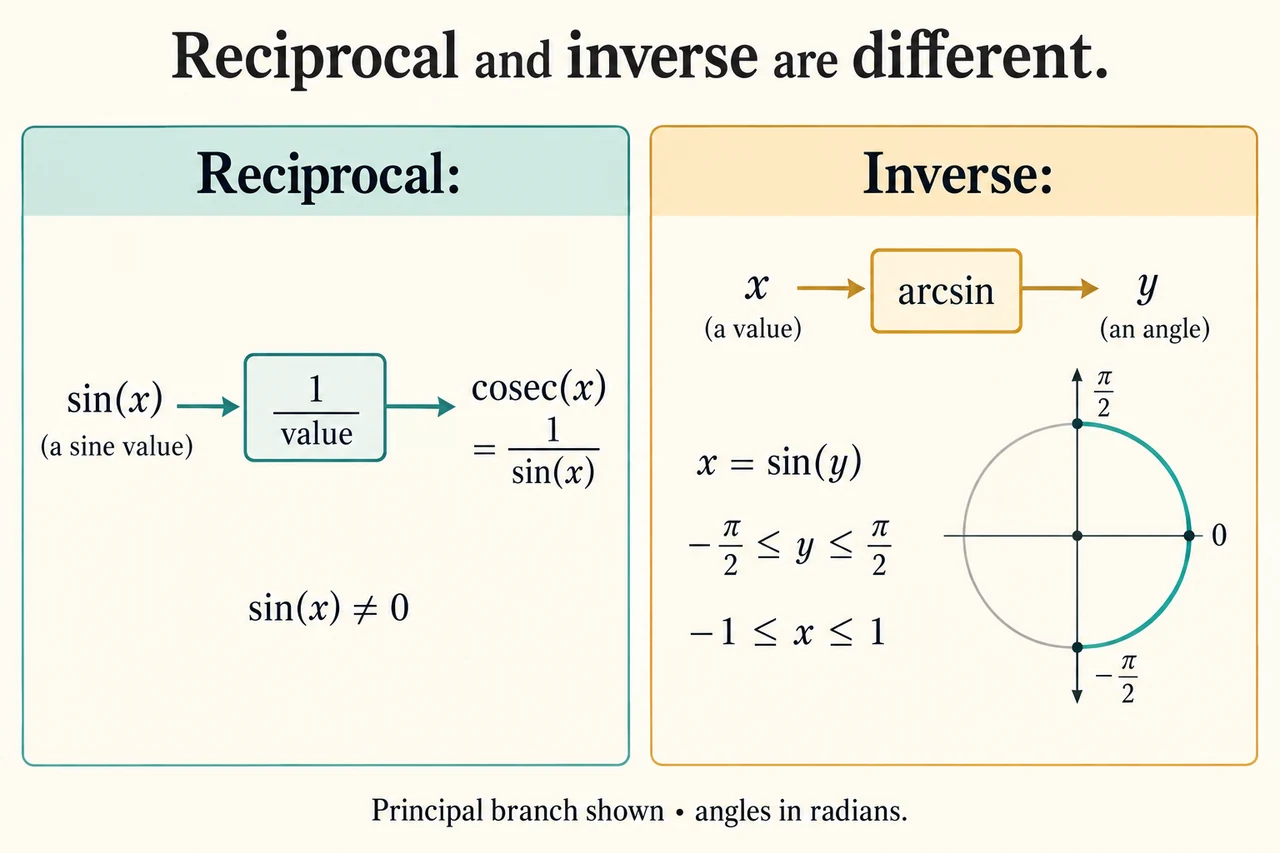
Image: illustration, not a documentary photograph. Principal-angle semicircle is an angle/branch diagram, not a Cartesian plot of arcsin or arccos. Endpoint differentiability is governed by the explanation. · Original generated project artwork; no source textbook or exam-board figures reused.
Reciprocal and inverse trigonometry: notation, branches and slopes
Reciprocal and inverse mean different operations. The reciprocal of sin(x) is 1/sin(x), written cosec(x), wherever sin(x) is nonzero. The inverse function arcsin(x) returns an angle in a selected interval whose sine is x. It is not 1/sin(x). Notation such as sin⁻¹(x) is conventionally used for the inverse in this context and can obscure that distinction; writing arcsin while learning makes the intended operation clearer. The reciprocal changes a value by division, whereas an inverse reverses a function's input-output relationship. Before differentiating, establish which function is meant and which inputs its definition allows.
Derive reciprocal trigonometric derivatives from familiar rules. Since sec(x)=[cos(x)]⁻¹, the chain rule gives sec′=−[cos(x)]⁻²[−sin(x)]=sin(x)/cos²(x)=sec(x)tan(x), on cos(x)≠0. Similarly cosec′=−cos(x)/sin²(x)=−cosec(x)cot(x), on sin(x)≠0. The quotient rule applied to cot(x)=cos(x)/sin(x) gives cot′=[−sin²(x)−cos²(x)]/sin²(x)=−cosec²(x). The identity sin²+cos²=1 supplies the final simplification. Each restriction comes from the original reciprocal or quotient; a derivative formula never defines a value at a denominator's zero.
Scaled inputs add a chain factor. The derivative of sec(2x) is 2sec(2x)tan(2x), and its domain excludes inputs where cos(2x)=0. The derivative of cot(3x) is −3cosec²(3x), with sin(3x)≠0. A coefficient multiplying a function is different from a factor inside its argument. Thus the derivative of 3cot(x) is −3cosec²(x), while the derivative of cot(3x) is −3cosec²(3x). Their identical leading factor does not make them the same function or derivative. State the angle convention: these formulas use radian inputs, and degree-based variables require an additional conversion factor.
An inverse derivative can be derived by differentiating an identity. Let y=arcsin(x), defined for −1≤x≤1 with output −π/2≤y≤π/2. Then x=sin(y). At an interior input −1<x<1, implicit differentiation gives 1=cos(y)dy/dx. On the interior of this principal branch cos(y) is positive, so cos(y)=√(1−sin²(y))=√(1−x²). Consequently d(arcsin x)/dx=1/√(1−x²). Choosing the positive square root is justified by the branch, not by a general rule that cosine is always positive. The inverse has endpoint values, but this finite derivative formula does not extend to x=±1; the gradient becomes unbounded approaching those endpoints from within the domain.
For y=arccos(x), select 0≤y≤π and again −1≤x≤1. Differentiating x=cos(y) gives 1=−sin(y)dy/dx. The sine is positive for interior branch angles, producing d(arccos x)/dx=−1/√(1−x²) for −1<x<1. For y=arctan(x), select −π/2<y<π/2 with every real x allowed. From x=tan(y), differentiate to obtain 1=sec²(y)dy/dx. Using sec²(y)=1+tan²(y)=1+x² yields d(arctan x)/dx=1/(1+x²) for all real x. These signs and domains express the increasing or decreasing behaviour of the chosen inverses; other branches cannot be imported without re-examining their definitions.
For f(x)=arcsin(2x), the function domain is −1/2≤x≤1/2 and its finite derivative is 2/√(1−4x²) on the open interval. At x=1/4, its value is π/6 because sin(π/6)=1/2. Its tangent gradient is 4/√3 and its normal gradient is −√3/4. The tangent and normal are therefore y−π/6=(4/√3)(x−1/4) and y−π/6=−(√3/4)(x−1/4). The inverse output is an angle in radians, so the plotted vertical coordinate represents that angle. The two endpoint inputs belong to the function's domain but do not supply a finite-gradient tangent of this form.
A sum such as q(x)=arctan(3x)+sec(x) combines an inverse with a reciprocal rather than two inverse functions. Its derivative is 3/(1+9x²)+sec(x)tan(x). At x=0, q=1 and q′=3. The local tangent is y−1=3x and the normal is y−1=−x/3. Although arctan(3x) alone permits every real input, the sum excludes each x where cos(x)=0 because sec(x) is undefined there. The domain of a sum must satisfy every participating term. A correct derivative for one term cannot repair an undefined original expression in another term.
Change the inverse scale and branch to check whether the method is understood. For G(x)=arccos(3x), the function is defined for −1/3≤x≤1/3, but its finite derivative requires strict inequalities. At x=1/6, G=π/3 and G′=−2√3; the normal gradient is 1/(2√3). Both the sign and the scale differ from the earlier arcsine model. Choosing the negative derivative is not arbitrary: arccos decreases on its principal branch. Reusing the arcsine answer would miss the sign, point and new domain. Derive the identity, state the branch, keep the chain factor and evaluate the original function before assembling a local line.
Further answered notation check
Question: At x=1/2, compare arcsin(x) with cosec(x). Would their derivatives have to agree because both are sometimes loosely called an inverse of sine?
Answer: arcsin(1/2)=π/6, whereas cosec(1/2)=1/sin(1/2), using radians. The latter is a reciprocal of a sine value, not an angle selected to reverse the sine function. Their derivatives are 1/√(1−x²) and −cos(x)/sin²(x), with different domains and different values at the stated input. Ambiguous informal wording cannot make these distinct operations equivalent.
Worked example: Find the tangent and normal to f(x)=arcsin(2x) at x=1/4. Then differentiate q(x)=arctan(3x)+sec(x) and state its domain.
1. For f, demand −1≤2x≤1, giving −1/2≤x≤1/2. Its inverse values use the principal arcsine branch. The derivative will be finite only on the interior of this interval.
2. Apply the inverse derivative with its chain factor: f′=2/√(1−4x²). At x=1/4, this is 2/√(3/4)=4/√3.
3. Evaluate f(1/4)=arcsin(1/2)=π/6. The tangent is y−π/6=(4/√3)(x−1/4). The nonzero tangent gradient permits the normal's negative reciprocal −√3/4.
4. Write the normal as y−π/6=−(√3/4)(x−1/4). Keep the radian coordinate and exact root rather than rounding them before constructing the line.
5. For q, the inverse term contributes 3/(1+9x²), while the reciprocal term contributes sec(x)tan(x). Thus q′=3/(1+9x²)+sec(x)tan(x).
6. The original q excludes inputs with cos(x)=0, namely x=π/2+nπ for integers n. The inverse term does not impose any additional restriction. At 0, the point is (0,1), tangent gradient 3 and normal gradient −1/3.
Answer: The two lines for f are y−π/6=(4/√3)(x−1/4) and y−π/6=−(√3/4)(x−1/4). The derivative of q is 3/(1+9x²)+sec(x)tan(x), on cos(x)≠0.
Check your understanding: Find the normal to G(x)=arccos(3x) at x=1/6, and assess a claim that every input in the function's domain has the same finite derivative formula.
Answer: The function domain is −1/3≤x≤1/3 and its principal output lies in[0,π]. Its derivative is −3/√(1−9x²) only for −1/3<x<1/3. At 1/6, the value is arccos(1/2)=π/3 and the gradient is −3/√(3/4)=−2√3. The normal gradient is 1/(2√3), so the line is y−π/3=[1/(2√3)](x−1/6). The claim is false: the function has endpoint values at ±1/3, but the displayed derivative is not finite there. A function's domain and the inputs where a particular derivative exists need not coincide.
Why: Change the inverse scale and branch to check whether the method is understood. For G(x)=arccos(3x), the function is defined for −1/3≤x≤1/3, but its finite derivative requires strict inequalities. At x=1/6, G=π/3 and G′=−2√3; the normal gradient is 1/(2√3). Both the sign and the scale differ from the earlier arcsine model. Choosing the negative derivative is not arbitrary: arccos decreases on its principal branch. Reusing the arcsine answer would miss the sign, point and new domain. Derive the identity, state the branch, keep the chain factor and evaluate the original function before assembling a local line.