Connected rates: identify what changes before cancelling symbols
By UK A Level Mathematics · independent study · myAudience
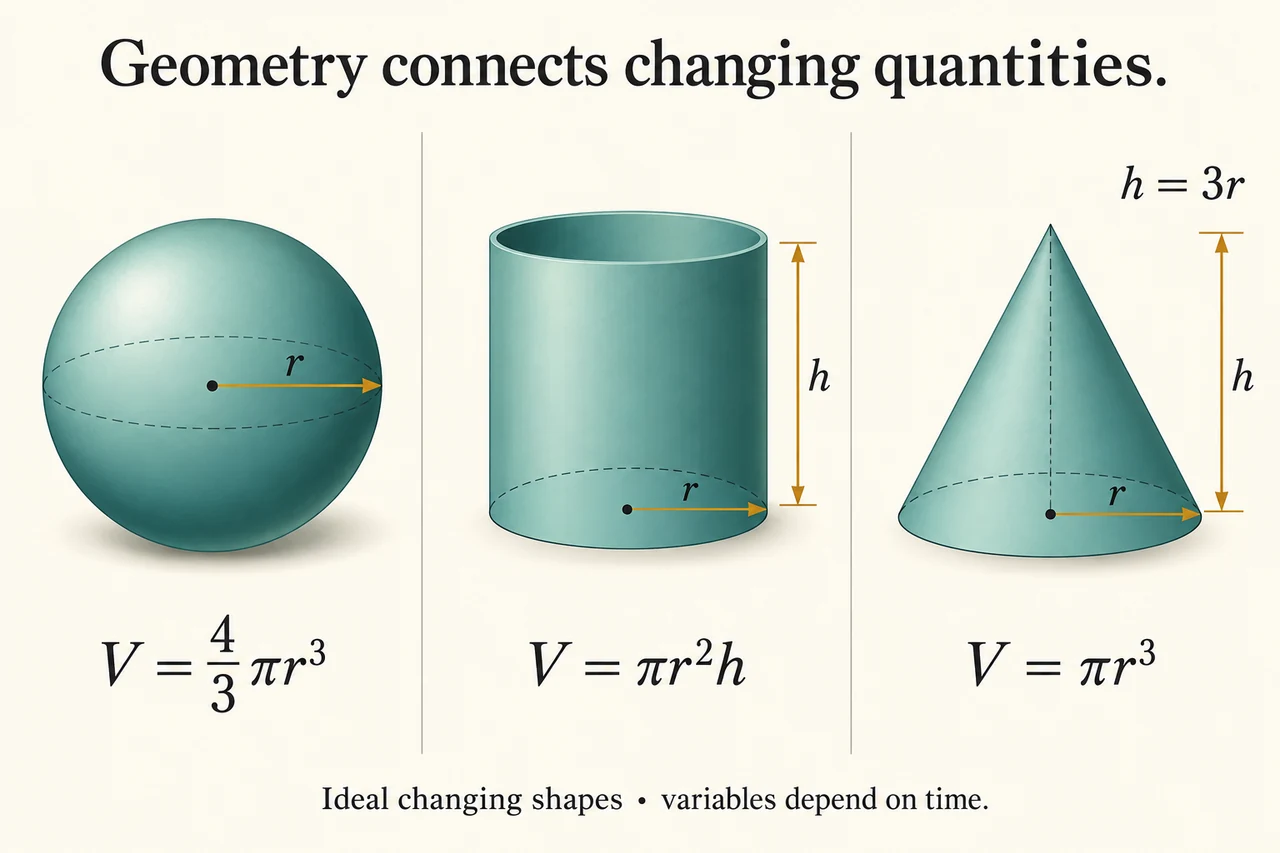
Image: illustration, not a documentary photograph. Ideal sphere, cylinder and maintained-ratio cone geometries, not measured vessels. Stated constraints determine which dimensions can change. · Original generated project artwork; no source textbook or exam-board figures reused.
Connected rates: identify what changes before cancelling symbols
Connected rates describe quantities that change together with time. If a sphere's radius r changes, its volume V changes because V=(4/3)πr³. The formula relates quantities; differentiating it with respect to time relates their rates. The chain rule gives dV/dt=(dV/dr)(dr/dt)=4πr²dr/dt. Here dV/dr is a volume change per radius change and has units of square length, while dV/dt has units of volume per time. Writing every variable and unit prevents a radius rate from being mistaken for a volume rate. A geometrical relation must hold for the changing object over the modelled interval, not merely at one isolated photograph.
Suppose an ideal sphere receives volume at 96π cm³/s and has radius 4 cm at the instant considered. Its radius rate is dr/dt=(96π)/(4π·4²)=3/2 cm/s. This is an instantaneous rate. If the volume supply stays constant while the sphere grows, the radius rate does not remain 1.5: the multiplying area 4πr² increases, so dr/dt falls. The differential equation is dr/dt=24/r² for r>0, with r measured in centimetres and t in seconds. Its constant 24 carries units cm³/s in this model. An initial radius is needed to select a particular trajectory, and the equation alone does not claim that a real balloon stays spherical or accepts material without pressure effects.
A cylinder exposes a common missing assumption. Its volume is V=πr²h. If the height h is fixed at 10 cm, differentiation gives dV/dt=20πr dr/dt. At r=3 cm with a volume supply 60π cm³/s, the radius rate is 1 cm/s. If h also varies, the product rule instead gives dV/dt=2πrh dr/dt+πr²dh/dt. The second term cannot be discarded just because a height value is given at the instant. A number such as h=10 cm identifies a local height; the separate statement “height is fixed” supplies dh/dt=0. Quantities given in a question and quantities held constant are different kinds of information.
A changing cone with the maintained relation h=3r has V=(1/3)πr²h=πr³, so dV/dt=3πr²dr/dt. At r=2 cm and dV/dt=36π cm³/s, dr/dt=3 cm/s and dh/dt=9 cm/s. These are rates of a geometrical cone whose whole shape changes with that relation. They are not automatically the rates of water rising in a fixed container. For a fixed conical vessel, the radius of the water surface and water depth may obey a similar ratio derived by similar triangles, but the variables must be defined as the liquid's changing dimensions. The container's dimensions stay fixed; confusing the vessel radius with the liquid-surface radius would make the derivative model inconsistent.
Surface area provides a second connection for the sphere. Since A=4πr², dA/dt=8πr dr/dt. At the original r=4 cm and dr/dt=3/2 cm/s, dA/dt=48π cm²/s. Increasing volume, increasing area and increasing radius therefore have different numerical values and units at the same instant. A solution that reports 48π cm/s has assigned an area rate the wrong units, even if the differentiation was otherwise correct. Rates should be checked against the quantity being differentiated, not against the familiar units of another variable in the diagram.
A rate law can also depend on the state. Suppose the stipulated inflow to the ideal sphere is proportional to its surface area: dV/dt=kA, where k is a positive constant in cm/s. Combining A=4πr² with the volume-rate relation gives 4πr²dr/dt=4πkr², hence dr/dt=k for r>0. Constant volume inflow and surface-area-proportional inflow produce different radius behaviour. This algebra constructs the differential equation from the stated law; it does not infer a physical mechanism for the inflow. A diagram can illustrate the dependence but cannot establish that a measured object obeys the law or that the chosen proportionality constant is realistic.
The same method supports decreasing quantities if signs are retained. For a sphere losing volume at 48π cm³/s, dV/dt is −48π, not a positive 48π with a verbal shrinking label. At radius 2 cm, dr/dt=−3 cm/s. The formula remains valid while r>0, but one cannot use it blindly after the model reaches zero radius: division by r² fails there, and a physical object cannot have the negative radius that an inappropriate continuation might suggest. Differential equations require a domain and assumptions as well as a symbolic derivative. Check whether contact, emptying, a valve limit or a change of shape ends the interval of validity.
A complete connected-rate answer defines the changing variables, writes a relationship that holds during the model, states what is fixed, differentiates with respect to time, substitutes the instantaneous values and checks units and sign. Rearranging a formula first can make differentiation easier, but it must preserve those assumptions. If another dimension changes, add its derivative term or use the stated relation between dimensions; do not silently set its rate to zero. If the question asks for a model equation rather than one local number, retain the variable dependence and specify the initial information still needed. Construction, numerical evaluation, general solution and practical validation are separate tasks.
Further answered rate-law check
Question: In the spherical model let dV/dt=kA with constant k>0. Is the radius rate still 24/r², and can the resulting equation be evaluated at r=0 by cancelling r²?
Answer: The inflow law has changed, so the old 24/r² expression is not retained. For r>0, substitution gives 4πr²dr/dt=4πkr² and hence dr/dt=k. The cancellation is justified only on that positive-radius domain. The original rate relation at r=0 reduces to 0=0 and does not by itself determine a derivative there; endpoint behaviour would need an additional definition or model. A limit of the positive-radius solution is not the same as a justification for dividing by zero.
Worked example: An ideal growing sphere receives volume at 96π cm³/s. At radius 4 cm, find the rates of radius and surface-area change. Construct its radius equation if the volume inflow remains constant.
1. Define r(t)>0 in centimetres, V(t) in cubic centimetres and A(t) in square centimetres, with t in seconds. The geometrical assumptions are a sphere and continuous differentiable changes.
2. Write V=(4/3)πr³ and differentiate with respect to time: dV/dt=4πr²dr/dt. The factor dr/dt is required because r depends on t.
3. Substitute r=4 and dV/dt=96π: dr/dt=96π/(64π)=3/2 cm/s. The positive sign agrees with the stipulated inflow.
4. Differentiate A=4πr²: dA/dt=8πr dr/dt. Substitute 4 and 3/2 to obtain 48π cm²/s.
5. Keep r variable for the constant-inflow model: dr/dt=96π/(4πr²)=24/r², valid for r>0 under the stated spherical assumption.
6. State that an initial radius is required to determine a particular r(t). The instantaneous 1.5 cm/s is not a constant radius-growth rate under constant volume inflow.
Answer: dr/dt=1.5 cm/s and dA/dt=48π cm²/s at the stated instant. The model equation is dr/dt=24/r² for r>0, with the stated units and an initial condition still needed.
Check your understanding: A cylinder has radius 3 cm and height 10 cm at an instant. Its volume increases at 60π cm³/s and its height increases at 2 cm/s. Find the radius rate. Compare the result with the genuinely fixed-height case.
Answer: Since both dimensions vary, differentiate V=πr²h to get dV/dt=2πrh dr/dt+πr²dh/dt. Substitution gives 60π=60π dr/dt+18π, so dr/dt=42/60=0.7 cm/s. The units in the middle equality are understood from the stated centimetre/second variables; the final rate is a length rate. If the height were fixed, dh/dt would be zero and the radius rate would instead be 1 cm/s. The increasing height accounts for part of the volume increase, so less must be supplied by radial growth. Merely knowing the instantaneous height 10 cm would not justify the fixed-height calculation.
Why: A complete connected-rate answer defines the changing variables, writes a relationship that holds during the model, states what is fixed, differentiates with respect to time, substitutes the instantaneous values and checks units and sign. Rearranging a formula first can make differentiation easier, but it must preserve those assumptions. If another dimension changes, add its derivative term or use the stated relation between dimensions; do not silently set its rate to zero. If the question asks for a model equation rather than one local number, retain the variable dependence and specify the initial information still needed. Construction, numerical evaluation, general solution and practical validation are separate tasks.