Implicit curves: a relation can contain more than one local branch
By UK A Level Mathematics · independent study · myAudience
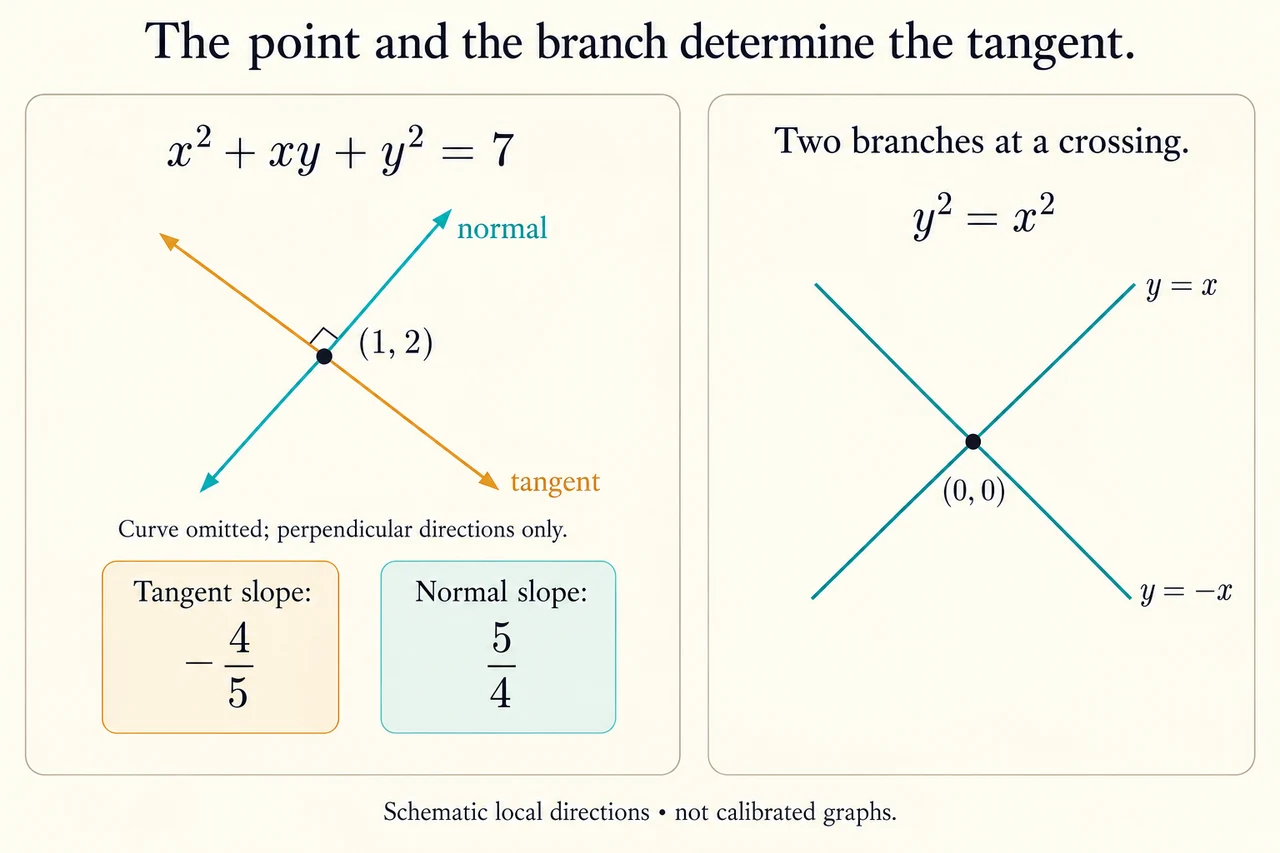
Image: illustration, not a documentary photograph. Conceptual tangent/normal and crossing directions; the original implicit curve is intentionally omitted. The diagram is not a calibrated curve plot. · Original generated project artwork; no source textbook or exam-board figures reused.
Implicit curves: a relation can contain more than one local branch
An equation can relate x and y without presenting y as a single formula in x. The circle x²+y²=25 includes both an upper and a lower branch; a single input between −5 and 5 usually has two different y-values. When finding a tangent at one named point, we work with a local branch through that point rather than declaring the entire curve a single-valued function. Implicit differentiation lets us obtain that branch's gradient without first solving the full equation for y. The point must satisfy the original relation, and the derivative must be checked for the conditions under which division is legitimate.
Treat y as depending on x along the branch. The derivative of y² is 2y(dy/dx), not 2y alone. The derivative of xy is y+x(dy/dx) by the product rule; x contributes its derivative 1 while y contributes its own rate. For x²+xy+y²=7, differentiation gives 2x+y+x(dy/dx)+2y(dy/dx)=0. Grouping the gradient terms yields (x+2y)(dy/dx)=−(2x+y). Where x+2y≠0, the gradient is −(2x+y)/(x+2y). This is a local derivative formula on the relation, not a new definition for arbitrary pairs (x,y).
At (1,2), the original equation gives 1+2+4=7, so the named point lies on the curve. Its gradient is −(2+2)/(1+4)=−4/5. The tangent is y−2=−(4/5)(x−1), and the normal is y−2=(5/4)(x−1). A negative gradient describes the local direction of change as x increases; it does not imply that every point on the whole curve slopes down. The other point with x=1 is y=−3, found from y²+y−6=0, and its gradient is −1/5. A derivative expression involving both coordinates therefore requires the selected point, not merely its horizontal input.
A zero denominator asks for analysis rather than a calculator error. On this curve x+2y=0 means y=−x/2. Substitution into the original relation gives 3x²/4=7, so x=±2√(7/3), with the corresponding opposite-signed y-values. At those points 2x+y=3x/2 is nonzero. The rearranged derivative equation has a nonzero right side and zero coefficient on a finite dy/dx; the tangent is vertical. More explicitly, write F=x²+xy+y²−7. Its partial derivatives are F_x=2x+y and F_y=x+2y. The tangent relation F_x Δx+F_y Δy=0 reduces to Δx=0 when F_y=0 and F_x≠0. This establishes a vertical tangent without assigning an ordinary real number called infinity to the gradient.
A horizontal tangent instead requires 2x+y=0 with x+2y nonzero. Substituting y=−2x into the relation gives 3x²=7, so x=±√(7/3) and y=∓2√(7/3). At these points x+2y=−3x≠0, and the gradient is zero. The normal is vertical, expressed as x equal to the point's horizontal coordinate. The formula −1/m cannot be evaluated at m=0. Treat horizontal and vertical cases as line directions with appropriate equations rather than forcing every normal into a finite-gradient template.
If both derivative coefficients vanish, this reasoning needs another method. For y²=x² at (0,0), differentiation gives 2y dy/dx=2x, and the quotient x/y is 0/0 at the origin. The original relation is the union of y=x and y=−x, which cross there with different tangent directions. It has no unique tangent for the whole union at the crossing. For the earlier ellipse-like relation, F_x and F_y vanish simultaneously only at (0,0), which is not on its level 7 curve; that particular singularity does not arise. A missing denominator and a singular crossing are different situations, so neither should be labelled automatically as a vertical tangent.
Implicit differentiation can combine familiar functions. For x²+xy+y²=12, the formal gradient expression stays −(2x+y)/(x+2y), but the points on the curve change. At (2,2), which satisfies 4+4+4=12, the gradient is −1 and the normal gradient 1. The identical derivative formula across two level curves does not permit reusing the earlier point or line intercept. The relation's constant has derivative zero yet still determines which points exist. This explains why differentiating an equation discards some information: retain the original equation alongside the derivative for domain, point and branch checks.
A complete local-line answer verifies the point, differentiates every occurrence of the dependent variable, collects the gradient terms, checks the coefficient used for division and evaluates at the chosen branch. If asked about all horizontal or vertical tangents, solve the relevant condition simultaneously with the original relation and test the remaining coefficient. If both vanish, inspect the original geometry or use a suitable higher-order argument. These steps make failures meaningful: an off-curve point, a forbidden division and a crossing do not all indicate the same kind of missing answer. A generated drawing may illustrate the distinction but is not the proof that a curve has those local properties.
Further answered singularity check
Question: Does the vanishing denominator in y′=x/y for y²=x² prove a vertical tangent at (0,0)?
Answer: No. Both numerator and denominator vanish. The original relation splits into y=x and y=−x, whose slopes are 1 and −1. Each branch has its own tangent, while the crossing union has no single tangent direction there. The vertical-tangent test needs the other coefficient to remain nonzero; this example fails that condition.
Worked example: For x²+xy+y²=7, find the tangent and normal at (1,2). Determine how a vertical tangent is detected and identify its possible horizontal coordinates.
1. Verify the point: 1²+1·2+2²=7. It belongs to the required relation.
2. Differentiate with respect to x along a local branch: 2x+y+x y′+2y y′=0. Both the product and chain contributions are necessary.
3. Collect terms to get (x+2y)y′=−(2x+y). At (1,2), the coefficient is 5, so division is allowed and y′=−4/5.
4. Write y−2=−(4/5)(x−1) for the tangent. The nonzero gradient gives normal gradient 5/4, so the normal is y−2=(5/4)(x−1).
5. For a prospective vertical tangent, solve x+2y=0 with the original equation. Substitution gives 3x²/4=7, hence x=±2√(7/3) and y=−x/2.
6. At those points 2x+y=3x/2≠0. The tangent relation therefore forces Δx=0, establishing the vertical lines at those two x-values rather than a finite slope.
Answer: The tangent and normal at (1,2) are y−2=−(4/5)(x−1) and y−2=(5/4)(x−1). The vertical tangents have x=±2√(7/3), with the corresponding points on the relation.
Check your understanding: Change the relation to x²+xy+y²=12 and use point (2,2). A learner keeps the earlier line y−2=(5/4)(x−1) because the derivative formula is unchanged. Find the actual normal and explain the mistake.
Answer: The new point satisfies 12. The gradient formula remains −(2x+y)/(x+2y), but evaluation now gives −6/6=−1. Its normal gradient is 1, and the line through (2,2) is y−2=x−2, equivalently y=x. The earlier line passes through (1,2) and uses a different local gradient. A level constant disappears during differentiation but remains necessary to identify the actual curve and point; identical formulas do not give identical local lines at different coordinates.
Why: A complete local-line answer verifies the point, differentiates every occurrence of the dependent variable, collects the gradient terms, checks the coefficient used for division and evaluates at the chosen branch. If asked about all horizontal or vertical tangents, solve the relevant condition simultaneously with the original relation and test the remaining coefficient. If both vanish, inspect the original geometry or use a suitable higher-order argument. These steps make failures meaningful: an off-curve point, a forbidden division and a crossing do not all indicate the same kind of missing answer. A generated drawing may illustrate the distinction but is not the proof that a curve has those local properties.