Parametric curves: one point can be reached by different branches
By UK A Level Mathematics · independent study · myAudience
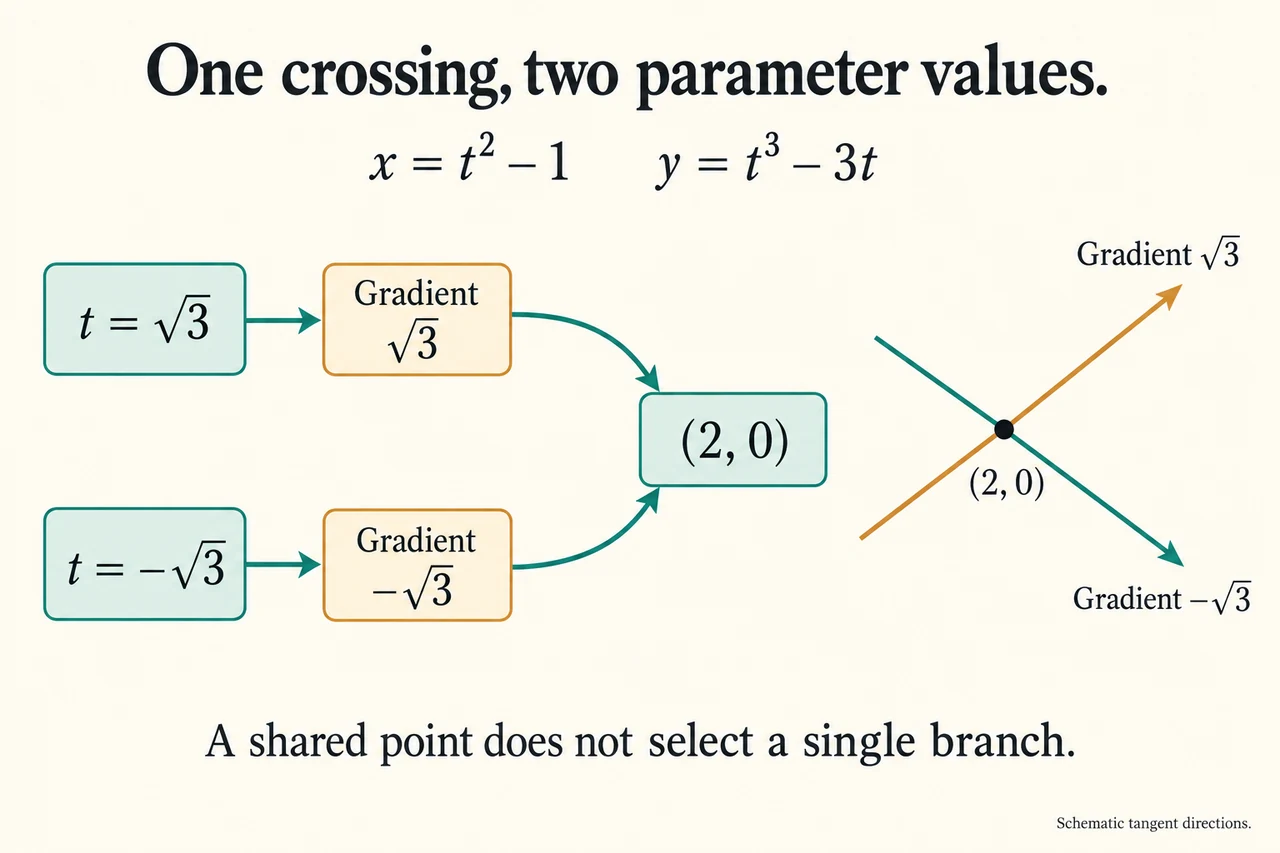
Image: illustration, not a documentary photograph. Local parameter branches and line directions are schematic, not a calibrated whole-curve graph. First derivatives only; singular cases need the full explanation. · Original generated project artwork; no source textbook or exam-board figures reused.
Parametric curves: one point can be reached by different branches
A parameter describes a curve by giving both coordinates as functions of another variable: x=x(t), y=y(t). The parameter might represent time in a stated physical model, but it can simply be a mathematical label. If t is only a parameter, do not call dx/dt a measured velocity or assume seconds as its units. The coordinates can trace a curve that would be awkward to describe using one globally single-valued y(x). A coordinate pair can occur at more than one parameter value, so a tangent question must identify the relevant passage through the point or ask about every possible branch.
Where dx/dt is nonzero, the chain rule gives dy/dx=(dy/dt)/(dx/dt). The denominator condition matters. This ratio compares how the two coordinates change along the same parameter branch; it does not divide the coordinates themselves. To find a tangent, determine the point from x(t) and y(t), calculate both parameter derivatives, verify that the division is allowed and evaluate the ratio at the stated parameter. A result such as dy/dx=0 identifies a horizontal direction only if the denominator remains nonzero. If it vanishes, inspect the original parametrisation instead of treating every failure of the ratio as a single kind of tangent.
For x=t²−1 and y=t³−3t, dx/dt=2t and dy/dt=3t²−3. At t=2 the point is (3,2), dx/dt=4 and dy/dt=9, so the gradient is 9/4. The tangent is y−2=(9/4)(x−3), and the perpendicular normal is y−2=−(4/9)(x−3). The point's coordinates are not (2,2): t=2 is a label from which x and y are calculated. Confusing parameter with horizontal coordinate would produce a plausible but misplaced line even if the slope formula were correct.
At t=0 the same curve passes through (−1,0). Its horizontal parameter derivative is zero while its vertical derivative is −3, which is nonzero. The local direction is therefore vertical, and the tangent is x=−1. One can check this through the coordinate increments: for a small nonzero t, x+1=t² and y=t³−3t, so the horizontal change is of smaller order than the vertical change. The normal is horizontal, y=0. Do not enter 0 in the denominator and then use a negative reciprocal of an undefined number; vertical and horizontal line equations already express the directions cleanly.
A crossing shows why branch identification is necessary. The point (2,0) occurs at both t=√3 and t=−√3 because t²−1=2 and t(t²−3)=0. At these two parameter values the numerator 3t²−3 is 6, while the denominators are 2√3 and −2√3. The gradients are √3 and −√3. Thus the crossing has two tangents, y=√3(x−2) and y=−√3(x−2). A point alone does not select one of them. Dividing after substituting y=0 into an eliminated equation without retaining both branches could silently lose this distinction.
Horizontal tangents occur when 3t²−3=0 and 2t≠0, so t=±1. At t=1 the point is (0,−2), and at t=−1 it is (0,2). Their tangent lines are y=−2 and y=2, with vertical normals x=0. Neither is the crossing (2,0), even though several examples involve a zero coordinate. A zero y-value, zero dy/dt and zero dy/dx are different statements. Check the original coordinates and both derivatives before labelling a special point.
When both parameter derivatives vanish, the quotient alone does not settle the geometry. For x=t³ and y=t⁶ at t=0, both derivatives are zero. Yet eliminating the parameter gives y=x², which has a horizontal tangent at the origin. For x=t² and y=t³, both derivatives also vanish at 0, but the parametrisation has a cusp; its local tangent direction is horizontal, while the way the curve is traversed and its two sides differ. Those examples are not covered by substituting 0/0 into the quotient. A limiting ratio or the original relation supplies additional information. A stopped parameter speed, a regular vertical tangent and a singular cusp should not be treated as interchangeable cases.
Change the parametrisation to x=t²+1 and y=2t³−t. At t=1 the point is (2,1), dx/dt=2 and dy/dt=5, giving gradient 5/2 and normal gradient −2/5. The normal is y−1=−(2/5)(x−2). The derivative technique stays the same, but both coordinates, both derivative values and the resulting line have to be recomputed. A parameter diagram can show ordered passage along the branch; it does not justify retaining coordinates from an earlier curve. If the parameter is later assigned physical meaning, its units and valid time interval must also be stated rather than inferred from an arrow on the image.
Further answered zero-over-zero check
Question: For x=t³ and y=t⁶ at t=0, does the ratio of parameter derivatives show a vertical tangent?
Answer: No. Both derivatives vanish, so direct substitution yields an indeterminate 0/0 and the nonzero-denominator formula cannot be evaluated that way. The relation is y=x², which has derivative 2x and hence horizontal tangent y=0 at the origin. Equivalently, for t≠0 the ratio 6t⁵/(3t²)=2t³ tends to 0. The zero parameter speed does not itself determine a vertical tangent; additional local information is required.
Worked example: For x=t²−1 and y=t³−3t, find the tangent and normal at t=2, the tangent at t=0 and both tangents at (2,0).
1. Differentiate the coordinate functions: dx/dt=2t and dy/dt=3t²−3. Where t≠0, their ratio is (3t²−3)/(2t).
2. At t=2, calculate x=3 and y=2. The derivatives are 4 and 9, so the gradient is 9/4 and the tangent is y−2=(9/4)(x−3).
3. The nonzero finite gradient gives normal gradient −4/9, hence y−2=−(4/9)(x−3). Both lines pass through the calculated coordinate pair.
4. At t=0, the point is (−1,0), dx/dt=0 and dy/dt=−3≠0. Its tangent is vertical, x=−1; its normal is horizontal, y=0.
5. For (2,0), solve x=2 to get t=±√3 and verify y=0 for both. The point is reached by two parameter branches.
6. Evaluate the ratio at those values: 6/(2√3)=√3 and 6/(−2√3)=−√3. The two tangent equations are y=±√3(x−2), each sign belonging to its respective passage.
Answer: At t=2 the tangent and normal are y−2=(9/4)(x−3) and y−2=−(4/9)(x−3). At t=0 the tangent is x=−1. At (2,0) there are two tangents, y=√3(x−2) and y=−√3(x−2).
Check your understanding: For x=t²+1 and y=2t³−t, find the normal at t=1. Is its point (1,1) because the parameter and vertical coordinate are both 1?
Answer: No. The horizontal coordinate is x(1)=2, while y(1)=1, so the point is (2,1). The parameter derivatives are 2t and 6t²−1, giving 2 and 5 at 1. Therefore dy/dx=5/2 and the normal gradient is −2/5. Its line is y−1=−(2/5)(x−2). Calling the parameter the horizontal coordinate would shift the line to the wrong point. Both its slope and location must be computed from the new coordinate functions.
Why: Change the parametrisation to x=t²+1 and y=2t³−t. At t=1 the point is (2,1), dx/dt=2 and dy/dt=5, giving gradient 5/2 and normal gradient −2/5. The normal is y−1=−(2/5)(x−2). The derivative technique stays the same, but both coordinates, both derivative values and the resulting line have to be recomputed. A parameter diagram can show ordered passage along the branch; it does not justify retaining coordinates from an earlier curve. If the parameter is later assigned physical meaning, its units and valid time interval must also be stated rather than inferred from an arrow on the image.