Why sine differentiates to cosine — and why radians matter
By UK A Level Mathematics · independent study · myAudience
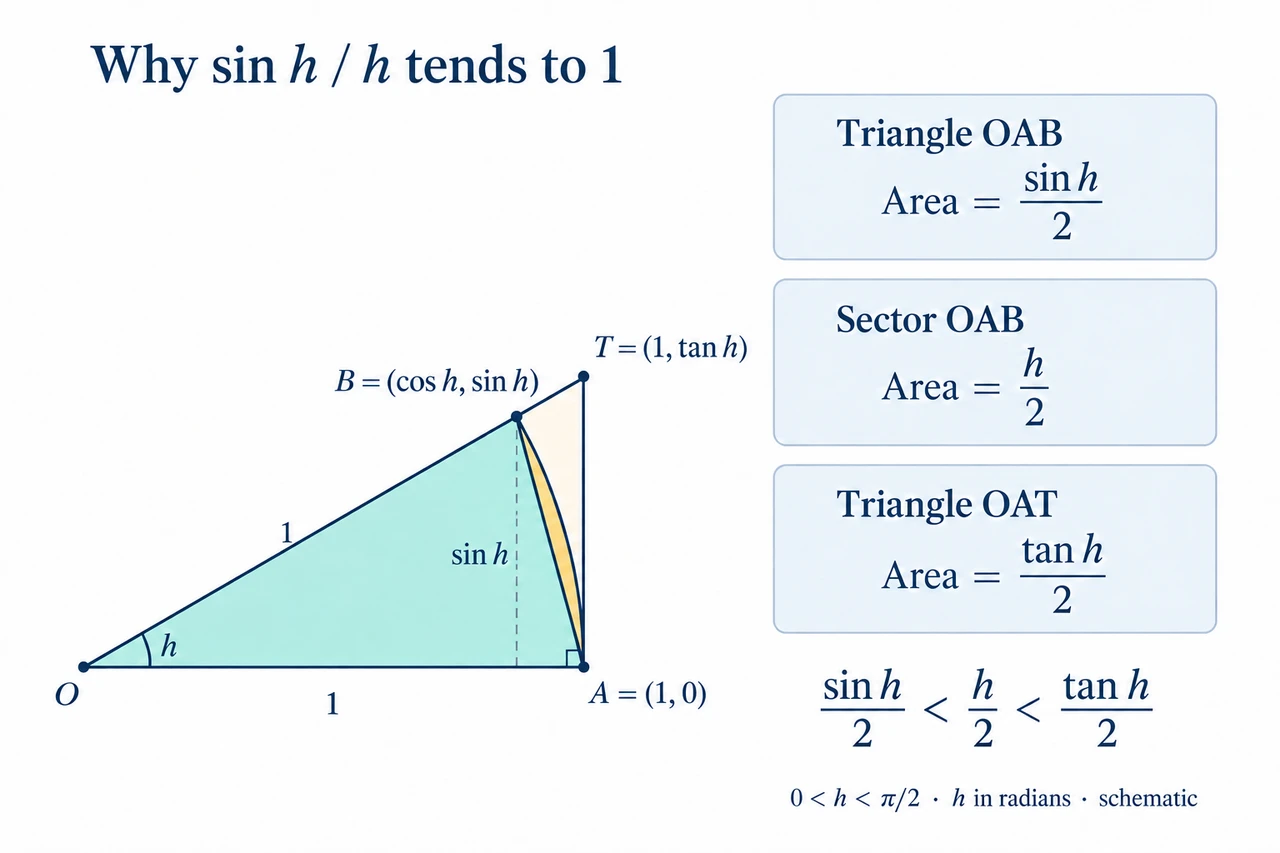
Image: illustration, not a documentary photograph. Schematic unit-circle construction for an acute angle h in radians. Triangle OAB (teal) is inside sector OAB (the teal triangle plus the gold curved sliver), which is inside triangle OAT. OA and OB are unit radii; O, B and T share one straight ray, and AT is tangent at A. The dashed perpendicular height from B is sin h. The written coordinates and area formulas are authoritative; the illustration is not for measuring a numerical angle or area. For 0 < h < π/2, the three areas satisfy (sin h)/2 < h/2 < (tan h)/2. · Original project illustration; rendered schematic teaching aid, not a calibrated measurement or exam-board figure.
Why sine differentiates to cosine — and why radians matter
A formula such as d(sin x)/dx=cos x is a conclusion, rather than a substitute for a proof. At an arbitrary real input x, start with the slope between the points at x and x+h: [sin(x+h)−sin x]/h, for h≠0. A derivative exists when this quotient has one finite limit as h approaches zero from either side. Substituting h=0 immediately gives an undefined quotient and proves nothing. Nor does a numerical table prove that a limit has the proposed value. The useful task is to rewrite the quotient in terms of simpler limits whose existence has been established independently. Here the required foundation comes from unit-circle geometry, not from already assuming trigonometric derivatives.
Angles throughout the basic proof are measured in radians. On a circle of radius 1, a positive angle h subtends an arc of length h, and its sector has area h/2. Accept these Euclidean circle/sector facts, the trigonometric addition identities, parity identities, ordinary limit laws and the squeeze theorem as prerequisites. For 0<h<π/2, let O=(0,0), A=(1,0), B=(cos h,sin h), and T=(1,tan h), where T lies on the ray OB and on the tangent line through A. Triangle OAB sits inside sector OAB, which sits inside triangle OAT. Their areas are respectively (sin h)/2, h/2 and (tan h)/2. Therefore sin h<h<tan h. This is a comparison of positive areas, not an assertion that sine equals its angle at a nonzero input.
The same comparison first establishes sin h→0 as h→0⁺, because 0<sin h<h. For negative h, odd symmetry sin(−h)=−sin h gives the corresponding bound in magnitude, so sine tends to zero from both sides. Near zero, cos h is positive and cos h=√(1−sin²h); the continuity of the square-root function and the limit laws give cos h→1 without using a derivative formula. Now divide the positive inequality sin h<h<sin h/cos h: it yields cos h<sin h/h<1. The outer expressions both tend to 1, so the squeeze theorem gives sin h/h→1 for positive h. The quotient is even, since sin(−h)/(−h)=sin h/h; the negative-side limit is also 1. All divisions were made at nonzero h, and positivity ensured that the inequality directions were legitimate.
The second necessary limit is (cos h−1)/h→0. For sufficiently small nonzero h, 1+cos h is positive and nonzero. Multiply the numerator by its conjugate to obtain (cos h−1)/h=−sin²h/[h(1+cos h)]=−(sin h/h)·[sin h/(1+cos h)]. The first factor tends to 1 and the second to 0/2=0, so the product tends to 0 from both sides. Do not use a quotient law with denominator h tending to zero before doing this rearrangement: the quotient law requires a nonzero limiting denominator. After rearranging, the remaining denominator has limit 2. L’Hôpital’s rule would be circular here if its application relied on the sine and cosine derivatives being proved.
For any fixed real x, use the addition identity sin(x+h)=sin x cos h+cos x sin h. The difference quotient becomes sin x·[(cos h−1)/h]+cos x·[sin h/h]. The factors sin x and cos x are constants with respect to h. The two independently proved limits give sin x·0+cos x·1=cos x. This shows that the derivative exists at every real x, including inputs where sine itself is zero or has a horizontal tangent. It is the existence of the two component limits that licenses the sum and product limit laws. There is no need to divide by sin x or cos x, so no extra exclusions are introduced.
Cosine needs its own sign-sensitive argument. The identity cos(x+h)=cos x cos h−sin x sin h gives [cos(x+h)−cos x]/h=cos x·[(cos h−1)/h]−sin x·[sin h/h]. Passing to the limit gives−sin x. The negative sign comes from the cosine addition identity; it cannot be chosen by remembering that the graph sometimes decreases. At x=0, cosine's derivative is 0; at x=π/2 it is−1. These two checks agree with the unit-circle graph, but the proof applies to every real input rather than only those sample points. The reasoning depends on radian measure in the foundational sine ratio.
The input scale can be derived directly rather than smuggled into a formula. For a fixed nonzero real k and fixed phase b, the quotient for sin(kx+b) rewrites as sin(kx+b)·[(cos(kh)−1)/h]+cos(kx+b)·[sin(kh)/h]. Put u=kh. As h approaches zero, u approaches zero; for negative k the direction reverses, but the available limits are two-sided. The two factors become k(cos u−1)/u→0 and k sin u/u→k. Hence the derivative is k cos(kx+b). The corresponding cosine argument gives−k sin(kx+b). When k=0 the function is constant and its quotient is exactly zero; do not use u=kh to divide by a zero scale. These proofs justify constant input scaling without requiring the general chain rule as an unstated premise.
Sources, rights and unresolved assessment
Official scope: Pearson Edexcel 9MA0 Issue 4 February 2020, Pure 7.1, PDF page 26 (1-based), printed 22, checked 2026-10-05; existing inherited requirement pearson-9ma0-pure-7-1-05 is A-Level-only. https://qualifications.pearson.com/content/dam/pdf/A%20Level/Mathematics/2017/specification-and-sample-assesment/a-level-l3-mathematics-specification-issue4.pdf
Verification reference: OpenStax Calculus Volume 1 2.3, unit-circle squeeze limits and conjugate limit; 3.5, addition-identity sine derivative proof. Bodies obtained directly from the publisher and read 2026-10-05. https://openstax.org/books/calculus-volume-1/pages/2-3-the-limit-laws and https://openstax.org/books/calculus-volume-1/pages/3-5-derivatives-of-trigonometric-functions. The cosine, scaled-input, degree and joined-piece explanations and all example tasks/answers here are original. No publisher diagram, exercise or mark scheme is copied. Standard mathematical identities/proof structure are independently expressed. Publisher licensing must be honoured if any of its actual text or art is later reused; this packet proposes no such asset reuse.
This bounded lesson is not a complete mathematical foundations treatment: Euclidean area facts, addition identities, square-root continuity, limit laws and the squeeze theorem are stated prerequisites. Formal epsilon-delta construction, independent assessment, numerical/error analysis beyond stated checks, general chain-rule proof, whole-qualification coverage remain open. The selected illustration and prepared variants have been visually checked; the 160-pixel version supports recognition, not reading every label.
If d is a numerical angle in degrees, the function meant by “sine of d degrees” is S(d)=sin(πd/180), with the sine on the right taking radian input. Its derivative with respect to the number of degrees is (π/180)cos(πd/180), not simply cosine. The derivative of cosine of d degrees similarly includes−π/180. At d=0 the sine slope is π/180 per degree, whereas the radian-input sine slope at x=0 is 1 per radian. These describe the same geometry using different input units. A calculator's angle mode is therefore part of interpreting a numerical difference quotient. In a time-dependent model, distinguish the phase angle in radians, the angular frequency in radians per second, and the derivative output units. The proof does not establish that a sine model describes a particular real machine accurately.
Image caption: Schematic unit-circle construction for an acute angle h in radians. Triangle OAB (teal) is inside sector OAB (the teal triangle plus the gold curved sliver), which is inside triangle OAT. OA and OB are unit radii; O, B and T share one straight ray, and AT is tangent at A. The dashed perpendicular height from B is sin h. The written coordinates and area formulas are authoritative; the illustration is not for measuring a numerical angle or area. For 0 < h < π/2, the three areas satisfy (sin h)/2 < h/2 < (tan h)/2.
Worked example: Starting from the limit definition, derive the derivative of y=cos x at an arbitrary real x. State every foundational limit used and show why no value of x needs to be excluded. Find the tangent and normal at x=π/6; x is in radians.
For h≠0, the quotient is [cos(x+h)−cos x]/h. Use the cosine addition identity to rewrite it as cos x·[(cos h−1)/h]−sin x·[sin h/h]. The independently established limits are 0 and 1 respectively; the trigonometric factors depend on x, which is fixed while h tends to zero. The derivative is therefore−sin x for every real x. No division by either trigonometric factor occurred. At x=π/6, the point has height cos(π/6)=√3/2 and the derivative is−sin(π/6)=−1/2. The tangent is y−√3/2=−(1/2)(x−π/6). Its nonzero finite slope gives normal slope 2, so the normal is y−√3/2=2(x−π/6). Their slopes have product−1. At a zero tangent slope one would instead specify a vertical normal; taking−1/0 would not produce a finite slope.
Worked model 2: a scaled-input proof before evaluation
Task. Without assuming a chain rule, obtain the derivative of F(x)=sin(4x−π/6)+2 cos(3x) from the two limit patterns. Find the point, slope, tangent and normal at x=π/6.
Complete reasoning. In the sine quotient the phase is fixed at θ=4x−π/6 while the increment is 4h. The addition identity gives sin θ·[(cos(4h)−1)/h]+cos θ·[sin(4h)/h]. Substitution u=4h makes the respective limits 0 and 4. Thus the sine contribution is 4 cos(4x−π/6). The cosine quotient at phase 3x has increment 3h. Its two terms have limits 0 and−3 sin(3x); the output multiplier 2 makes that contribution−6 sin(3x). Add the two justified finite limits to get F′(x)=4 cos(4x−π/6)−6 sin(3x). At x=π/6, both phases areπ/2, so F(π/6)=1 and F′(π/6)=−6. The tangent is y−1=−6(x−π/6), while the normal is y−1=(1/6)(x−π/6). The input scales 4 and 3 multiply derivative magnitudes because the corresponding increment is a multiple of h, not because of any output coefficient in the original sine term.
Answer. F′(x)=4 cos(4x−π/6)−6 sin(3x), with real domain unchanged. The point is(π/6,1), tangent slope−6 and normal slope 1/6. Both constant scales were justified from the limit definition; any later use of a general chain rule is a separate result.
Unfamiliar transfer 1: a degree-input rate with a misleading answer
Question. A learner defines G(d)=3 sin(2d degrees)+5 and claims G′(15)=6 cos(30°)=3√3. Derive the derivative with respect to the numerical degree input d from a radian representation. State the correct height and rate at d=15 and explain the missing factor.
Complete answer. Write G(d)=3 sin(πd/90)+5. Its constant input scale is π/90, so the already justified scaled-sine proof gives G′(d)=(π/30)cos(πd/90). At d=15 the phase isπ/6, and G(15)=3/2+5=13/2. The rate is (π/30)(√3/2)=π√3/60 output units per degree. The proposed 3√3 is missing π/180: it would be the correct derivative if the same algebraic-looking input had meant radians instead of degrees. Merely entering cosine of 30° on a calculator does not fix a derivative taken with respect to the wrong input scale. The constant 5 changes the height but contributes zero rate.
Unfamiliar transfer 2: continuity does not guarantee a shared derivative
Question. Let P(x)=sin(2x) for x≥0 and P(x)=3 sin x for x<0, with angles in radians. Is P differentiable at 0? A learner says that both formula pieces are smooth and both have value 0 there, so their common derivative must be 0. Use first-principles one-sided quotients to decide.
Complete answer. P(0)=0 and both one-sided function limits are 0, so P is continuous at 0. For h>0, [P(h)−P(0)]/h=sin(2h)/h=2·sin(2h)/(2h)→2. For h<0, the quotient is 3 sin h/h→3. The one-sided limits disagree, so P has no derivative at 0. The individual pieces are smooth away from the join, but this does not make their tangent slopes match there. A common zero height is a continuity condition, not a zero-gradient condition. On x>0, P′(x)=2 cos(2x); on x<0, P′(x)=3 cos x. No derivative value should be filled in at 0.
Answer: The first-principles derivative is−sin x on all real inputs. At the requested point, the tangent slope is−1/2 and normal slope 2, with the equations given above. Geometric circle/sector facts, the addition identity and the two radian limits are prerequisites; the derivative formula was not assumed in its own proof.
Check your understanding: To establish lim(h→0) sin h/h=1, a learner applies L’Hôpital’s rule and writes cos 0/1=1, then uses that limit to prove d(sin x)/dx=cos x. Explain why this is not an independent foundation for the derivative proof, and give a non-circular route instead.
Answer: The calculation assumes that differentiating sin h produces cos h, which is the result the subsequent proof is meant to establish. Even if L’Hôpital’s hypotheses were otherwise verified, this argument cannot provide an independent derivation of that result. Start from radian unit-circle area comparisons for 0<h<π/2, obtain sin h<h<tan h, establish sin h→0 and cos h→1 geometrically, and squeeze cos h<sin h/h<1. Odd symmetry extends the sine ratio to negative increments. Then prove the cosine-difference limit by conjugation, and only after that apply the addition identities to the derivative quotients. No trigonometric derivative is needed in that chain of reasoning.
Why: Audit which results a proposed limit argument already uses. Applying L’Hôpital to the sine ratio requires differentiating its numerator, so it imports the derivative that this lesson is trying to justify. A valid foundational route instead orders the dependencies: geometric area comparison and continuity, the two-sided squeeze, the conjugate cosine limit, then addition identities in the derivative quotient. The check tests independence of the proof, rather than whether the final numerical limit happens to be correct.