Find area by deciding which boundary is above
By UK A Level Mathematics · independent study · myAudience
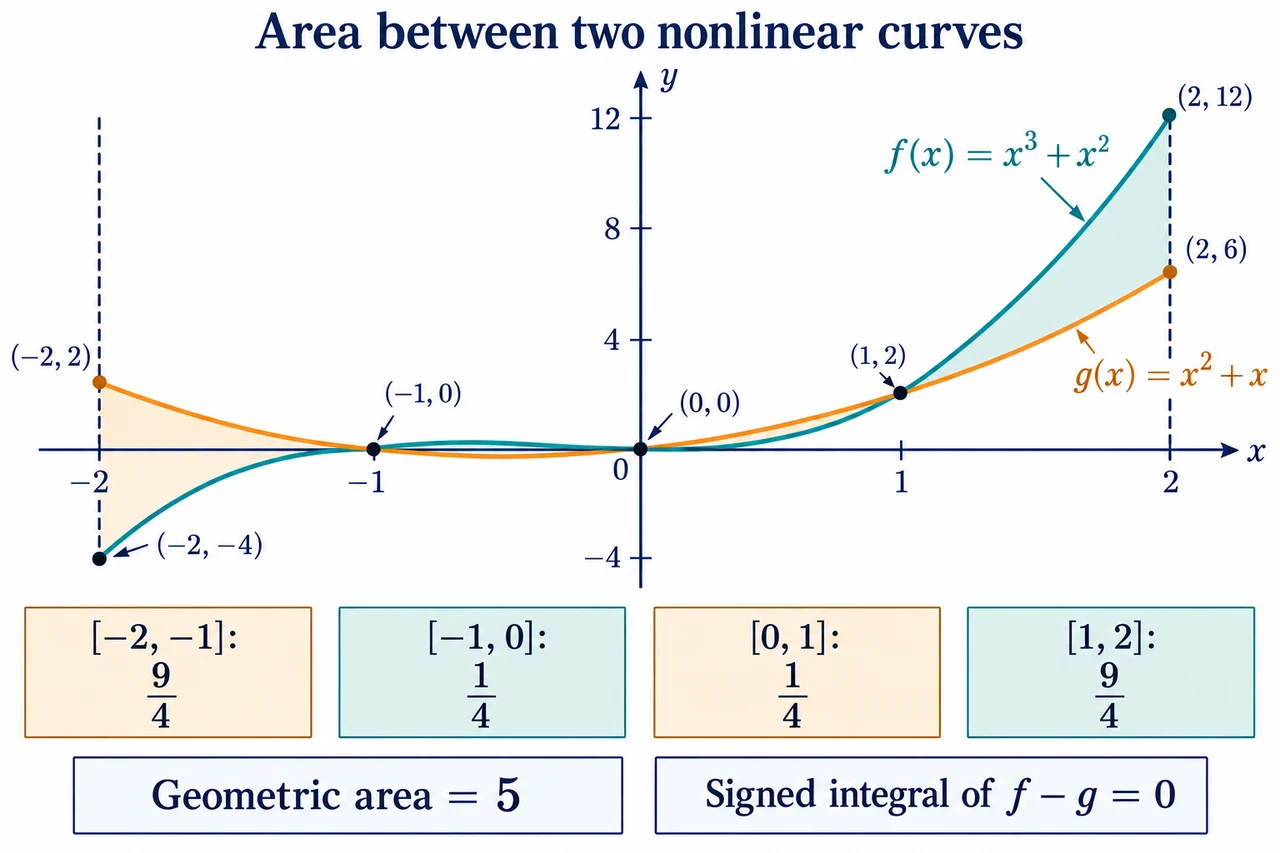
Image: illustration, not a documentary photograph. The two nonlinear boundaries are f(x)=x³+x² and g(x)=x²+x on [−2,2], with intersections (−1,0), (0,0), (1,2) and endpoint values f(−2)=−4, g(−2)=2, f(2)=12, g(2)=6. Their difference h=x³−x has signs −,+,−,+ on the four intervals, so the upper boundary is g,f,g,f. Positive piece areas 9/4,1/4,1/4,9/4 sum to 5, while the signed integral of f−g is 0. The central features are small on this y-scale; rendered curves are schematic and formulas, coordinates and sign checks are authoritative. f stays nonnegative near zero and positive for x>0. The 160-pixel preview supports recognition, not reading every coordinate or resolving the central lobes. · Original project scientific illustration; schematic teaching aid, not a calibrated measurement or exam-board figure.
Find area by deciding which boundary is above
Before integrating, name the region. A curve alone usually does not close a finite area: an axis, another curve or specified straight lines must finish the boundary. If the region lies between y=f(x) and y=g(x), with vertical ends x=a and x=b, a thin vertical strip has width Δx and height equal to the upper y-value minus the lower y-value. That height is nonnegative. Multiplying the two gives a small area; summing increasingly narrow strips leads to an integral. The units also follow the geometry: horizontal units multiplied by vertical units give area units. When both coordinates are lengths in metres, the result is in square metres. A diagram helps identify the boundary, but it is the equations and interval that define the mathematical region.
Delivery and source scope
The curve-and-straight-line material is AS-and-A-level; the two-curved-boundary extension is A-level-only. This single private lesson does not claim the entire extension is AS content. All independent assessment and full qualification coverage remain open.
For continuous curves with f(x)≥g(x) throughout [a,b], every strip has height f(x)−g(x), so the area is ∫ₐᵇ[f(x)−g(x)] dx. The names f and g do not decide which is upper. If the curves exchange positions, the geometric height becomes |f(x)−g(x)|; in practice, split the interval where their order changes and integrate the appropriate subtraction on each piece. This is why solving f(x)=g(x) is part of finding an area, rather than an unrelated algebra exercise. A raw difference integral records oriented contributions and can contain cancellation. Taking the absolute value of its final answer cannot reconstruct area that has already cancelled. Positivity belongs inside the accumulated strip heights.
A curve and the horizontal axis provide the simplest ordering test. Above the axis, strip height is f(x); below it, strip height is −f(x). Factorising the function or checking signs between its zeros tells us which formula applies. Consider y=x²−4x+3, the x-axis and the vertical lines x=0 and x=4. The factorisation (x−1)(x−3) gives crossings at 1 and 3. The curve is above the axis on [0,1], below it on [1,3] and above it on [3,4]. All three pieces belong to the stated region. Integrating over [0,4] once would combine positive and negative contributions; the geometric question requires all three positive areas. This curve-and-straight-line example belongs to the AS core as well as A-level mathematics.
An antiderivative of that quadratic is F(x)=x³/3−2x²+3x. Its endpoint values are F(0)=0, F(1)=4/3, F(3)=0 and F(4)=4/3. The first piece contributes F(1)−F(0)=4/3. The middle piece lies below the axis, so its area is −[F(3)−F(1)]=4/3. The last contributes F(4)−F(3)=4/3. Their total is 4 area units. By contrast, the signed integral is F(4)−F(0)=4/3. Neither answer is an arithmetic accident: they answer different questions. A sketch that omits the region below the axis would omit one of the specified pieces, while reporting |4/3| as the total area would lose the cancellation information.
For the A-level extension, apply the same strip argument to two curved boundaries. First find their intersections within the interval of interest, then determine the sign of their difference on every resulting interval. An intersection need not change the ordering: y=x² and y=0 touch at x=0, yet x² stays above the axis on both sides. A repeated root therefore deserves a sign check, not an automatic change of subtraction. Vertical end lines can also enclose pieces beyond the outermost intersections. Decide whether the question requests the whole region between those end lines or only one naturally enclosed component. Both are valid geometric questions, but they have different limits and can have different answers.
Take f(x)=x³+x² and g(x)=x²+x between x=−2 and x=2. Both boundaries are nonlinear, while their difference is h(x)=f(x)−g(x)=x³−x=x(x−1)(x+1). They intersect at (−1,0), (0,0) and (1,2). The endpoint values are f(−2)=−4, g(−2)=2, f(2)=12 and g(2)=6; the vertical end lines retain the outer pieces. On the four consecutive intervals the difference signs are negative, positive, negative and positive, so the upper boundary alternates g, f, g, f. The derivative difference h′(x)=3x²−1 is 2, −1 and 2 at the three roots, confirming genuine crossings. An antiderivative K(x)=x⁴/4−x²/2 has values 2, −1/4, 0, −1/4 and 2 at the five relevant endpoints. Positive piece areas are 9/4, 1/4, 1/4 and 9/4, totalling 5. The raw difference integrates to K(2)−K(−2)=0 because h is odd, although the individual curves are not odd. Symmetry confirms cancellation; it does not make the bounded region disappear.
A reliable area solution connects three forms of evidence: equations determine intersections, signs determine which boundary is upper, and antiderivatives determine the accumulated strip heights. Check all three. A negative proposed geometric area indicates an ordering or orientation error; a zero answer for a visibly nonempty continuous region warrants a cancellation check. The reasoning assumes finite continuous boundaries over the interval. If a boundary has a pole inside that interval, endpoint substitution alone does not establish a finite area. Nor does the vertical-strip formula automatically handle a parametric curve whose x-coordinate reverses direction. Those problems need additional analysis. The method here is deliberately limited to ordinary finite regions described by single-valued continuous functions of x.
Changing the boundaries tests whether the method is understood. For y=x² and y=2x+3, their intersections solve x²−2x−3=0, giving x=−1 and x=3. The line-minus-parabola height is 2x+3−x²=4−(x−1)², positive between those endpoints. One integral now suffices because the order does not switch inside the region. Translating the horizontal coordinate by u=x−1 gives the independent check ∫₋₂²(4−u²) du=32/3. The contrast with the four-piece cubic example matters: split only where the boundary order requires it, rather than mechanically splitting every problem or mechanically using one subtraction. Sources and open scope: Pearson Edexcel 9MA0 Issue 4, February 2020, Pure 8.3, PDF page 29/printed page 25; OpenStax Calculus Volume 1 6.1, theorems 6.1 and 6.2, checked 6 October 2026. Standard strip arguments are independently explained and all numerical questions here are original. The AS curve-and-straight-line core is separated from the A-level two-curve extension. Parametric area, volumes, independent assessment and complete AS/A-level qualification coverage remain open. No publisher diagram or exam question is reused. The selected original illustration and its 1280-, 640- and 160-pixel variants have been visually checked; formulas and the full caption state its schematic and preview limits.
Image: illustration, not a documentary photograph. The two nonlinear boundaries are f(x)=x³+x² and g(x)=x²+x on [−2,2], with intersections (−1,0), (0,0), (1,2) and endpoint values f(−2)=−4, g(−2)=2, f(2)=12, g(2)=6. Their difference h=x³−x has signs −,+,−,+ on the four intervals, so the upper boundary is g,f,g,f. Positive piece areas 9/4,1/4,1/4,9/4 sum to 5, while the signed integral of f−g is 0. The central features are small on this y-scale; rendered curves are schematic and formulas, coordinates and sign checks are authoritative. f stays nonnegative near zero and positive for x>0. The 160-pixel preview supports recognition, not reading every coordinate or resolving the central lobes.
Worked example: Find the complete area between y=x²−4x+3, the x-axis and x=0,4. Then find the area between f(x)=x³+x² and g(x)=x²+x with vertical ends x=−2,2. Give the actual intersections and boundary endpoint values, compare each area with its raw signed integral and justify every change of subtraction.
For the quadratic, factor x²−4x+3=(x−1)(x−3). Its zeros 1 and 3 lie inside [0,4]. The two factors have the same sign on [0,1] and [3,4], so the curve is above the axis there; they have opposite signs on [1,3], so it is below. The geometric height is f, −f, f on the three pieces respectively. The specified vertical lines retain every piece, including both outer ones.
Integrate the polynomial to obtain F(x)=x³/3−2x²+3x and differentiate it to recover x²−4x+3. Evaluate F(0)=0, F(1)=4/3, F(3)=0 and F(4)=4/3. These values give signed changes 4/3, −4/3 and 4/3. Reversing only the middle subtraction makes each geometric contribution positive.
The three areas sum 4/3+4/3+4/3=4. The unsplit signed integral is F(4)−F(0)=4/3. Its absolute value remains 4/3 and therefore does not equal the area. The below-axis contribution cancelled part of the above-axis contributions before that final absolute value was taken.
For the two nonlinear boundaries, subtract h=f−g=x³−x=x(x−1)(x+1). Their intersections are (−1,0),(0,0),(1,2); endpoints are f(−2)=−4,g(−2)=2,f(2)=12,g(2)=6. The difference signs on the four intervals are negative, positive, negative, positive, so the upper boundary is g,f,g,f. Use g−f=x−x³, f−g=x³−x, g−f=x−x³, f−g=x³−x. The difference of slopes at the roots is h′=3x²−1, giving 2,−1,2: each intersection crosses, rather than merely touching.
Use K(x)=x⁴/4−x²/2, whose derivative is h=f−g=x³−x. Its values at −2,−1,0,1,2 are 2,−1/4,0,−1/4,2. The appropriate oriented differences produce areas 9/4,1/4,1/4,9/4, summing to 5. The smaller central lobes and both outer end-bounded pieces are included. The common x² term cancels in the vertical separation, but remains in each actual boundary function; a graph of the difference h alone would not show the two specified curves.
The raw signed difference integral is K(2)−K(−2)=0. Independently, h is odd on a symmetric interval, so its positive and negative integrals cancel. The area instead integrates |h| and is 5. This resolves the apparent conflict: odd symmetry is useful evidence for a signed integral, while boundary ordering supplies the geometric height. Neither original numerical example relies on a scale drawing.
Answer: The quadratic-axis region has geometric area 4 and signed integral 4/3. The region between the two nonlinear boundaries f=x³+x² and g=x²+x on [−2,2] has geometric area 5 and raw signed difference 0. Actual intersections and endpoint values identify the drawn region; factorisation and sign checks determine every subtraction, and odd symmetry applies to the difference h, not the individual curves.
Check your understanding: Find the complete finite region between y=x² and y=2x+3. Explain the limits, prove which curve is upper, calculate its area and test the tempting reversed subtraction. Give an independent translated-coordinate check.
Answer: Solve x²=2x+3 to obtain (x−3)(x+1)=0, hence endpoints −1 and 3. The line-minus-parabola difference is 2x+3−x²=4−(x−1)², positive for −1<x<3, so the line is upper throughout the enclosed region. Its area is ∫₋₁³(2x+3−x²) dx=[x²+3x−x³/3]₋₁³. The upper value is 9 and the lower value is −5/3, producing 32/3 area units. Reversing the subtraction gives −32/3, an oriented difference rather than a negative geometric area. With u=x−1 the limits become −2 and 2, and the integral becomes ∫₋₂²(4−u²) du=2[4u−u³/3]₀²=32/3. Outside the intersections these two curves do not close the same finite component without additional end boundaries.
Why: The changed region requires solving a new pair of boundary equations and proving their order, rather than reusing the earlier split points. The translated check confirms the same positive strip height and limits in a second coordinate description. Reversed subtraction preserves arithmetic but changes orientation; understanding that difference prevents a correct-looking antiderivative from becoming an incorrect area answer.