A substitution must preserve the domain and limits
By UK A Level Mathematics · independent study · myAudience
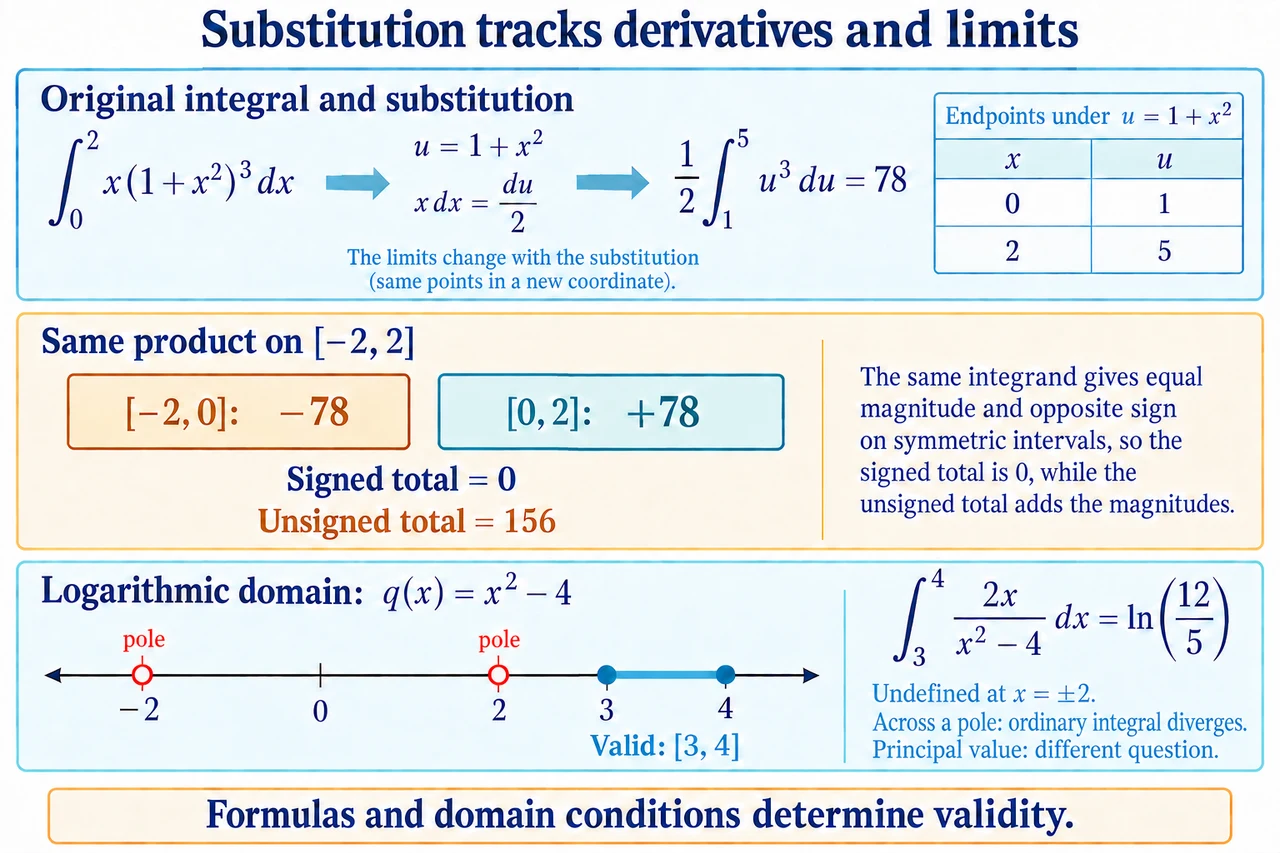
Image: illustration, not a documentary photograph. For ∫₀²x(1+x²)³dx, u=1+x² gives xdx=du/2 and transforms limits 0,2 to 1,5, producing 78. On [−2,2], the negative and positive contributions are −78 and +78; the signed total is 0 and the unsigned total is 156. The lower graphic is a domain number line, not a graph of the rate: 2x/(x²−4) is undefined at ±2, while its integral on [3,4] is ln(12/5). Ordinary improper integration across either pole does not converge; a principal-value convention is a separate excluded question. The 160-pixel preview supports recognition, not reading every formula. · Original project scientific illustration; schematic teaching aid, not a calibrated measurement or exam-board figure.
A substitution must preserve the domain and limits
Substitution begins with a derivative, not with a trick for renaming a symbol. Suppose F′(u)=f(u) and g is differentiable. The chain rule gives d[F(g(x))]/dx=f(g(x))g′(x). Consequently F(g(x)) is an antiderivative of that whole product. This explains both the power of substitution and its restriction: the inner function and its derivative must occur together, possibly with a constant factor that can be accounted for. For the ordinary definite-integral version, take g′ continuous on the interval and f continuous on the range reached by g. These conditions let the Fundamental Theorem connect the antiderivative to its endpoint values. The result is a proof-based identity rather than permission to replace every x by any convenient expression.
Delivery and source scope
A-level-only substitution and derivative-over-function logarithmic integrals. Standard logarithmic forms support the explanation, without claiming full exponential/trigonometric coverage. Full assessment and qualification remain open.
Writing u=g(x) and du=g′(x) dx abbreviates the chain-rule relationship. It is useful notation when all factors are tracked, but it does not justify cancelling unrelated quantities. If the integrand contains only half the required derivative, the integral needs a factor of one half. If it contains an additional x that has not been expressed in u, the substitution is unfinished. After finding an indefinite antiderivative, replace u by g(x), retain the constant of integration and differentiate the result. That derivative check detects a missing multiplier immediately. A candidate formula can look simpler than the original integrand while still having the wrong derivative everywhere.
Definite limits also belong to a variable. Under u=g(x), the endpoint x=a becomes u=g(a) and x=b becomes u=g(b). Thus the integral of f(g(x))g′(x) from a to b equals the integral of f(u) from g(a) to g(b), with the ordinary oriented bounds. Alternatively, find F(g(x)) and use the original x-limits after returning to x. Both routes give F(g(b))−F(g(a)). Using an antiderivative in u with the old x-endpoints mixes two coordinate descriptions and generally gives a false answer. Decreasing substitutions can reverse the transformed bounds; that reversal is part of the identity, not an error to be silently removed. If the integrand becomes singular inside the original interval, valid-looking endpoint values cannot repair the broken continuity condition.
For ∫₀²x(1+x²)³ dx, choose u=1+x². Its derivative is 2x, so x dx=du/2. The transformed endpoints are 1 and 5, giving (1/2)∫₁⁵u³ du=[u⁴/8]₁⁵=(625−1)/8=78. Returning to x gives the antiderivative (1+x²)⁴/8, whose derivative is exactly the original integrand. Expanding the original product produces x+3x³+3x⁵+x⁷; integrating those powers gives the same 78 independently. The substitution avoids a longer expansion but does not change what is being accumulated. The factor one half and transformed endpoints are both essential parts of the calculation.
A matched-derivative substitution can be valid even when g is not one-to-one on the original interval. Use the same integrand from x=−2 to x=2. Both transformed endpoints are 5, so the signed integral is zero. This is correct because x(1+x²)³ is odd: the negative contribution on [−2,0] cancels the positive contribution on [0,2]. Their unsigned total is 156. The identity follows from the antiderivative F(g(x)), not from pretending that x has a single-valued inverse throughout the interval. This does not authorize arbitrary inverse changes of variable without branch analysis. It also does not turn equal transformed endpoints into proof that a geometric area or distance is zero.
Logarithms provide another precise reverse-chain-rule pattern. Where q(x) is differentiable and nonzero, d[ln|q(x)|]/dx=q′(x)/q(x). For q>0 this is the derivative of ln q. For q<0 write ln|q|=ln(−q); the two minus signs in its chain-rule derivative cancel. The formula is valid on each connected interval avoiding zeros of q. An integration constant can differ between separate intervals, and an initial condition on one interval does not determine another branch. The absolute value belongs around the logarithm's argument; ln|q| is not |ln q|, which may not even be defined when q is negative. Stating the domain is part of the antiderivative, not an optional finishing note.
Consider q(x)=x²−3x+5=(x−3/2)²+11/4. It is positive for every real x, and q′=2x−3, exactly the numerator of (2x−3)/(x²−3x+5). Therefore ln q is an antiderivative on the whole real line. Between 0 and 2 the integral is ln q(2)−ln q(0)=ln 3−ln 5=ln(3/5), which is negative. Positive q does not imply positive q′/q: q decreases until x=3/2 and then increases, finishing below its starting value. The logarithmic integral records that net change. This example connects the algebraic matched-derivative test, a no-zero domain proof and an endpoint sign check instead of treating the logarithm rule as a pattern with no conditions.
A changed denominator makes the boundary visible. For q=x²−4, the zeros ±2 split the real line into three intervals. On x>2, q is positive and an initial condition can determine one particular antiderivative. A proposed integral from 1 to 3, however, crosses x=2 where the rate is undefined. Endpoint logarithms cannot justify an ordinary finite answer there. The one-sided logarithmic divergences also mean that its ordinary improper integral does not converge; a separately specified principal value would be a different question. Sources and open scope: Pearson Edexcel 9MA0 Issue 4, February 2020, Pure 8.5, PDF page 29/printed page 25, with logarithmic context in Pure 8.2, PDF page 28/printed page 24; OpenStax Calculus Volume 1 5.5, theorems 5.7 and 5.8, and 5.6, checked 6 October 2026. All numerical problems and explanations here are original. This is A-level-only material, not full AS content. Integration by parts, general partial fractions, full standard-function coverage, improper-integral techniques and independent qualification assessment remain open. No publisher diagram or exam question is reused. The selected original illustration and its 1280-, 640- and 160-pixel variants have been visually checked; formulas and the full caption state its schematic and preview limits.
Image: illustration, not a documentary photograph. For ∫₀²x(1+x²)³dx, u=1+x² gives xdx=du/2 and transforms limits 0,2 to 1,5, producing 78. On [−2,2], the negative and positive contributions are −78 and +78; the signed total is 0 and the unsigned total is 156. The lower graphic is a domain number line, not a graph of the rate: 2x/(x²−4) is undefined at ±2, while its integral on [3,4] is ln(12/5). Ordinary improper integration across either pole does not converge; a principal-value convention is a separate excluded question. The 160-pixel preview supports recognition, not reading every formula.
Worked example: Evaluate ∫₀²x(1+x²)³ dx by one substitution and verify it independently. Then evaluate the same signed integrand on [−2,2] and explain its unsigned total. Finally evaluate ∫₀²(2x−3)/(x²−3x+5) dx, proving that the logarithmic antiderivative is valid on the whole interval.
Set u=1+x² and verify du/dx=2x. The integrand contains x dx rather than 2x dx, so x dx=du/2. At x=0, u=1; at x=2, u=5. The integral becomes (1/2)∫₁⁵u³ du. Neither the factor one half nor the transformed endpoint values may be discarded.
Integrate u³ to u⁴/4 and retain the outside factor: [u⁴/8]₁⁵=(5⁴−1⁴)/8=78. The x-antiderivative is (1+x²)⁴/8. Its derivative is (4/8)(1+x²)³(2x)=x(1+x²)³, checking the coefficient and inner derivative together.
Expand x(1+x²)³=x+3x³+3x⁵+x⁷. An antiderivative is x²/2+3x⁴/4+x⁶/2+x⁸/8, whose difference from the substituted antiderivative is only a constant. At 2 it gives 2+12+32+32=78; at 0 it is zero. This independent route confirms the transformed-limit result.
On [−2,2], u takes the same value 5 at both endpoints, so the matched-derivative definite identity gives zero. Independently, the integrand is odd and continuous on a symmetric interval. The positive half contributes 78 and the negative half −78. Integrating its absolute value instead gives 78+78=156. Equal transformed endpoints describe net cancellation in this matched product, not zero geometric area.
For q=x²−3x+5, complete the square: q=(x−3/2)²+11/4>0 everywhere. Its derivative is 2x−3, so the entire rational integrand is q′/q and ln q is a valid antiderivative throughout [0,2]. There is no zero or hidden singularity to split the interval. Differentiation recovers both numerator and denominator exactly.
Evaluate q(0)=5 and q(2)=3, so ∫₀²q′/q dx=ln 3−ln 5=ln(3/5)<0. The rate changes sign at 3/2, but the theorem tracks its net logarithmic change; q ends below its starting value. For contrast, q=x²−4 has poles at ±2 and ln|q| works only on each separated interval. A finite endpoint expression across one of those poles is not an ordinary definite-integral answer.
Answer: The substituted integral on[0,2] is78. On[−2,2] its signed integral is0 but its unsigned integral is156. The logarithmic integral isln(3/5)<0, with its denominator positive on the whole interval. Derivative checks, transformed bounds and domain proofs justify each result.
Check your understanding: On x>2, H′(x)=2x/(x²−4) and H(3)=7. Recover H, verify the rate and initial value, evaluate ∫₃⁴H′(x) dx, then explain why this method does not evaluate an ordinary integral from 1 to 3.
Answer: On x>2, q=x²−4>0 and q′=2x, so H(x)=ln(x²−4)+C. At x=3 the condition gives ln 5+C=7, hence H(x)=7+ln((x²−4)/5), x>2. Differentiating gives 2x/(x²−4), and substituting x=3 gives 7. Between 3 and 4 the denominator expression changes from 5 to 12, producing ∫₃⁴H′ dx=H(4)−H(3)=ln(12/5)>0. The integration constant cancels. The proposed interval from 1 to 3 crosses x=2, where the rate is undefined, so the ordinary continuous-interval theorem does not apply. In fact 2x/(x²−4)=1/(x−2)+1/(x+2); the first term has divergent one-sided logarithmic integrals at 2. The ordinary improper integral across that pole does not converge. A principal-value convention would be a different excluded problem, not permission to cancel infinities. The initial condition determines only the connected x>2 branch, not constants on the other intervals.
Why: The changed task tests three independent decisions: matching the numerator with the denominator's derivative, keeping the logarithm on its valid connected domain, and distinguishing a valid finite interval from a path through a pole. Differentiation and the initial-value check verify the recovered function separately. The complete pole explanation prevents a formally correct endpoint subtraction from concealing an invalid theorem application.